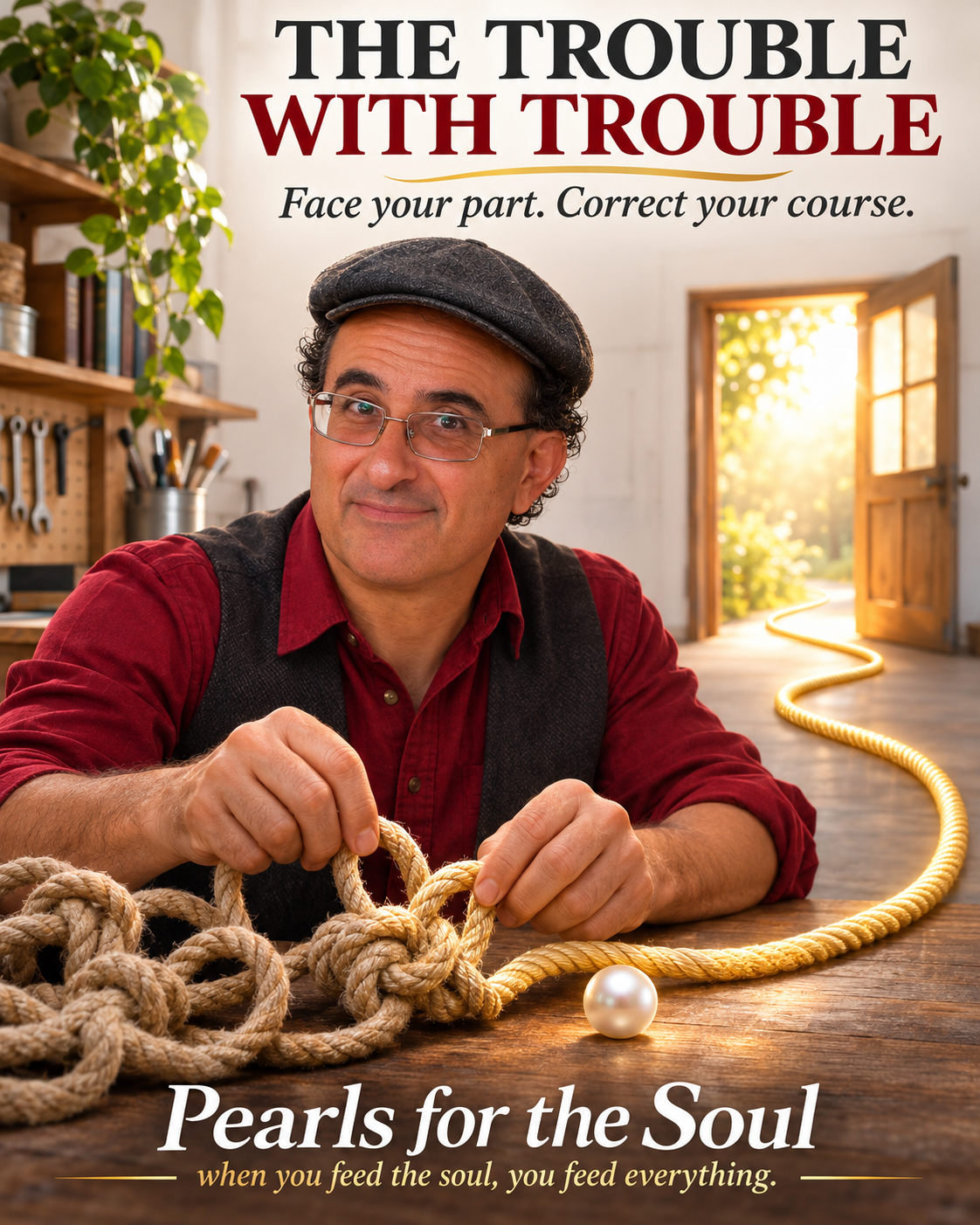
Trouble enters everyone’s life.
The trouble with trouble is that blame, denial, excuses, and repeated mistakes can give it a permanent place to live.
THE TROUBLE WITH TROUBLE—FACE YOUR PART AND CORRECT YOUR COURSE
Trouble plagues humanity.
It intrudes.
It interrupts.
It challenges what we believed was stable.
How much life we give trouble may depend partly upon the way we handle it.
Some trouble arrives through circumstances we did not create and could not reasonably prevent. Other trouble grows because we blame, deny, excuse, or refuse to account for the part we played—or failed to play.
When our decisions helped create the difficulty, we must examine them.
There is inner work to be done.
Disagree?
Trouble is delighted when we refuse to look.

WHAT ARE WE DOING WRONG?
“Wrong” can sometimes appear subjective.
What one person considers acceptable, another may consider harmful. That does not mean every action is equally good or that consequences disappear because the person responsible disagrees.
Begin with an honest personal assessment.
What did I do?
What did I fail to do?
What effect did it have?
What other people or circumstances contributed?
Was my intention good but my method poor?
Could I have responded differently?
Discovering that we are not operating at our best makes course correction possible.
Treat it simply:
Notice.
Admit.
Correct.
Proceed.
WHAT CAN WE DO ABOUT IT?
When we discover an error, we can begin correcting it.
We may not be able to erase every consequence immediately. Some damage requires time, repair, restitution, forgiveness, treatment, or assistance.
The original action cannot always be undone.
The behavior producing it can be stopped.
How empowering is that?
Recognizing and correcting an error invests in our personal stock. Continue making honest corrections and change becomes possible.
Growth is a natural part of being alive—but it still requires our participation.
CHARACTER
You cannot eat or drink something that produces instant character.
Character cannot be purchased, borrowed for an afternoon, or worn like a costume.
It develops through choices.
It is strengthened through honest living, accountability, courage, patience, kindness, reliability, and correction.
When character holds, other qualities join it.
Self-respect grows.
Confidence develops from within.
A person becomes more certain—not because they never make mistakes, but because they know they are willing to face and correct them.
ARE THEY THE PROBLEM?
Outside forces can absolutely contribute to our troubles.
People may mistreat, deceive, manipulate, neglect, or harm us.
Systems can be unfair.
Circumstances can work against us.
To use that truth properly, however, we must still determine whether we played any part.
This is not about blaming ourselves for what another person did.
It is about refusing to surrender the portion of power that remains ours.
What can I control now?
What boundary can I establish?
What help can I seek?
What choice remains available?
Blaming, accusing, explaining, and rehearsing the story endlessly can consume time without producing movement.
Account for their part.
Account for your part.
Then determine what can be done next.
BAD INFLUENCES
Bad influences are no myth.
At first glance, a harmful influence may appear entertaining, exciting, daring, profitable, or harmless.
That attraction is how it begins acquiring power.
The person being drawn in often believes:
“I am above this.”
“I can handle it.”
“It will not affect me.”
“I can stop whenever I want.”
Be careful.
Whatever you get into can get into you.
Repeated exposure shapes thoughts, habits, expectations, and behavior.
This is not magic or destiny. It is influence reinforced through participation.
Do not continually invite something into your life and then act surprised when it begins rearranging the furniture.
THE SHORTCUTS
Lying, cheating, and stealing can appear to work.
Come to terms with this.
If dishonest shortcuts never produced an immediate advantage, fewer people would attempt them.
A lie may avoid a confrontation.
Cheating may produce a temporary gain.
Stealing may place something in a person’s hands.
But the apparent success comes with consequences.
Until discovery, fear, suspicion, doubt, and the possibility of a “gotcha” moment remain nearby.
Discovery may come from another person, evidence, circumstances, or the individual’s own conscience.
Even when someone escapes public exposure, dishonesty can still alter character and relationships.
The shortcut reaches a destination while damaging the traveler.
REPEATING WHAT DOES NOT WORK
The form of “insanity” I am referencing is repeatedly doing something questionable or ineffective while expecting a better outcome without making any meaningful change.
Something does not work.
We repeat it.
The same result appears.
We become angry at the result while protecting the behavior producing it.
The conscience may speak up to help us.
Do not resist the correction.
If you fight to keep a destructive pattern, you may eventually get exactly what you fought for.
DISEASE AND EXCESS
Disease means dis-ease—a disruption of well-being.
It does not respect status, wealth, strength, goodness, or personal importance.
Disease can arise through genetics, infection, environment, aging, injury, circumstance, behavior, or combinations we may never fully understand.
It is neither accurate nor fair to treat every illness as someone’s personal failure.
At the same time, some behaviors are known to increase risk.
Smoking, excessive drinking, chronic overeating, drug misuse, and other forms of excess can require a price.
Group thinking may whisper:
“Everyone is doing it, so it must be all right.”
Really?
Popularity does not transform a harmful behavior into a healthy one.
Use reliable information, common sense, medical guidance, and honest self-observation.
IGNORANCE
There is no shame in not knowing something.
No one knows everything.
The problem begins when opportunities to learn are continually rejected.
It is one thing not to know and then investigate.
It is another to refuse knowledge because learning might require a change.
Willful ignorance gives confusion permission to remain.
Ask.
Read.
Listen.
Verify.
Learn from trustworthy sources.
Knowledge does not guarantee perfect decisions, but refusing knowledge makes sound decisions much more difficult.
DOUBTING WHAT IS RIGHT IN OUR HEARTS
One source of trouble is continually doubting what we already recognize as right.
Common sense speaks.
Conscience speaks.
Experience speaks.
Evidence appears.
Then an outside influence introduces manipulation, hesitation, and confusion.
We begin thinking in circles.
Analysis paralysis sets in.
I call it sinking in your thinking.
Careful thought is valuable.
Endless thought that prevents every responsible action becomes another hiding place.
There comes a time to decide.
WE ARE NEVER ALONE
My faith tells me that creation points toward a Creator.
Others may interpret existence differently, but I choose Creator.
The microcosm and macrocosm—the smallest systems and the largest—fill me with wonder.
I do not believe that our lives are meaningless accidents.
For me, this means that inner work is not performed in complete isolation. Prayer, faith, conscience, wisdom, and the help of others can accompany us.
Being responsible does not mean refusing support.
Sometimes responsibility means admitting that we need it.
ADMIT IT
Once we discover something that is not working—or appears questionable—we should bring it forward for investigation, exposure, and testing.
Name it.
“I did that.”
“I keep repeating this.”
“I have been dishonest.”
“I am avoiding responsibility.”
“I need help.”
“I am that person.”
A simple admission can become a door.
The admission does not mean we must remain that person forever.
It means we have stopped hiding from the person we have been.
Recognition allows correction.
Correction creates a different course.
Choose that freedom.
TROUBLE AS A TEACHER
Trouble is not automatically good.
It can hurt, frighten, interrupt, exhaust, and damage.
We do not need to glorify suffering in order to learn from it.
Once trouble has arrived, however, we can examine what it reveals.
Did it expose a weak boundary?
A destructive habit?
A dishonest relationship?
A need for help?
An unrealistic expectation?
A medical problem?
A financial mistake?
A part of life beyond anyone’s control?
The lesson depends upon the trouble.
Our responsibility is to discover what is true and respond accordingly.
FINAL THOUGHT
Not every trouble is your fault.
Your response, however, becomes part of what happens next.
Face what belongs to you.
Refuse what does not.
Correct what you can.
Seek help where needed.
Then stop feeding trouble with the very behaviors that allow it to remain.
PEARLS INSIGHT (SEO)
Trouble becomes harder to resolve when blame, denial, excuses, harmful influences, dishonest shortcuts, and repeated mistakes replace personal accountability. Effective course correction begins by separating what is within our control from what is not, admitting our actual part, seeking reliable help, and changing the behavior that continues producing unwanted results.
PEARLS FROM THE BOOKS
A pearl develops because an irritation is met with a continuing response.
The irritation does not instantly disappear, but something valuable begins forming around it.
Trouble can offer a similar opportunity. We may not have chosen the difficulty, but patience, truth, character, and correction can influence what develops around it.
PEARLS CONNECTION
Choose one trouble presently occupying your attention.
Divide a page into two sections:
WHAT BELONGS TO ME
WHAT DOES NOT BELONG TO ME
Place each fact where it honestly belongs.
Then choose one corrective action from the first section.
That is where your available power begins.
RICHIE SPEAKS
Blame everyone else and you may hand them the keys to your future.
Blame yourself for everything and you assume power you never possessed.
Account for your actual part.
Admit what is true.
Make the correction.
Trouble hates losing free room and board.
FINAL SAY
Face your part.
Correct your course.
Evict the trouble you no longer need to house.
— Richie
Pearls for the Soul
when you feed the soul, you feed everything.
https://pearlsforthesoul.com

Been expecting you