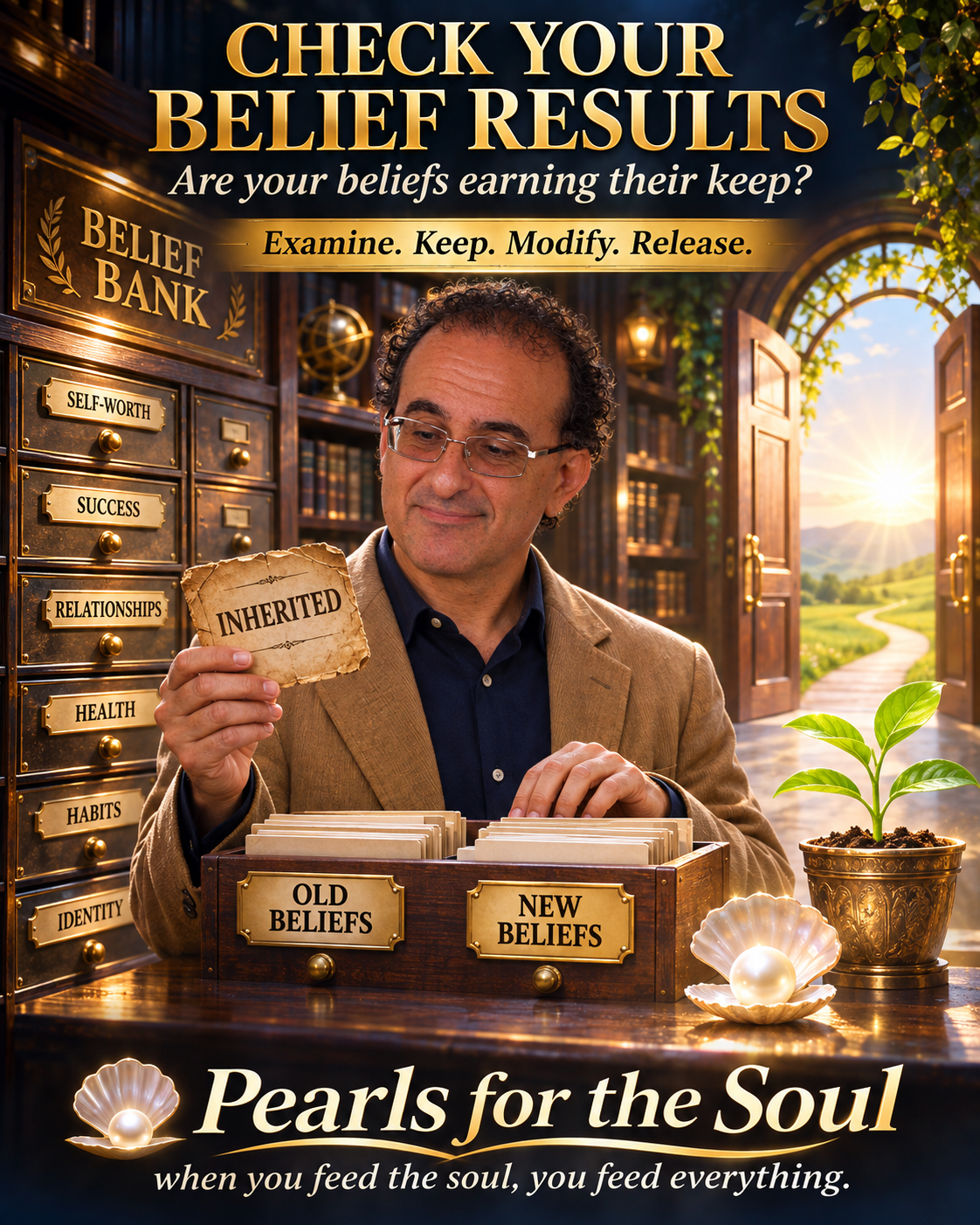
Some beliefs guide us. Some confine us. Some were placed inside us before we were old enough to choose.
This remains one of the most important things to understand during a person’s journey:
Beliefs matter.
Things do not always happen because of our beliefs. Life includes other people’s choices, unexpected events, natural circumstances, injustice, opportunity, timing, and mystery.
Still, long before many results appear on our radar screens, our beliefs are influencing what we notice, expect, attempt, avoid, accept, and repeat.
A person’s stance in life is formed, in part, by what that person believes.
Spend some time examining yours.
BELIEVE THIS
Thoughts come and go throughout the day.
Where they all come from is a fascinating subject for another post.
A passing thought is not automatically a belief.
But when a thought enters your mind, is accepted, repeatedly entertained, and given a home, it can become part of the belief system you call upon while navigating life.
That is one reason advertising can be powerful.
It sends a clear, repeated message hoping to find a home within you.
Once accepted, the message may begin influencing your choices without asking permission again.
LOOK OVER YOUR BELIEF BANK
Imagine that you possess a belief bank.
Inside are deposits made by parents, teachers, friends, religion, culture, advertising, successes, failures, painful experiences, and personal discoveries.
Some beliefs have earned interest.
Others have charged fees.
A few may be occupying valuable space while producing nothing useful.
If you find yourself arguing more than necessary, ask what belief you are protecting.
Many of us do not test our beliefs. For one reason or another, we defend them blindly because changing them feels like changing ourselves.
The question becomes:
Are they earning their keep?

BELIEFS PRODUCE BEHAVIOR
A belief becomes visible through its results.
If you believe no one can be trusted, you may approach every relationship guarded and suspicious.
If you believe you cannot learn, you may avoid the very experiences that could teach you.
If you believe mistakes make you worthless, you may hide them instead of repairing them.
If you believe growth remains possible, you are more likely to explore, practice, adjust, and try again.
The belief does not control every outside event.
It influences how you enter, interpret, and respond to it.
OBJECTIVITY IS PRICELESS
Many people say they want to change.
Change begins with examining oneself.
The willingness to explore is already a positive belief.
From there, thoughts, memories, emotions, people, books, experiences, and opportunities may arrive for review.
Objectivity helps.
Closed-mindedness can lock us inside a cell of our own making.
Life does not always impose a new understanding upon us. Sometimes it waits to be invited.
Open the door—but use discernment concerning what you allow inside.
CHILDHOOD BELIEFS
Releasing a belief can be frightening, especially when it was accepted during childhood and never thoroughly explored.
Children receive beliefs before possessing the experience needed to evaluate them.
Some beliefs are loving and useful.
Others arise from fear, criticism, prejudice, family pain, or someone else’s limitations.
When an old childhood belief is challenged, strong emotions may surface with it. That can make the belief more difficult to examine—but not impossible.
Emotion does not automatically prove that a belief is true.
It may prove that the belief has deep roots.
Calmness helps bring clarity.
WHO PLANTED THIS?
Ask yourself:
Where did this belief originate?
Did I choose it—or inherit it?
Was it based on one experience or repeated evidence?
Did it belong to my parents, community, or former circumstances?
Does it remain true now?
What happens when I act from it?
What might become possible if it were modified?
We do not dishonor the past by examining what it gave us.
We honor our present responsibility.
COME HITHER, OH MY BELOVED BELIEF
The beliefs we personally seek, test, and welcome often feel precious because we participated in their formation.
We examined them.
We experienced them.
We saw what they produced.
Consequently, modifying or losing a cherished belief can be painful. The mental, emotional, and psychological root may extend deeply within us.
Cutting or transplanting that root requires patience.
But once the process is complete, more fertile belief ground becomes available.
KEEP, MODIFY, OR RELEASE
Not every old belief should be discarded.
Some have protected, guided, encouraged, and sustained us.
The purpose of examination is not destruction.
It is stewardship.
Keep what remains true and fruitful.
Modify what contains some truth but needs maturity.
Release what repeatedly produces harm, confusion, limitation, or falsehood.
Plant something better in the available ground.
CHECK THE RESULTS
Results do not answer every philosophical question, but they provide useful evidence.
Does the belief produce honesty or deception?
Courage or needless fear?
Responsibility or blame?
Growth or stagnation?
Compassion or contempt?
Peace or constant internal conflict?
Healthy boundaries or isolation?
Look at the pattern—not merely one difficult day.
A worthwhile belief should be able to face examination.
A FASCINATING SPIRITUAL EXAMPLE
I remember reading scriptural accounts in which Jesus asked whether people believed He could help them.
Their belief mattered because it opened them to trust, participation, and receiving.
In another account, a man honestly responded:
“Lord, I believe; help thou mine unbelief.”
That is one of the most human statements imaginable.
He did not pretend to possess perfect faith. He brought both his belief and his struggle.
Help came through honest asking.
FAITH IS NOT BLAME
Belief and faith should never become weapons used to blame people for illness, loss, hardship, injustice, or circumstances beyond their control.
A person can believe deeply and still experience pain.
Faith does not promise a life without storms.
It provides a way to stand, seek meaning, continue, and ask for help while the storm is present.
CHECK YOURS
Beliefs are invisible—but powerful.
They influence the direction of our attention, choices, habits, relationships, and efforts.
Do not be afraid to inspect them.
Open your belief bank.
Examine each account.
Keep what is earning its place.
Modify what can serve better.
Release what no longer belongs.
FINAL THOUGHT
You are not required to remain imprisoned by every belief you inherited or formed during a painful season. Beliefs can be examined, refined, strengthened, and changed. The results will help reveal what deserves to remain.
PEARLS INSIGHT (SEO)
Core beliefs influence thoughts, emotions, habits, relationships, confidence, and decision-making. Identifying where a belief originated, examining the evidence supporting it, and evaluating its repeated results can help replace limiting beliefs with healthier and more accurate ones.
PEARLS FROM THE BOOKS
“Lord, I believe; help thou mine unbelief.” — Mark 9:24
Honest uncertainty can be a better beginning than borrowed certainty.
PEARLS CONNECTION
An oyster does not keep every grain exactly as it arrived. Through a process, irritation is covered and transformed. We can also examine what entered us and participate in its transformation.
RICHIE SPEAKS
Do not merely ask what you believe. Ask what happens to your life when that belief goes to work.
FINAL SAY
Examine it. Keep it. Modify it. Release it—but know why.
— Richie
Pearls for the Soul
when you feed the soul, you feed everything.
https://pearlsforthesoul.com

Been expecting you