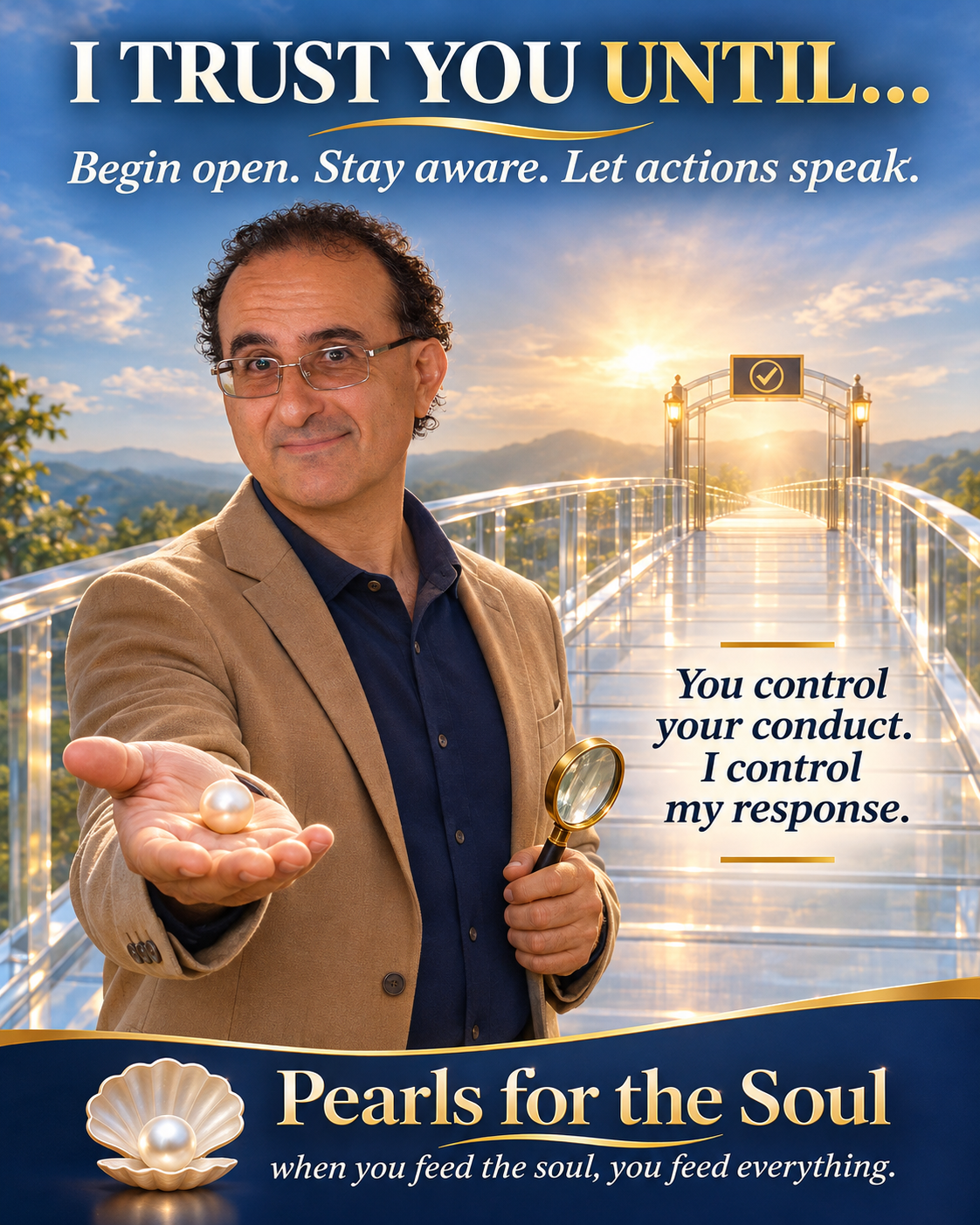
I will begin by trusting you. What happens to that trust will depend upon what you consistently do.
I have experimented with this subject over the decades and found an approach that consistently works in everyone’s favor.
It is simply this:
I trust you—whoever you are—and I believe what you tell me until I have a reason not to.
You control your conduct.
I observe what you do.
When words and actions no longer agree, I do not have to doubt what is plainly being demonstrated.
That is why it works.
CARE-FREE
Being able to enter a situation, event, relationship, or new experience without unnecessary bias or prejudice is one of the purest ways to experience life.
It allows us to meet the moment instead of forcing yesterday’s disappointments upon today’s people.
That can make us lighthearted and carefree, freeing energy for better purposes.
Of course, some people view openness as an opportunity to take advantage.
Trust does not require blindness.
It requires awareness.
TRUST IS A BEGINNING
Trust should not always be treated as a reward another person must earn before receiving basic human respect.
We trust strangers in small ways every day.
We trust that drivers will remain on their side of the road.
We trust that a cashier will return the correct change.
We trust that ordinary conversations are not secret traps.
Without some starting level of trust, society could hardly function.
Deeper trust, however, grows through consistency.

Q&A
If something presents itself that is unclear or borderline, I consider it an invitation to explore further.
I ask questions.
If we are dealing with newness, innocence, or a simple misunderstanding, reasonable questions may clear up the matter quickly.
What happened?
What did you mean?
Why did the circumstances change?
Can this be verified?
A truthful explanation usually becomes clearer as the conversation continues.
Questions do not automatically indicate distrust.
They protect understanding.
COME OUT?
If shenanigans are afoot—if a hidden agenda, manipulation, or dishonesty is being presented—the follow-up often reveals the song and dance.
What exists beyond the first impression begins coming into view.
The person driving the deception may expose it through contradictions, pressure, changing explanations, missing details, or anger at reasonable questions.
They begin producing their own outcome.
Game over.
CONFIDENCE
Trust and belief are dynamics we humans use more often than we realize.
They are working as we move from person to person and place to place without knowing exactly what to expect until we arrive.
If we keep our eyes open and permit awareness to participate, we are better equipped to continue confidently.
Confidence in yourself matters.
Without it, another person may try to redefine what you clearly experienced.
CHOOSE AND HOLD
Do not casually dismiss what you repeatedly see and hear.
At the same time, make room for context, honest mistakes, incomplete information, and misunderstanding.
One unusual incident may deserve a question.
A continuing pattern deserves attention.
Learn to listen to the small, gentle, still voice within—but do not confuse it with fear, prejudice, old wounds, or impulse.
Test the feeling.
Ask questions.
Observe the pattern.
Then choose your position and hold it unless reliable new information provides a reason to reconsider.
Practice refines this.
SECOND THOUGHT?
Watch regret and self-doubt.
When someone is needy, guilty, frightened, or carrying an unaddressed vulnerability, a manipulative person may use that weakness for personal gain.
Hesitation can become the opening for another sales pitch:
“You misunderstood.”
“You are overreacting.”
“You will regret saying no.”
“No one else will help you.”
Be selective about whom you open yourself to.
Not everyone has earned access to your deepest vulnerabilities.
INTUITION WORKS
Many women describe a strong intuitive sense—knowing something before being able to explain exactly how they know it.
Men experience intuition too.
Sometimes intuition reflects rapid pattern recognition: tone, timing, facial expression, inconsistency, past experience, or a detail the conscious mind has not yet named.
Many people can remember saying afterward:
“I knew—but I did not follow what I knew.”
Intuition deserves attention.
It should not become the sole basis for accusing another person, but it can tell us when to slow down, ask questions, verify information, or step away.
QUICK AND IN A HURRY?
Doing something in a hurry creates another dynamic.
Why?
What is so pressing that it should drive you away from your own common sense?
I listen and observe what is presented without believing that I must immediately do anything.
Then, when ready, I respond—if I choose to.
Someone else’s urgency does not automatically become my emergency.
REACTIONS
Avoid reacting immediately when pressure is being used against you.
A pressured reaction means the situation has gotten one foot through the door and is attempting to bring the entire body inside.
Relax.
Become calm.
Respond with a firm yes, a firm no, a request for time, or silence.
Silence can work wonders when dealing with hucksters, manipulators, and people who refuse to respect boundaries.
This ability develops through practice.
TALK IS CHEAP
Trust cannot be maintained by talk alone.
Persuasion and attempts to dominate should not receive the respect they demand merely because they are loud, emotional, polished, or repeated.
Promises matter.
Actions reveal whether those promises were meant.
People sometimes throw away their own trustworthiness through dishonesty and then believe a few persuasive words should instantly restore it.
No way.
Words may begin an apology.
Changed conduct completes it.
WHEN TRUST IS BROKEN
Broken trust does not always require the immediate end of a relationship.
The seriousness, frequency, circumstances, responsibility taken, and willingness to repair all matter.
Was it a mistake or a pattern?
Was the truth offered or discovered?
Did the person take responsibility or redirect blame?
Were amends attempted?
Has conduct genuinely changed?
Forgiveness and restored access are not always the same thing.
You may forgive someone without returning the relationship to its former level of trust.
TRUST YOURSELF TOO
Part of trusting others is trusting yourself to respond if something changes.
You do not have to identify every possible danger in advance.
You can begin openly while remembering that you retain the power to ask, pause, decline, leave, verify, or change your decision.
That understanding allows trust without helplessness.
I TRUST YOU UNTIL…
I trust you and believe you until I have a reason not to.
You control your conduct.
I control my response.
Your actions determine what you show me.
My awareness determines what I do with what I have been shown.
FINAL THOUGHT
Trust does not require choosing between innocence and wisdom. Begin open, remain aware, ask when something is unclear, and allow repeated actions—not persuasive words—to reveal character.
PEARLS INSIGHT (SEO)
Healthy trust combines openness with boundaries, communication, observation, and consistency. When words and actions conflict, ask questions, slow the decision, verify important information, and evaluate repeated behavior before granting deeper access.
PEARLS FROM THE BOOKS
“Wherefore by their fruits ye shall know them.” — Matthew 7:20
Words introduce people. Their repeated fruits reveal them.
PEARLS CONNECTION
A pearl forms behind a protective shell. Openness and protection can coexist. The heart may remain generous while wisdom determines who receives deeper access.
RICHIE SPEAKS
I do not begin by making you prove you are trustworthy. I begin by trusting—and allow your conduct to tell me whether to continue.
FINAL SAY
Begin open. Stay aware. Let actions speak.
— Richie
Pearls for the Soul
when you feed the soul, you feed everything.
https://pearlsforthesoul.com

Been expecting you