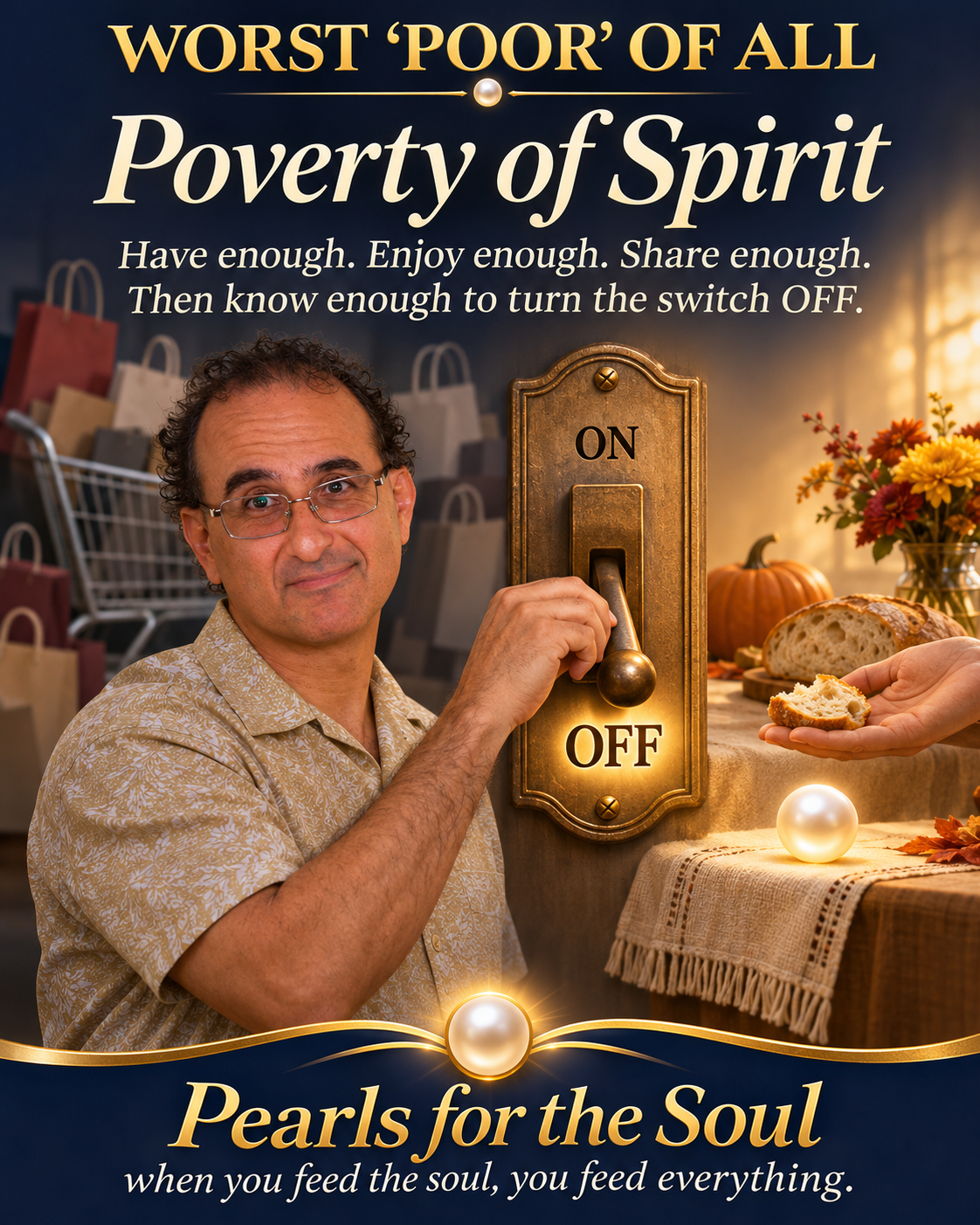
Have enough. Enjoy enough. Share enough. Then know enough to turn the switch OFF.
Have enough. Enjoy enough. Share enough. Then know enough to turn the switch OFF.
WE START WITH NOTHING
We come into this world with nothing but bare skin, relying upon others for everything.
Years pass, and then we are introduced to wanting, having, needing, and the go-getting of things wanted, needed, and more.
As we acquire, a subtle dynamic can implant itself within us. The gathering continues, sometimes with very little conscious effort on our part.
What we may eventually discover—and should pay attention to—is that there may be no automatic OFF switch.
WHY TURN IT OFF?
Drive, ambition, getting ahead, living comfortably, and enjoying the pleasures of life all support the ON switch—and they should.
There is nothing automatically wrong with succeeding, acquiring, building, or enjoying what you have earned.
However, how you go about it, what it means to you, and the often-ignored question of “When is enough, ENOUGH?” deserve a closer look.
WORTHY NOTE
It is not merely what a person has.
It is how that person came to have it—and why.
YOU GAINED EVERYTHING?
Food, shelter, clothing, and the necessities of life—we understand those.
Luxuries can also be welcomed and enjoyed.
But what about indulgence, waste, gluttony, excess, and runaway whims?
This is where, often unknown to the gatherer, what we possess begins possessing us.
Whatever we continually get into eventually gets into us.
That is one of life’s non-negotiable exchanges.
WHAT COMES NEXT?
Repeating it all.
But why?
Simply put, the desire for more can become like an addiction. It wants and wants without providing a good reason. It compels us as it feeds upon our attention.
There is an outer you and an inner you.
If the outer person obsesses over more and more while the inner person receives no care, use, or nourishment, the inside begins going dormant.
Whichever part you feed grows stronger.
THE INNER POVERTY
Unrest, guilt, conflict, and compulsion can creep in.
We keep doing what does not work while believing the next purchase, possession, achievement, or indulgence will finally change everything.
Others may see the pattern before we do.
A person can become a prisoner inside a life filled with possessions.
The true identity becomes buried while a manufactured identity—constructed from things, appearances, and appetites—takes over.
“IT WON’T HAPPEN TO ME”
Famous last words, I say.
Society, civilization, law, and order require certain standards of conduct. We even have laws and authorities to enforce the boundaries people are expected to observe.
But external rules cannot repair a person who has become lost within.
The real work must also take place inside.

ILL-GOTTEN GAINS LEAVE A STAIN
If you had to lie, cheat, steal, manipulate, or ignore what you knew was right, no explanation can transform the wrong way into the right way.
Excuses may protect the ego temporarily, but they cannot nourish the spirit.
Something acquired dishonestly may have financial value while costing far more internally.
That is a poor trade.
POVERTY OF SPIRIT
“Can’t get enough” may eventually begin driving the person.
The reasoning mind becomes compromised. Healthy boundaries disappear. A person can begin obsessing over nearly everything while losing the ability to recognize satisfaction.
Some of the symptoms may include:
- Lying, cheating, storytelling, taking what is not yours, hoarding, accusing, complaining, excessive explanations, and ignoring conviction.
- Trying to make the wrong way appear right so the behavior can continue openly and without correction.
- Satisfying every impulse without considering the effect upon other people—or upon the person you are becoming.
More does not always resolve the unrest.
Sometimes more simply increases the toxicity within.
THE TRUE POVERTY
Financial poverty and poverty of spirit are not the same thing.
A person may possess little and remain rich in honesty, compassion, dignity, generosity, faith, and character.
Another person may possess nearly everything and remain unable to experience enough.
The worst poverty is not always an empty wallet.
Sometimes it is an empty place within that no amount of acquiring can fill.
THE OFF SWITCH
The OFF switch does not mean abandoning ambition, refusing comfort, or feeling guilty for enjoying life.
It means maintaining command over your desires before your desires take command of you.
It means being able to say:
I have enough.
I enjoyed enough.
Someone else can benefit now.
I do not need to chase every appetite merely because it appeared.
Having an OFF switch is not deprivation.
It is freedom.
TRUE STORY
A tradesman who depended upon the tools of his trade came across another man’s tools that had been left behind. They worked at the same construction site.
Instead of making an effort to locate the owner, the finder kept the tools and said, “Look what I have—and for free too.”
But what was that man actually declaring?
I could not—or would not—obtain my own tools, so I kept what belonged to another person.
The tools may have enriched his collection, but the decision impoverished his character.
That is poverty of spirit.
Go get your own.
WHAT BLACK FRIDAY CAN TEACH US
A bargain is not a bargain merely because something costs less.
If you do not need it, cannot comfortably afford it, or are buying it to satisfy an appetite that never rests, the discount may still carry a high price.
Thanksgiving asks us to recognize what we already have.
Black Friday immediately invites us to seek more.
Perhaps the real test is whether gratitude survives the sale.
Can we enjoy without overindulging?
Can we purchase without becoming possessed?
Can we receive and still remember to share?
OUTER AND INNER WEALTH
Outer wealth can provide comfort, opportunity, security, and pleasure. Used wisely, it can also help other people.
Inner wealth determines what we do with everything placed in our hands.
Character asks:
Was it obtained honestly?
Was anyone harmed?
Can some of it be shared?
Do I control it, or does it control me?
Is my spirit becoming richer—or poorer?
THERE IS A SAYING
Whoever is generous to the poor and seeks what is right lends unto the Lord—and He will repay that person.
Outer poverty can often be helped with food, shelter, clothing, opportunity, and generosity.
Inner poverty requires truth.
It lives in the core of character, where virtue resides and the soul is nourished.
CONTENTMENT IS NOT FAILURE
Contentment does not mean giving up.
It means being able to appreciate where you are while deciding wisely where you are going.
You can still build, earn, improve, and accomplish.
Contentment merely prevents every success from instantly becoming insufficient.
Without contentment, every arrival becomes another departure.
Nothing is enjoyed because the next thing is already calling.
FINAL THOUGHT
Success is not measured only by how much you can turn ON.
It is also measured by whether you remain strong enough, wise enough, and free enough to turn something OFF.
Enjoy what you have earned.
Share where you can.
Protect your character.
Do not become poor inside while trying to appear rich outside.
PEARLS INSIGHT (SEO)
Poverty of spirit can develop when materialism, compulsive consumption, dishonesty, hoarding, and the constant desire for more replace contentment, integrity, generosity, and spiritual nourishment. True wealth includes the wisdom to recognize enough and the discipline to stop.
PEARLS FROM THE BOOKS
A continuing lesson throughout the Pearls writings is that the motive beneath an action eventually becomes part of the person performing it. What we repeatedly feed—gratitude or greed, integrity or excuse—grows stronger within us.
PEARLS CONNECTION
A pearl is valuable, but it does not need to own the whole ocean.
Its beauty comes from what it has become—not from how much it has collected.
We can acquire, enjoy, and succeed without surrendering the soul that makes any achievement worth having.
RICHIE SPEAKS
I am not telling you to stop enjoying life.
I am telling you to make certain that you are still the one operating the switch.
Have enough. Enjoy enough. Share enough. Then know enough to turn the switch OFF.
FINAL SAY
The poorest person may not be the one who has the least.
It may be the one who has everything—except enough.
— Richie
Pearls for the Soul
when you feed the soul, you feed everything.
https://pearlsforthesoul.com
Been expecting you