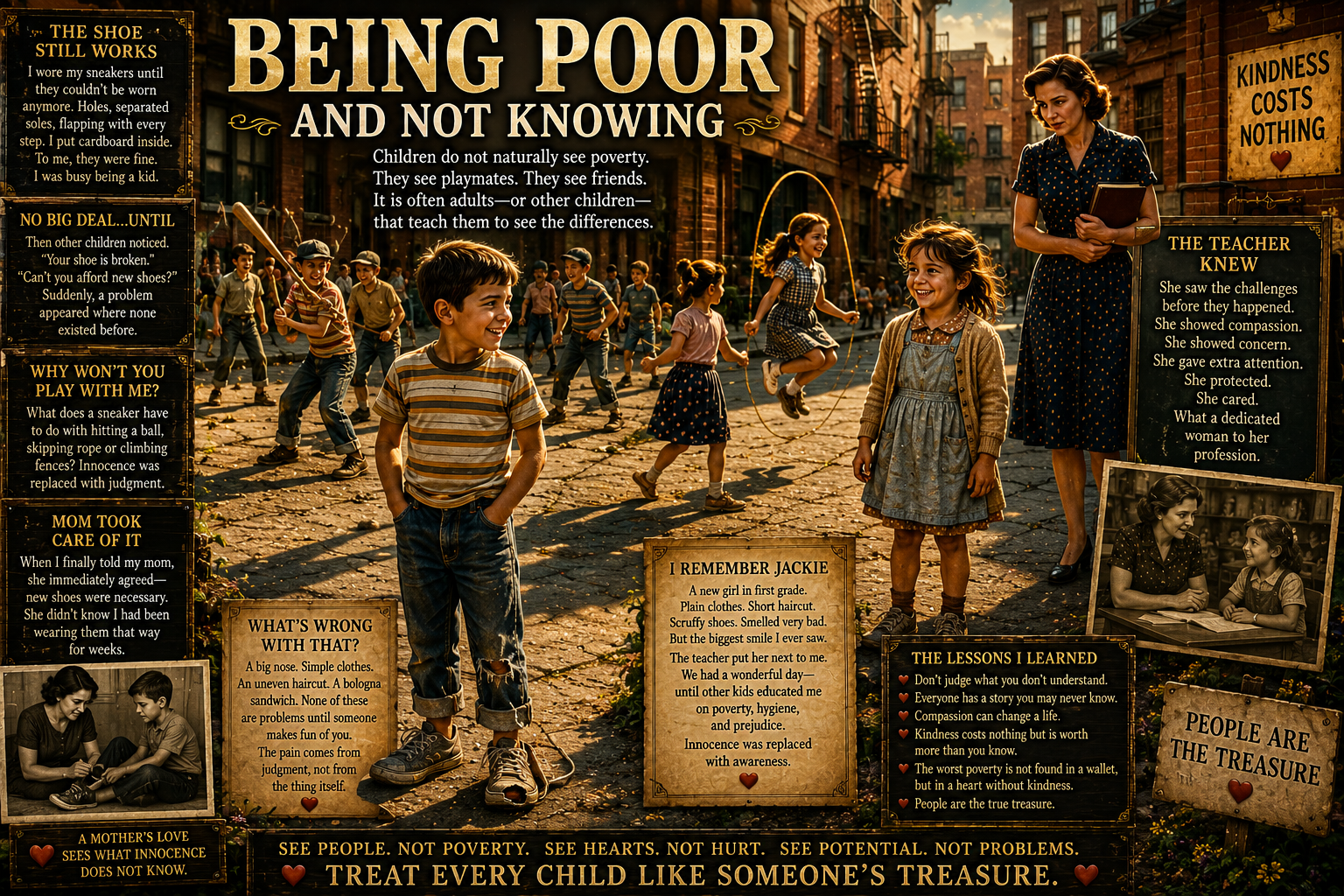
Children do not naturally see poverty.
They see playmates.
They see friends.
They see someone to laugh with.
It is often adults—or other children—that teach them to see the differences.

Here I am growing up in Brooklyn, New York.
Life was simple.
I ran.
I jumped.
I climbed.
I explored.
I did what kids do.
The problem was my sneakers.
I wore them until they couldn’t be worn anymore.
Not almost worn out.
Completely worn out.
Past the sole.
Past the inner sole.
Past the point where common sense would suggest replacement.
You could see my sock.
Then you could almost see my foot.
THE SHOE STILL WORKS.
Now before you judge me, understand something.
The shoe still worked.
At least according to me.
If there was a hole, I put cardboard inside.
Problem solved.
If the sole separated, I kept walking.
If it flapped when I moved, so what?
I was busy being a kid.
I wasn’t conducting a fashion show.
I was conducting important childhood business.
Running.
Playing.
Exploring.
Living.
NO BIG DEAL…UNTIL.
Then something happened.
Other children noticed.
One child asked:
“Your shoe is broken.”
Another asked:
“Can’t you afford new shoes?”
Another simply laughed.
Suddenly a problem appeared where none existed before.
Nothing had changed about my shoe.
Nothing had changed about me.
Only awareness had changed.
I had been introduced to comparison.
WHY WON’T YOU PLAY WITH ME?
What surprised me most was how quickly differences became barriers.
Some children stopped wanting to play.
Not because I could not run.
Not because I could not jump.
Not because I could not climb.
But because of a shoe.
Think about that.
A shoe.
What does a sneaker have to do with friendship?
Nothing.
At least not to innocence.
But children are constantly teaching each other things.
Sometimes good things.
Sometimes unfortunate things.
MOM TOOK CARE OF IT.
Eventually I mentioned the situation to my mother.
She immediately agreed.
New shoes were necessary.
What she didn’t know was that I had been wearing the old ones that way for weeks.
To me they were fine.
I wasn’t embarrassed.
I wasn’t ashamed.
I simply didn’t know any better.
WHATS WRONG WITH THAT?
Having a big nose isn’t a problem.
Until someone says it is.
Simple clothes aren’t a problem.
Until someone says they are.
An uneven haircut isn’t a problem.
Until someone points it out.
A bologna sandwich isn’t a problem.
Until someone laughs at it.
The pain does not come from the thing itself.
The pain comes from the judgment attached to it.
The moment someone tells you that you are less because of something superficial, a wound can be created.
KIDS DON’T KNOW THEY DON’T KNOW.
One of my clearest childhood memories happened in first grade.
A new girl entered our classroom.
Her name was Jackie.
She wore simple clothes.
Her shoes were worn.
Her hair looked as though it had been cut at home.
She had a smell about her that I did not understand.
None of these things registered with me.
What I noticed was her smile.
It was enormous.
One of the biggest smiles I had ever seen.
THE TEACHER KNEW.
The teacher seated Jackie next to me.
Today, looking back, I understand something I did not understand then.
The teacher was worried.
Not for herself.
For Jackie.
She knew what the other children might do.
She knew how cruel children can be without intending to be.
She knew Jackie needed an ally.
A friend.
A chance.
A little protection.
I can still remember the expression on her face.
Compassion has a look.
Concern has a look.
Love has a look.
That teacher wore all three that day.
EVERYTHING WENT WELL…UNTIL.
Jackie and I had a wonderful day.
We talked.
We laughed.
We played.
We enjoyed each other’s company.
I saw nothing wrong.
Nothing.
Then other children began making comments.
Suddenly I was introduced to concepts I didn’t know existed.
Poverty.
Hygiene.
Social status.
Prejudice.
The education had begun.
Unfortunately, it was the wrong kind.
THE POVERTY OF THE HEART.
As I grew older, I learned something.
There are many forms of poverty.
Financial poverty is one.
But there are others.
Poverty of compassion.
Poverty of understanding.
Poverty of patience.
Poverty of kindness.
Poverty of acceptance.
Those forms of poverty often cause far more damage than a worn-out pair of shoes.
THE GREAT EQUALIZER.
Years later I would meet wealthy people who were miserable.
I would meet poor people who were joyful.
I would meet educated people lacking wisdom.
And simple people overflowing with it.
Life taught me that appearances reveal very little.
The heart tells the real story.
PEOPLE ARE THE TREASURE.
One of the recurring themes throughout Pearls for the Soul is that people are the true treasure.
Not their clothes.
Not their houses.
Not their titles.
Not their bank accounts.
People.
The person sitting inside the body.
The soul behind the smile.
The heart behind the eyes.
That is what matters.
WHAT THEN?
If you see someone struggling, be kind.
If you see someone different, be curious.
If you see someone hurting, be compassionate.
And if you encounter a child wearing worn-out shoes, remember:
They may not even know they are poor.
But they will always remember how you treated them.
— Richie
Pearls for the Soul
when you feed the soul, you feed everything.
https://pearlsforthesoul.com

Been expecting you