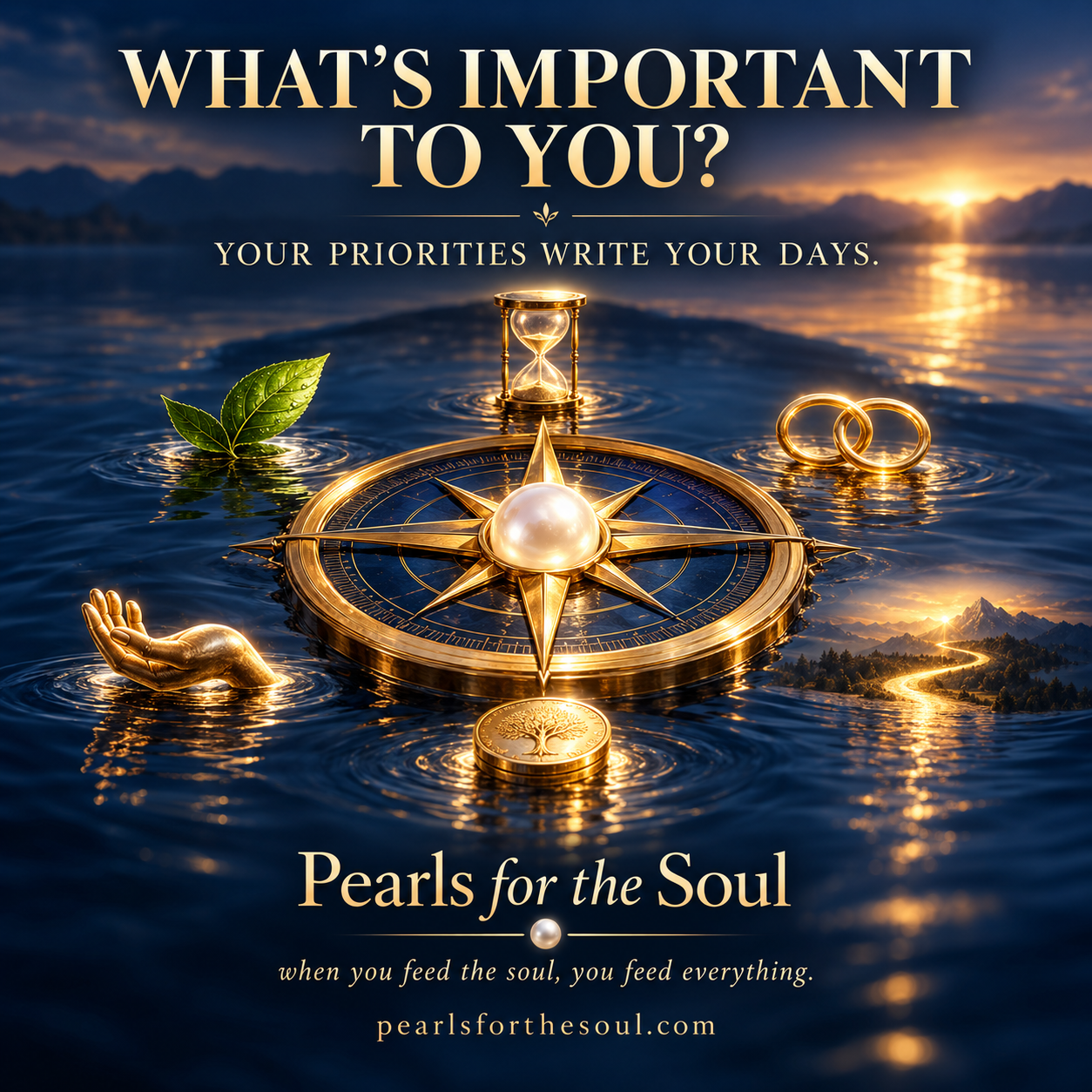
Your calendar, attention and energy quietly reveal what matters to you—even when your words say something different.
WHAT’S IMPORTANT TO YOU?
Importance is personal.
What matters greatly to one person may mean very little to another. Yet certain things become important to families, organizations and entire communities because they affect everyone involved.
Saying something is important does not automatically make it important.
Our choices usually reveal the truth.
LISTEN UP
“Listen up” is meant to get your attention.
It announces that something important may be coming. But attention cannot be demanded forever. Eventually, the message must give us a reason to keep listening.
When someone asks for your attention, listen long enough to decide:
Does this concern me?
Is it valuable?
Does it require action?

THIS CONCERNS YOU
Those words can stop us in our tracks.
Before reacting, ask whether the matter truly concerns you. If it does, give it your attention. If it does not, decide whether your involvement would help—or merely add noise.
Not everything deserves the same amount of your time.
PRIVATE IMPORTANCE
Some things are deeply important because of your experiences, memories, beliefs and personal values.
Other people may not understand their significance.
They do not have to.
Something can be important to you without becoming an obligation for everyone else.
PROFESSIONAL MATTERS
When you agree to provide a product or service, importance is no longer based only on personal preference.
Standards matter.
Conduct matters.
Promises matter.
Results matter.
Professional responsibility means recognizing that your actions affect someone beyond yourself.
LOVED ONES
Love may be difficult to measure, but its influence is unmistakable.
The people we love can give meaning to our efforts, comfort to our struggles and joy to ordinary moments.
Try the Richie Reverse Rule:
Imagine removing their love, companionship and presence from your life.
What would be missing?
Sometimes we recognize importance most clearly by imagining its absence.
OUTCOMES
Life teaches through trial and error, cause and effect, effort and result.
Some outcomes are favorable.
Some are disappointing.
Others are unpredictable, expected or completely shocking.
The outcome matters—but so does what it teaches you.
MATERIAL OR IMMATERIAL?
Are you pursuing what you genuinely value, or simply chasing the next thing you have been told to want?
Possessions can be useful.
Achievement can be meaningful.
Ambition can move us forward.
But none of them should automatically outrank peace, health, purpose or the people we love.
THE NON-NEGOTIABLES
TIME
Time is easily taken for granted because another day appears to be waiting.
But time is not stored away for later use.
Where you place your time is one of the clearest statements you make about what matters to you.
HEALTH
Health affects how we experience nearly everything else.
It is not completely within our control, and illness never diminishes a person’s worth. Still, we can respect our health through reasonable care, support, attention and gratitude.
Do not wait for its absence before recognizing its importance.
MONEY
Money allows us to exchange goods and services, meet needs, create opportunities and help others.
It is a useful resource.
But money should serve your values—not become the only value directing your life.
The question is not merely, “How much do I have?”
The better question may be, “What is it helping me accomplish?”
DESIRE
Desire is a powerful inner prompt.
It can lead toward love, service, learning and meaningful achievement. It can also pull us toward power, recognition or possessions without asking whether they will satisfy us.
Desire needs direction.
Before following it, ask:
Where is this leading me?
Who might benefit?
Who might be harmed?
Will it still matter after the excitement passes?
RANDOM IMPORTANCE
Many things compete for our attention every day.
Some deserve it.
Some merely demand it.
Use the Richie Reverse Rule again:
Remove something you consider important and ask what would remain.
Would your life lose meaning—or only convenience?
Would your relationships suffer—or become stronger?
Would you miss the thing itself—or the feeling you expected it to provide?
A PRIORITIES CHECKUP
Look at your calendar.
Look at your spending.
Look at your conversations.
Look at what receives your strongest emotions and most consistent energy.
Together, they tell a story about your priorities.
If that story does not reflect what truly matters to you, you still have the opportunity to begin rewriting it.
FINAL THOUGHT
Your priorities are not proven by what you announce. They are revealed by what you repeatedly protect, pursue and practice.
PEARLS INSIGHT (SEO)
Personal priorities become clearer when you compare your stated values with how you use your time, energy and attention. Regularly examining your relationships, health, money, responsibilities and desires can help you reconnect with what matters most.
PEARLS FROM THE BOOKS
“Your priorities write your days long before your biography writes your life.”
PEARLS CONNECTION
Choose one person, responsibility or value that is deeply important to you. Give it one deliberate act of attention today.
RICHIE SPEAKS
Everything cannot be the most important thing. Decide what truly deserves that position—and let your choices show it.
FINAL SAY
Give your best attention to what deserves your deepest importance.
— Richie
Pearls for the Soul
when you feed the soul, you feed everything.
Website: https://pearlsforthesoul.com

Been expecting you