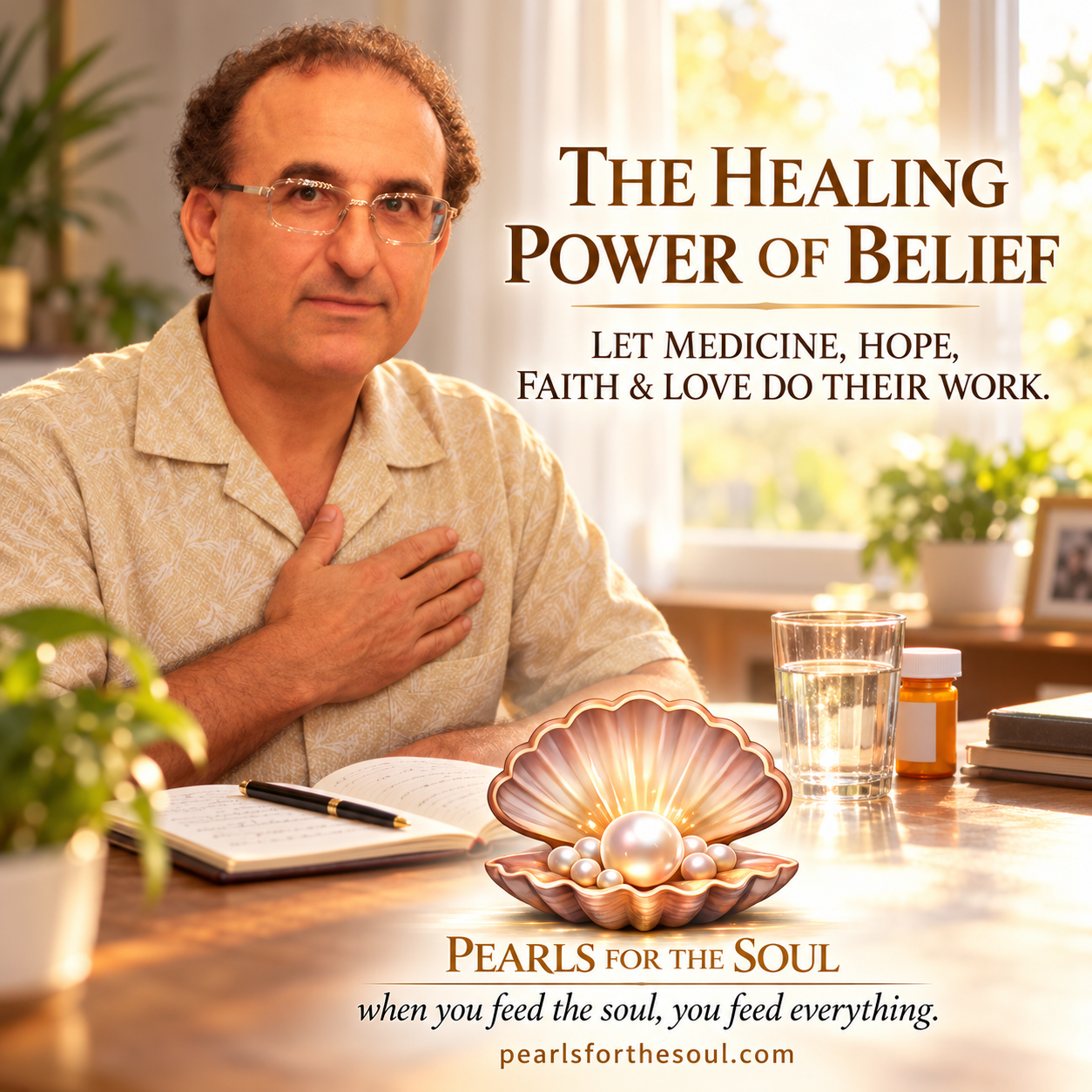
Medicine may treat the body—but hope, faith, expectation, and the will to get well can help the person carrying it.
Never underestimate the healing environment created when sound medical care and a hopeful spirit work together.
Something invades our peaceful existence, and suddenly we are not ourselves.
It could be a cold, the flu, an injury, or a more serious health concern requiring professional attention.
The next step is proper evaluation and treatment. We want to understand what is happening, why it may be happening, and what should be done about it.
Yet there is another part of the healing experience that is easy to overlook:
What we believe, expect, and feel can influence how we experience recovery.
THE PLACEBO
A placebo is an inactive or simulated treatment used in medical research to help scientists distinguish the effect of a treatment from the effects of expectation, attention, and belief.
The placebo effect does not mean an illness is imaginary.
It means the mind and body are connected in ways that can sometimes influence symptoms such as pain, stress, fatigue, nausea, and the perception of well-being.
That is not foolishness.
That is feedback.

“I FEEL GREAT” OR “I FEEL BETTER”
Feelings play a larger role in the healing experience than we may realize.
“I feel better.”
“I slept better.”
“My pain has eased.”
“I feel hopeful again.”
These statements do not necessarily tell us whether the underlying cause has disappeared, but they tell us something important about the person experiencing it.
The way we feel is part of the information—not all of it, but part of it.
That is why wise treatment listens to both the medical evidence and the patient.
WORTHY NOTE
It has been written that it can be done unto us according to our belief.
Belief systems are powerful traveling companions.
Some encourage us.
Some frighten us.
Some open the door to possibility, while others lock it before help can even knock.
PAUSE FOR CAUSE.
What beliefs are traveling with you today?
FAITH
Suppose someone offered you a magic pill and announced:
“This will cure most ailments, and it has no side effects.”
Would you take it?
Probably not without questions—and rightly so.
Skepticism, doubt, distrust, and bewilderment would immediately report for duty.
“How does it work?”
“Why haven’t I heard about it?”
“Where is the evidence?”
“And what exactly is in that thing?”
Good questions protect us. Blind belief is not the goal.
But neither is blind doubt.
The healthy position is an open mind accompanied by sound judgment.
AN AMAZING THING CAN HAPPEN
When a person believes that help has arrived, the expectation itself may sometimes affect how that person experiences symptoms.
The setting matters.
The caring professional matters.
The act of receiving treatment matters.
The belief that recovery is possible may matter too.
This does not mean an inactive pill destroys an infection, repairs a broken bone, or replaces necessary medical treatment.
It means expectation can become part of the total healing environment.
PATIENTS ARE ASKED
“How do you feel?”
“Is there an improvement?”
“Are you sleeping better?”
“Has the pain changed?”
The answers help guide the next step.
If someone genuinely feels better, why dismiss that experience?
At the same time, feeling better and being medically cured are not always the same thing. Both subjective experience and objective medical evidence deserve respect.
WORTHIER NOTE
“As a man thinks, so is he.”
The power of thought and belief is not a myth, but it is also not permission to ignore reality.
Healthy belief does not deny the illness.
It helps the person face it.
THE SPIRITUAL DIMENSION
In Scripture, Jesus sometimes asked those seeking help whether they believed.
Their faith mattered because it opened them to trust, hope, and something greater than fear.
For a person of faith, prayer does not have to compete with medical care.
Prayer can accompany it.
Faith can sit beside it.
Hope can help carry the person through it.
USE THE RICHIE REVERSE RULE
Here comes the RRR—the Richie Reverse Rule.
If believing in the possibility of improvement may help us participate in recovery, what happens when we continually affirm only doom, defeat, and despair?
The will to live is no small matter.
Neither is giving up.
A person should never be blamed for becoming ill or failing to recover. Disease is not a character defect, and suffering is not proof of weak faith.
However, when hope, help, and support are available, we should avoid locking them outside.
Open the door.
Let them enter.
WHAT HELPS—IF WE ALLOW IT
No one can promise how long another person will live. Every earthly life eventually ends.
But sometimes we can truthfully say:
“You are not alone.”
“Help is available.”
“There are still possibilities.”
“Let us take the next right step.”
We plead, pray, cry out, seek treatment, accept assistance, and continue forward.
Does all of that matter?
Yes.
Even when it cannot guarantee a cure, it can protect dignity, courage, connection, and peace.
THE INEVITABLE
Sometimes an illness or limitation visits temporarily.
Sometimes it stays longer than expected.
Sometimes life requires us to adjust, accept change, and continue differently.
Grace can meet us there.
For those who believe, God’s comfort can help carry us through uncertainty—not always by removing the condition, but sometimes by giving us strength, calm, companionship, and peace within it.
That is valuable medicine indeed.
THE PLACEBO CURE-ALL?
No.
A placebo is not a cure-all, and belief should never be used as a substitute for appropriate medical attention.
Symptoms that are new, severe, worsening, or concerning deserve evaluation by a qualified healthcare professional.
But hope, faith, expectation, trust, loving support, and the desire to continue can still serve a meaningful purpose.
Use the medicine.
Listen to the professionals.
Ask good questions.
Monitor what is happening.
And allow hope to do its part too.
FINAL THOUGHT
Healing is larger than a pill, but it should never exclude one that is truly needed.
The strongest approach may be the partnership:
Good medicine for the body.
Sound thinking for the mind.
Hope for the journey.
Faith for the soul.
PEARLS INSIGHT
Belief is most powerful when it cooperates with truth.
Positive thinking does not require us to pretend nothing is wrong. It helps us face what is wrong without surrendering every possibility of becoming better.
PEARLS FROM THE BOOKS
“Epilogue of Ebenezer Scrooge: A Second Chance” reminds us that healing often begins when a person becomes willing to see life differently.
A changed heart does not erase yesterday, but it can transform what we do with tomorrow.
PEARLS CONNECTION
The body may need treatment.
The mind may need reassurance.
The heart may need companionship.
The soul may need faith.
Why force them to compete when they were designed to help carry the same human being?
RICHIE SPEAKS
Take the medicine—but do not forget to give hope a glass of water too.
PAUSE FOR CAUSE.
A prescription may tell you what to take.
Your spirit may help remind you why you are taking it.
FINAL SAY
Do not worship the placebo.
Do not underestimate belief.
Do not refuse sound medical care.
And do not allow fear to write the entire prognosis before hope has been invited into the room.
Let medicine do its work.
Let faith do its work.
Let love do its work.
And let the person receiving all three participate in the healing journey.
— Richie
Pearls for the Soul
when you feed the soul, you feed everything.
https://pearlsforthesoul.com

Been expecting you