We have seen it by now—haven’t we?
Money comes and money goes.
It moves through our hands daily and all week long. We chase it, earn it, save it, spend it, and then begin the process again.
It is easy to develop a one-track money mind while neglecting everything else.
Money has power.
So does the person deciding what money will mean.
MONEY IS NECESSARY—LOVING IT IS NOT
Let us begin with the obvious.
Money is necessary.
We need it to function within the systems and communities where we live. Money pays for housing, food, transportation, education, medical care, recreation, and the ordinary responsibilities of being alive.
Money can also fund jobs, scholarships, discoveries, charities, businesses, opportunities, and dreams.
Money itself is not the villain.
However, loving money above all other things creates problems for many reasons.
Money has no loyalty.
It does not care who possesses it.
It does not know whether it is being held by a good person, a dishonest person, a generous person, or a frightened person.
Money simply goes where people move it.
Yet people will lie, cheat, steal, deceive, betray, and even kill to make sure it ends up with them.
That is when a useful tool becomes a dangerous master.

WHAT MAKES PEOPLE SICK?
There is an old cautionary story about Indigenous people observing European settlers’ obsession with gold.
The yellow metal itself was merely part of the earth.
But the behavior surrounding it was alarming.
Men became consumed by it.
They lied for it.
They fought over it.
They abandoned reason and humanity to possess it.
The deeper lesson is not about one people or another.
It is about what obsession can do to anybody.
The stone was not sick.
The human appetite surrounding it was.
Gold did not lose its mind.
People did.
WHERE DO YOU PUT YOUR TRUST?
Many financially successful people use wealth wisely.
They create jobs.
They support families.
They fund medical research.
They establish scholarships.
They build businesses.
They contribute to their communities.
They give qualified people enough freedom to pursue important work rather than spending every waking hour trying to survive.
That is how grants, fellowships, endowments, and scholarships can help worthy ideas become reality.
Money used wisely can free talent to serve society.
Money can do tremendous good.
But material possessions make a poor foundation for identity.
If happiness must be continually purchased, the next sale becomes another attempt to buy what the last purchase failed to deliver.
That is an expensive cycle.
WORTHY NOTE: It is not merely what a person has. How it was obtained and how it is used tell the larger story.
MILLIONAIRE, BILLIONAIRE—THEN WHAT?
At one time, becoming a millionaire represented financial independence.
It could mean escaping the nine-to-five routine and gaining time to pursue meaningful work, family, travel, service, or creativity.
Then came the billionaire.
What does the extra word mean?
It may mean that someone created enormous value, took substantial risks, employed thousands of people, or built something widely useful.
It may also mean that accumulation became the purpose rather than the tool.
The number alone cannot tell the whole story.
The question is what happened to the person while the number grew.
Did generosity grow with it?
Did responsibility grow?
Did compassion grow?
Did wisdom grow?
Or did the appetite simply demand another zero?
Greed rarely announces itself all at once.
It sneaks in quietly.
It calls itself ambition.
Then success.
Then security.
Then winning.
After a while, a person may have more money than could be spent across many lifetimes—yet still feel that one more deal, one more acquisition, and one more victory are necessary.
That deserves examination.
WORTHY NOTE: Wealth that creates jobs, advances medicine, relieves suffering, supports young people, and strengthens communities can do tremendous good. Vanity disguised as achievement deserves a closer look.
THE GREAT BOUNDARY
Between now and the end of life—whenever that may be—we will accumulate many things.
Money.
Possessions.
Ideas.
Relationships.
Accomplishments.
Titles.
Experiences.
Habits.
Character.
Some of these things will perish.
Some may outlive us.
If our entire identity is built upon things that eventually disappear, what happens when they disappear?
Consider your first nickel.
How important is that exact nickel today?
You may remember earning it.
You may remember what it taught you.
You may remember the person who gave it to you.
The nickel itself is probably long gone.
The lesson may remain.
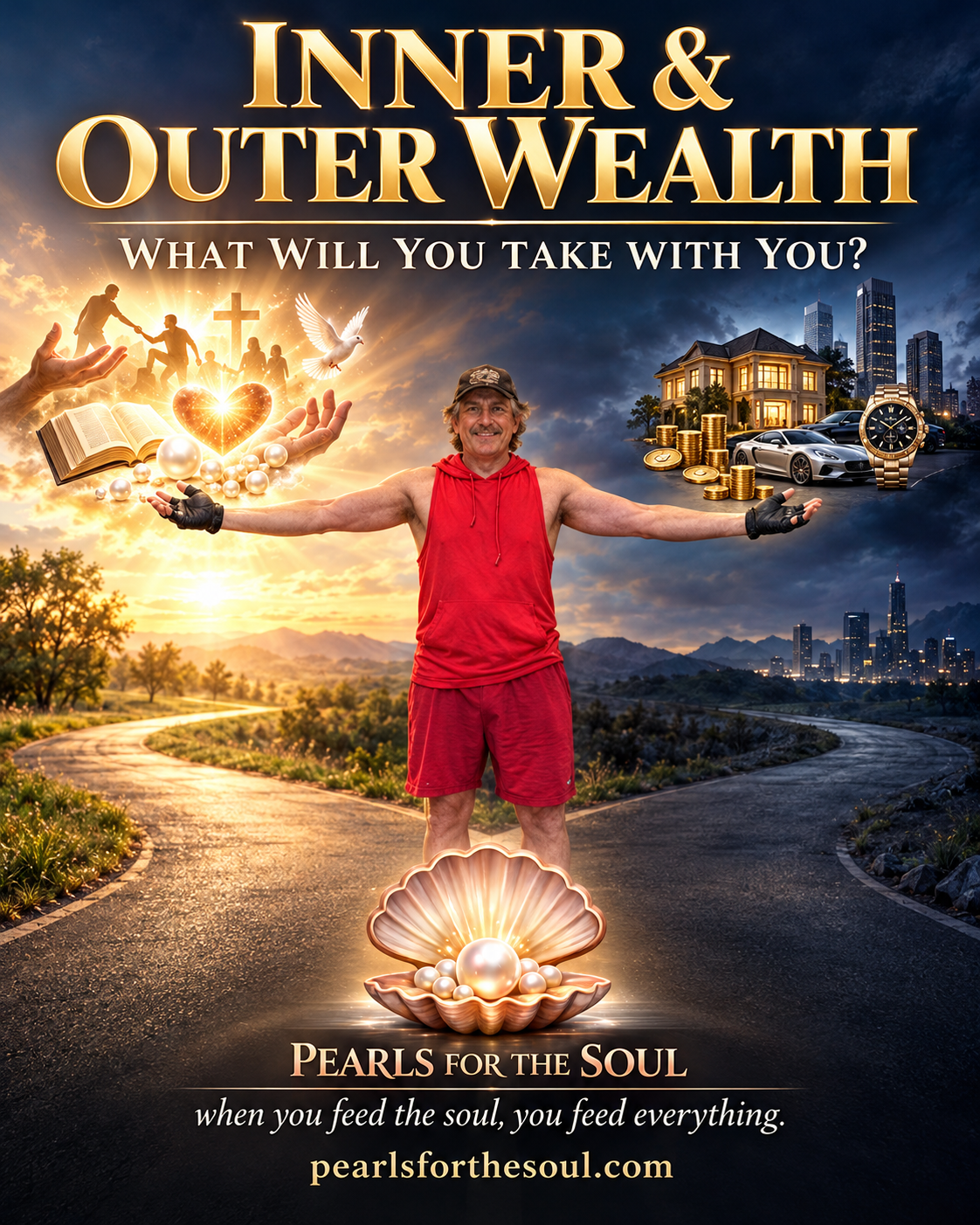
That is the difference between outer wealth and inner wealth.
Outer wealth can leave your possession.
Inner wealth becomes part of the person doing the possessing.
THE HEART IS RICH WITH LIFE—SPEND THAT GENEROUSLY
A person can be poor according to the world’s measurements and rich within.
That richness may include faith in something greater than what can be seen.
It may include love, gratitude, courage, wisdom, patience, humor, honesty, forgiveness, and peace.
These riches are not always displayed in bank statements.
You see them when someone remains kind under pressure.
You hear them when a person speaks truth even when lying would be profitable.
You feel them when somebody stays beside you after there is nothing left to gain.
Food, drink, pleasure, entertainment, and celebration all have their place.
Enjoy them.
Life is not meant to be endured with a permanent frown.
But pleasure without purpose can become another appetite that produces waste instead of fulfillment.
Be careful not to reach the end of the journey and discover that you existed for perishable principles but never fully lived.
What a waste that would be.
WORTHY NOTE: Many things may be allowed, but ask yourself how you truly profited from them.
YOUR CHARACTER—THE RIGHT IN YOU
Consider this:
The one possession that travels to life’s final boundary is your character.
Not the house.
Not the automobile.
Not the account balance.
Not the watch.
Not the title printed beneath your name.
Your character.
The inner part of you that cannot be stolen by a thief or eaten away by a moth.
Your character holds the evidence of how you lived.
Did you love?
Did you learn?
Did you help?
Did you forgive?
Did you tell the truth?
Did you become more generous?
Did you use what was placed in your hands to make something better?
The soul will not need to deliver a sales presentation.
It will display what it became.
OUTER WEALTH IS STILL WEALTH
Do not misunderstand me.
Poverty is not automatically virtuous, and wealth is not automatically corrupt.
There is no holiness in being unable to pay the rent.
There is no shame in succeeding honestly.
Providing for yourself and your family is responsible.
Saving for the future is wise.
Building something valuable can bless many people.
The danger begins when outer wealth is allowed to impoverish the inner person.
Money should expand what goodness can accomplish—not shrink the heart carrying it.
If financial success gives you greater reach, let your generosity acquire a longer reach too.
THE BETTER ACCOUNTING
We spend much of life balancing financial accounts.
What came in?
What went out?
What is owed?
What remains?
Perhaps the soul deserves an accounting too.
What kindness came in?
What kindness went out?
What truth was protected?
What promise was kept?
Who received help?
What fear was overcome?
What lesson was learned?
What part of your character increased in value?
This accounting may reveal that some of your richest days were not your most profitable days.
It may also reveal that money used with wisdom became part of something priceless.
FINAL THOUGHT
Outer wealth tells people what you accumulated.
Inner wealth tells them who you became.
Possessions can improve life, create freedom, and open opportunities. But they cannot substitute for purpose, love, truth, faith, generosity, or character.
Earn honestly.
Save wisely.
Enjoy appropriately.
Give generously.
Then make certain that while your outer holdings grow, your inner treasury does not go bankrupt.
PEARLS INSIGHT
True wealth is not measured only by what you possess. It is measured by what your possessions enable you to do—and by the person you become while acquiring and using them.
PEARLS FROM THE BOOKS
Pearls for the Soul repeatedly returns to a central truth:
Outer success gains its highest value when it strengthens rather than replaces the inner life.
PEARLS CONNECTION
If every possession and financial title disappeared from your name, what inner wealth would still identify you?
RICHIE SPEAKS
I am not against money.
I prefer having enough of it to not having enough.
Let us be honest here!
But I do not want money giving the orders while my character waits outside.
Money belongs in the toolbox.
The soul belongs in charge.
FINAL SAY
Your first nickel is probably gone.
What it taught you may still be here.
That is your clue.
Build the outer life.
Feed the inner life.
Use wealth without worshipping it.
Spend the riches of the heart generously.
Then, when you reach the great boundary, you will not have to explain what you owned.
Your character will reveal who you became.
— Richie
Pearls for the Soul
when you feed the soul, you feed everything.
https://pearlsforthesoul.com
Been expecting you