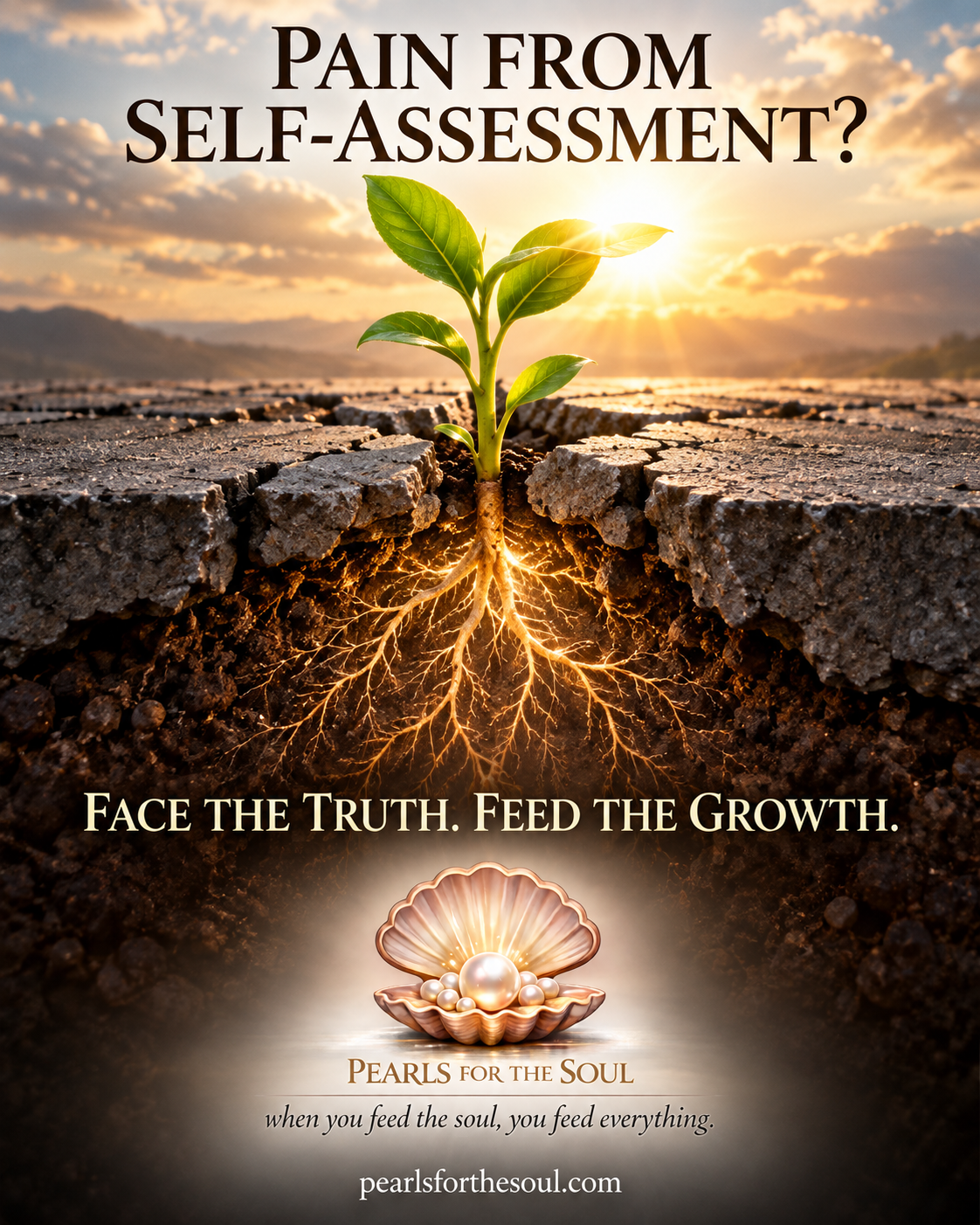
The most painful truth is often the truth about ourselves.
But if the discomfort reveals something that can be corrected, it did not arrive empty-handed.
It brought growth food.
The pain or discomfort in this post begins when you discover—or someone tells you—something disturbing about yourself.
It may be true.
It may be partly true.
It may be false.
But the statement lands.
You feel embarrassed, exposed or even humiliated. It interrupts the moment, and then another thought makes everything worse:
“Who else knows?”

Here is the question:
How can something be corrected, removed or healed if it is never first identified?
WORTHY NOTE:
Short-term discomfort often accompanies personal growth.
The goal is not to worship the pain.
The goal is to discover whether it is carrying useful information.
THE PAIN OF EMBARRASSMENT
Embarrassment is a powerful mixture of self-consciousness, awkwardness, inadequacy and the feeling of being exposed.
Sometimes it follows an innocent mistake.
Sometimes we said or did something wrong.
Sometimes somebody publicly revealed what should have been handled privately.
Guilt may also enter when we know our own actions contributed to the situation.
In private, embarrassment smarts.
In front of others, it hurts.
In public, it wounds.
The good news?
Most embarrassing events move away from us with time.
People return to their own lives.
The moment loses heat.
What felt permanent becomes a story—and eventually, perhaps, a lesson.
THE PAIN OF HUMILIATION
Humiliation is embarrassment on steroids.
It carries the deeper feeling of being degraded, ridiculed or deliberately diminished.
Pride and ego feed the injury, but mistreatment may also be real.
That distinction matters.
Being corrected is not the same as being humiliated.
Truth identifies behavior that should change.
Humiliation attempts to reduce the value of the person.
One can help you grow.
The other may simply be cruelty wearing the costume of honesty.
Do not reject every correction because it hurts.
But do not accept abuse merely because someone calls it truth.
CRIPPLED BY LOW SELF-ESTEEM
Low self-esteem tells a person:
“You are not worthy.”
“You are not good enough.”
“You deserve whatever happens.”
Repeated long enough, these beliefs may influence how a person lives, chooses and allows others to treat them.
That is like beating yourself with a giant stick covered in thorns and poison ivy.
Put the stick down!
Feeling unworthy does not make you unworthy.
And no person deserves mistreatment because confidence has been injured.
All people possess value.
Growth begins when you stop confusing a correctable weakness with your entire identity.
You may have made a poor decision.
That does not mean YOU are permanently poor in value.
YOUR PERSONAL FEARS
Personal fears can have us coming, going, running and hiding—sometimes from a real concern and sometimes from an imagined one.
Shakespeare wrote:
“Cowards die many times before their deaths;
The valiant never taste of death but once.”
Richspeare agrees.
When you continually think, repeat and believe that fear is all-powerful, you begin supplying some of the power it uses.
Stop participating long enough to examine it.
If the fear had all the authority it claimed, would you still be standing?
Still here?
You win!
FEEDBACK AND INPUT
Feedback can become a trusted friend—or food for a never-ending argument.
Much depends upon how much truth we can accept and how responsibly the other person presents it.
What people say may be useful.
It may also be biased, uninformed or intentionally harmful.
Do not swallow every opinion whole.
Examine it.
Ask:
Is it specific?
Is there evidence?
Does more than one trustworthy person see it?
Is the speaker trying to help—or merely injure?
Can I identify a constructive change?
Truth can survive examination.
Manipulation does not enjoy questions.
WORTHY NOTE:
Discomfort endured to discover truth may lead toward freedom.
But suffering by itself does not prove that something is true.
THE FIRST TRUTH
There are eternal truths—and there are personal beliefs we have accepted as truth.
Personal beliefs carry responsibility.
If one harms others, repeatedly fails or intrudes upon what is right, it should be examined and corrected.
That is difficult because the most painful truth may be the truth about yourself.
Why does it hurt so much?
Because it threatens the version of yourself you preferred to believe.
PRIDE—BACKED BY EGO
An ego-and-pride death can feel like one of life’s most painful experiences.
The correction happens in real time and hits the center of the target.
Pride and ego do not want to be wrong.
They do not want to be diminished, dismissed or removed from command.
These two rascals may inflict discomfort to make you stop examining yourself—and offer false relief if you retreat.
“Forget it.”
“Blame them.”
“Make an excuse.”
“Tell a better story.”
Do not accept the bribe.
PAUSE FOR CAUSE.
If the criticism is true, correction will strengthen you.
If it is false, calm examination will help release you.
Either way, truth remains your destination.
YOUR OWN IGNORANCE
Discovering your own ignorance is seldom cause for celebration.
You suddenly see that you misunderstood something, lacked information or acted from an inflated version of yourself.
The blind ego receives a direct hit.
Good!
Not because humiliation is desirable, but because ignorance recognized is ignorance already losing ground.
You cannot learn what you insist you already know.
SADNESS AND SORROW
Suffering is not advertised or readily shared, but it surrounds human life.
Who wants to watch another person endure pain, loss or defeat?
Sports show winners and losers within a game.
Life’s sorrow respects no category.
It visits people, families and even the living creation around us.
Self-assessment should not make us harder.
Properly used, it makes us more compassionate because recognizing our own weakness helps us treat another person’s weakness with mercy.
REALITY IS YOUR FRIEND
Reality is best friends with truth.
Not every painful event was chosen, deserved or specifically sent to teach us.
Some things happen through human wrongdoing, natural circumstances, loss or forces beyond our control.
But even when we did not choose the experience, we may still choose what we learn from it.
Face the moment with humility.
Use courage.
Ask what is true.
Correct what belongs to you.
Reject what does not.
Then become better—not bitter—because you faced reality.
PEARLS INSIGHT
Self-assessment is not self-condemnation.
Condemnation says:
“You are hopeless.”
Assessment says:
“Here is something that needs attention.”
One closes the door.
The other points toward it.
Growth requires honesty, but honesty should lead toward correction—not permanent shame.
RICHIE SPEAKS
When truth steps upon your toes, resist the temptation to shoot the messenger before checking your shoes.
Maybe the person is wrong.
Maybe the delivery was terrible.
Maybe your pride has been caught red-handed.
Find out!
Take the useful truth.
Discard the cruelty.
Correct the weakness.
And stop feeding the two rascals called Pride and Ego every time they complain about the menu.
FINAL SAY
Painful self-discovery can become growth food.
Chew it slowly.
Separate truth from poison.
Digest the lesson.
Then use the nourishment to become more honest, compassionate and whole.
Reality is not your enemy.
Reality is the friend willing to introduce you to the person you can still become.
— Richie
Pearls for the Soul
when you feed the soul, you feed everything.
https://pearlsforthesoul.com

Been expecting you