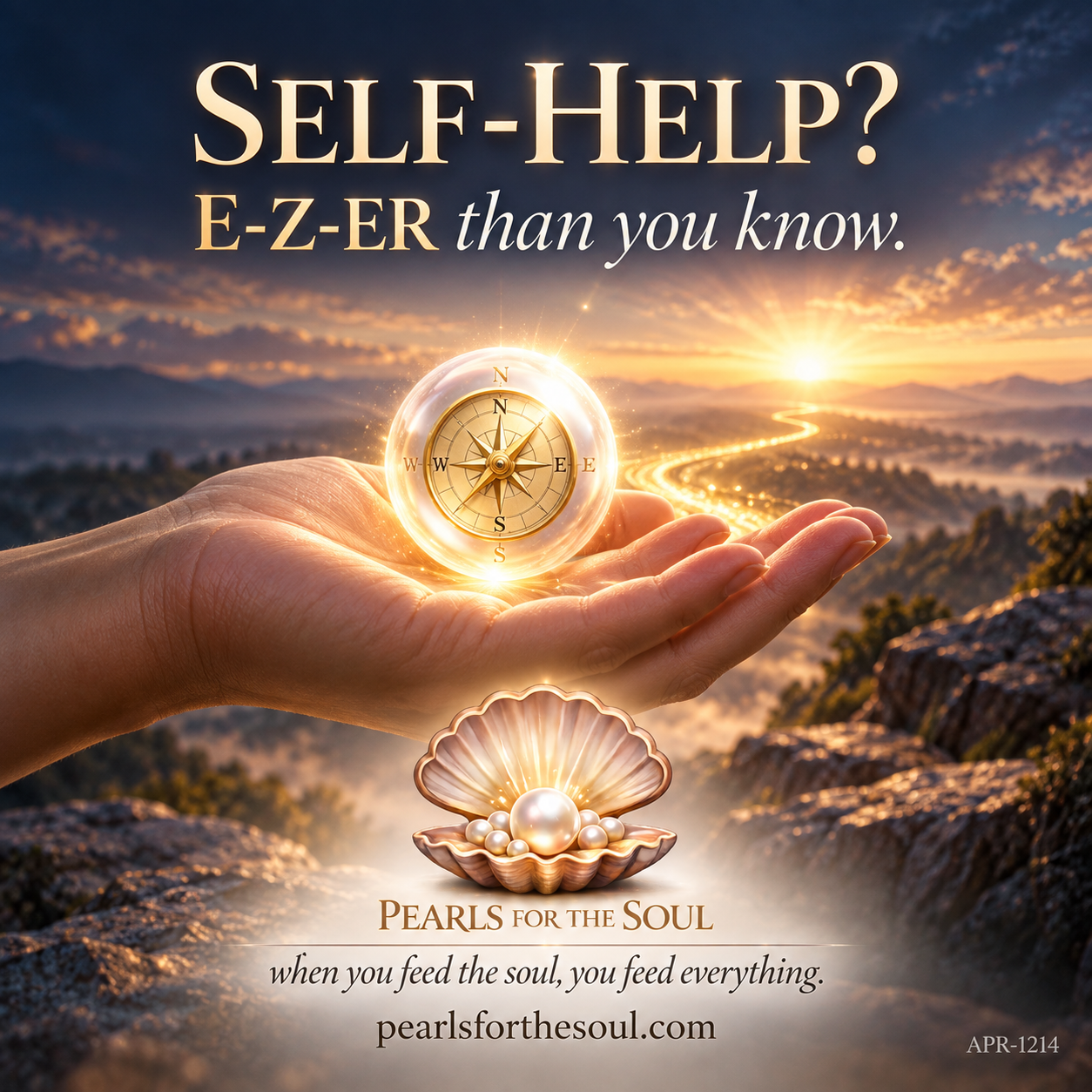
Self-help does not mean doing everything alone.
It means activating the part of you that must participate in your own growth.
Others can teach, guide, support, and encourage you—but nobody can take your steps for you.
I am not speaking only about classroom study, therapy, books, seminars, or specific courses that teach a particular subject, service, or method.
Those forms of help can be valuable.
But another system was already at work long before you learned the phrase “self-help.”
When life was breathed into you, something began operating.
At the appropriate time, curiosity activates it.
Need triggers it.
Desire summons it.
Experience teaches it.
We naturally gravitate toward what interests us and turn away from what does not.

This is self-help—or the self helping the self to learn, grow, choose, correct, and participate in life.
NO ON OR OFF SWITCH
This inner system is eager to work.
We are eager for it too.
We do not complain about losing it while asleep because we are unconscious. Upon awakening, there it is again, awaiting instructions.
What shall we do?
Where shall we go?
When do we begin?
Why does this matter?
Life presents the questions.
The awakened self begins responding.
YOU SEE SOMETHING YOU LIKE
Something catches your attention.
It summons you to know more—or have a go at it.
The opposite also happens.
Something repels you, troubles you, or signals that it does not belong in your life.
Everyone possesses this personal response system, but no two people wield it in exactly the same way.
We may join the same group, team, profession, family, or community and agree upon a general purpose.
Yet each person applies it subjectively.
Same team.
Different player.
Same road.
Different footsteps.
INDEPENDENT OR DEPENDENT?
Every person requires help and assistance at different times.
There is no shame in that.
We learn from parents, teachers, friends, professionals, partners, mentors, strangers, failures, and successes.
But eventually, a day or moment arrives when we discover the liberty we can give ourselves by taking responsibility for our own actions.
Taking charge is exhilarating.
Before that exhilaration, however, we encounter risk, fear, comfort-zone interference, and the unknown.
PAUSE FOR CAUSE.
Self-help does not mean refusing every hand extended toward you.
It means using that hand to rise—and then participating in standing.
SELF-HELP
When you take charge, you begin releasing love, care, standards, and personal beliefs about how you want to live and be treated.
You activate your personal compass.
Which direction will I take?
Why am I choosing it?
What will I accept?
What must change?
Where do I need guidance?
Making those decisions can be naturally self-rewarding because the life being directed is yours.
STAY AS LONG AS YOU LIKE
If something is meaningful, pleasurable, useful, or fulfills your curiosity, have at it to your heart’s content.
That is one measure of truly having an experience:
You are consciously participating in it.
You choose when to begin, continue, adjust, or leave.
With choice comes responsibility.
There is less room for blame because your decisions helped shape the outcome.
That does not mean you control every circumstance.
It means you remain responsible for the portion belonging to you.
LOOK AT YOURSELF
Human self-awareness allows us to observe ourselves—not only in a mirror, but through conscience, memory, imagination, reflection, and choice.
We can ask:
“Who am I becoming?”
“Why did I react that way?”
“What should I correct?”
“What could I create?”
“How can I improve?”
Being made in the Creator’s image means we share attributes that allow us to co-create, explore, enjoy, correct, improve, and evolve.
That is no small inheritance.
CONSCIENCE
Poets tell us to seize the day—carpe diem—and live fully.
Why not, especially if we were created to live?
This is where conscience shines and boasts—in humility—of its function and purpose.
Conscience sounds the alarm when we are going too far or traveling in the wrong direction.
It does not always wait to be asked.
It may arrive as discomfort, hesitation, conviction, or the quiet sentence:
“You know better.”
This is a life marvel.
The compass does not imprison you.
It helps reveal the course.
OBSERVE THE OPPOSITE
Seeing another person with opportunity but little momentum can sadden us.
Watching someone suffer, surrender potential, or fail to prosper often stirs our desire to help, encourage, support, or solve what we can.
That impulse matters.
But help is most effective when the person receiving it eventually participates.
You cannot permanently carry someone who refuses to move any part of themselves.
Neither should we use that truth to condemn people whose obstacles we do not fully understand.
Encouragement and responsibility can share the same room.
LESSONS THAT TEACH THEMSELVES
If you have ever burned yourself, you learned quickly not to repeat the exact action.
The pain supplied immediate feedback.
Life contains many teachers like this.
Some lessons whisper.
Some repeat.
Some shout.
Self-help includes listening to the lesson, making the correction, and refusing to volunteer for the same unnecessary pain.
VOLUNTARY SURRENDER OF ABILITY
A sad thing to observe is someone surrendering every ability while expecting others to carry responsibilities they could reasonably share.
Circumstances differ.
Some people face illness, disability, hardship, trauma, limited opportunity, or burdens unseen by observers. Assistance can be necessary, humane, and right.
But when ability exists and is deliberately abandoned, something within the person begins starving.
Contribution feeds dignity.
Responsibility strengthens liberty.
Using your skills reminds you why you are here.
WORTHY NOTE
The person who says, “I can,” and the person who says, “I can’t,” may both begin creating evidence for their chosen answer.
Which “right” would you rather become associated with?
Sometimes “I can’t” honestly means “I need help,” “I need training,” or “I am not ready yet.”
Good.
Name what is needed.
Then begin from there.
PEARLS INSIGHT
Self-help is not isolation.
It is participation.
A doctor may advise you, a teacher may instruct you, a counselor may guide you, and a friend may encourage you.
Their help becomes most powerful when something within you answers:
“I will participate.”
RICHIE SPEAKS
Your inner compass came built in.
But owning a compass does not move your feet.
Look at the direction.
Make the decision.
Ask for help when needed.
Then take the portion of the journey that belongs to you.
E-Z-ER THAN YOU KNOW
The self-help system works when engaged.
It came built into us without our asking.
Ponder and pause here.
This is magnificent to behold, learn, study, and explore.
It is an invitation to become more of what you were created to be.
FINAL SAY
You do not have to do everything alone.
But you must bring yourself along.
Engage the system.
Activate the compass.
Receive help.
Apply help.
Help yourself.
NO EXCUSES—only honest reasons, worthy assistance, necessary corrections, and the next responsible step.
— Richie
Pearls for the Soul
when you feed the soul, you feed everything.
https://pearlsforthesoul.com

Been expecting you