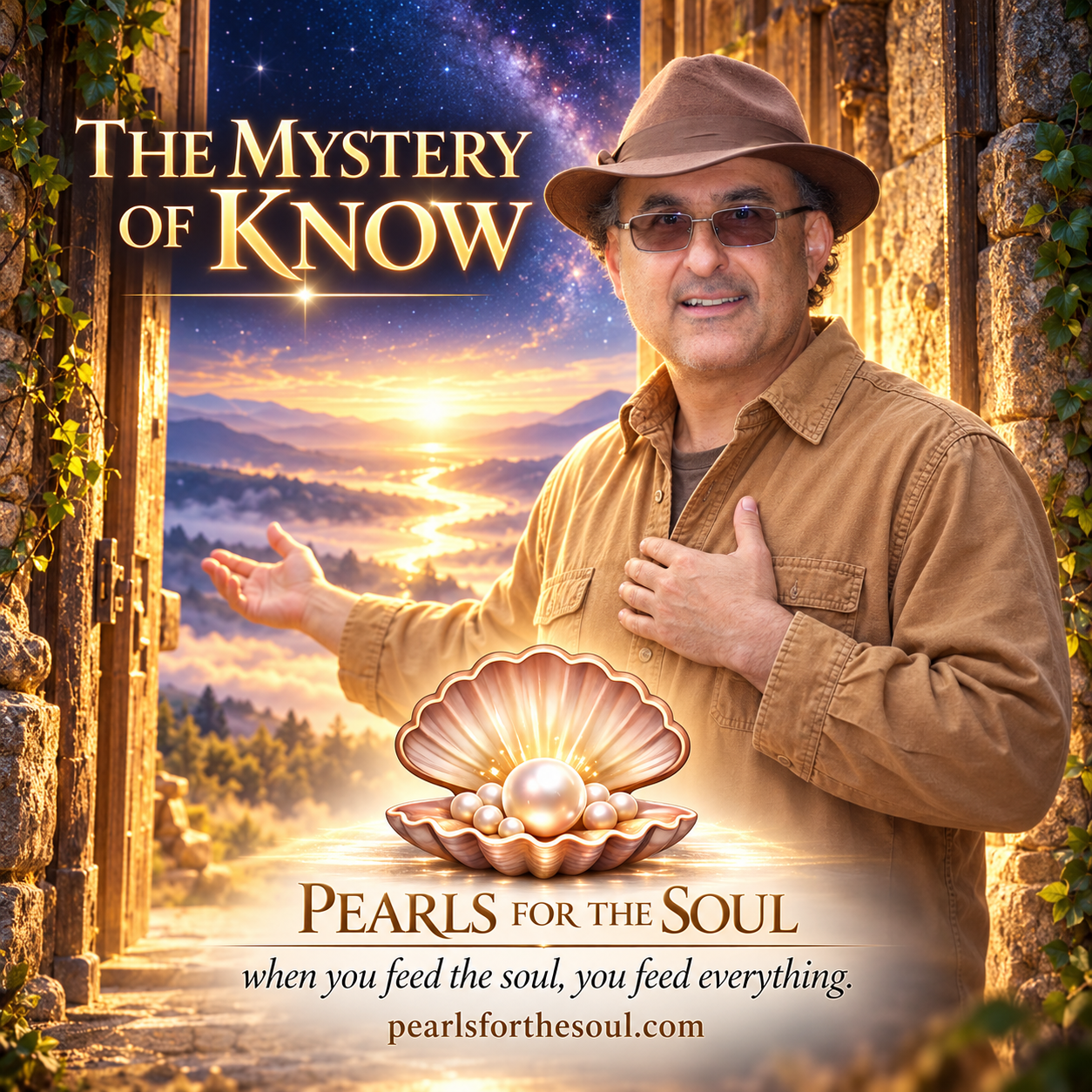
There are things we learn—and then there are things we simply KNOW.
One fills the mind with information. The other arrives quietly, touches the heart, and needs no argument to announce itself.
Where does that kind of knowing come from?
THE MYSTERY OF KNOW
PAUSE FOR CAUSE
Pause and let the title have its way with you.
This subject is not limited to one area of life. Pick any subject—love, work, purpose, friendship, faith, creativity or personal growth—and ask yourself:
What have I learned?
What do I understand?
What do I truly KNOW?
They are related, but they are not always the same.
ALL FIRST TIME
No one has ever been here before.
Every life is being lived for the first time, even when we travel roads that others have traveled. We receive advice, education and examples, but no one else can completely live our experience for us.
Some things are taught. Some things are discovered. Others seem to rise naturally from within us.
The journey toward maturity brings them together. We call that evolving.
EXPOSURE
Much of learning begins with exposure.
Remain around something long enough and repetition produces familiarity. Familiarity produces comfort. Comfort can eventually produce competence.
That is the learning curve at work.
It happens while learning an instrument, developing a trade, speaking another language or mastering a professional skill. Eventually, other people recognize what we have gathered and begin calling us knowledgeable.
PUT A VALUE ON IT
At some point, experience becomes valuable.
People may pay for what you have studied, practiced, tested or learned to handle. Your knowledge then joins your natural gifts, skills and abilities.
Many people may possess similar training, but no two people deliver it in precisely the same way.
There are countless similars—but only one UNIQUE you.

NATURAL OR FORCED?
I have seen natural ability at work, and I have seen ability being forced to perform.
We usually recognize the difference.
Natural ability engages without unnecessary strain. Forced performance requires constant pressure, control and maintenance.
One flows. The other must continually be pushed.
That does not mean every worthwhile pursuit will be easy. Practice and discipline still matter. But when something repeatedly demands that you fight your own nature, it may be time to ask:
Am I developing a gift—or forcing an identity?
WHAT “KNOW” MEANS
The “know” I am speaking about is intimate inner knowledge.
It is personal, self-evident and quietly reassuring. It seems to arise from the soul, travel through the heart and arrive before we can explain every detail.
We call it an aha moment.
Bingo.
Got it.
It is not loud, domineering or desperate to win an argument. It simply becomes recognizable within us.
That is a living form of natural awe.
WHAT “KNOW” IS NOT
Knowing is not guessing, opinionating or pretending to be certain.
It is not the refusal to say, “I don’t know.”
In fact, an honest “I don’t know” may be the doorway to genuine knowing. It clears away performance and makes room for discovery.
True inner knowing does not need to bully anyone. It carries a quiet confidence that allows the experience to speak for itself.
KNOWLEDGE
Knowledge is our ability to gather, retain and apply information.
Through repetition, the mind learns procedures, approaches and predictable systems. This is useful and necessary. Knowledge helps us function, teach, build and improve.
But knowledge alone can sometimes leave us repeating what we have been told without discovering what is true within our own experience.
Where is the inner child—the curious one who still asks why?
WISDOM IS KNOWLEDGE WITH UNDERSTANDING
Wisdom is knowledge joined with understanding.
It surpasses the mere collection of facts because it knows when, why and how knowledge should be applied.
The Latin root “confideo” points toward acting with trust or confidence. When wisdom and confidence work together naturally, people can see the gift in motion.
They can also see when it is missing.
Do not merely seek the performance.
Seek the gift.
KNOWING CANNOT BE FORCED
True knowing is natural.
It belongs to timeless systems that existed long before we named them. Wordless knowing may be one of the earliest forms of intimacy between Creator and creation.
Something is observed, received and understood in the twinkling of an eye.
The explanation may follow later.
The knowing arrived first.
REASON OPENS DOORS
Reason is one of our most useful tools when used correctly.
Its purpose is not merely to construct a logical explanation emptied of all feeling. Reason can also help us examine experience, ask healthy questions and follow evidence toward a natural conclusion.
Reason should not imprison wonder.
It should open the door to it.
Sometimes, after all the questions have been considered, the answer settles inside us:
You just know.
E-Z-P-Z.
THE WORLD OF NATURAL KNOWING
As we travel through life, awareness grows.
We become receivers of what we observe. When awareness joins honest questions and real-life experience, it can lead to discovery, confidence and adventure.
Strangely enough, becoming more childlike can help—not childish, but innocent, curious and free of hidden motives.
The child asks because the child truly wants to know.
The mystery is not a problem to eliminate. It is an invitation to keep discovering.
FINAL THOUGHT
Until we know, we do not know.
Wisdom begins when we can admit the difference between what we learned, what we believe and what we have genuinely come to understand.
PEARLS INSIGHT
Knowledge can explain the doorway. Inner knowing recognizes when it is time to walk through it.
PEARLS FROM THE BOOKS
“Epilogue of Ebenezer Scrooge: A Second Chance” reminds us that transformation becomes real when truth moves beyond intellectual recognition and becomes a living inner understanding.
PEARLS CONNECTION
Choose one area of your life today and ask:
What do I know about this because someone told me?
What do I know because experience taught me?
What do I quietly understand within my own heart?
Do not force the answer. Give it room to arrive.
RICHIE SPEAKS
The mind gathers the evidence. The heart recognizes the meaning. The soul sometimes whispers, “Now you KNOW.”
FINAL SAY
Knowing does not always arrive with a speech. Sometimes it arrives as peace.
— Richie
Pearls for the Soul
when you feed the soul, you feed everything.
https://pearlsforthesoul.com
Been expecting you