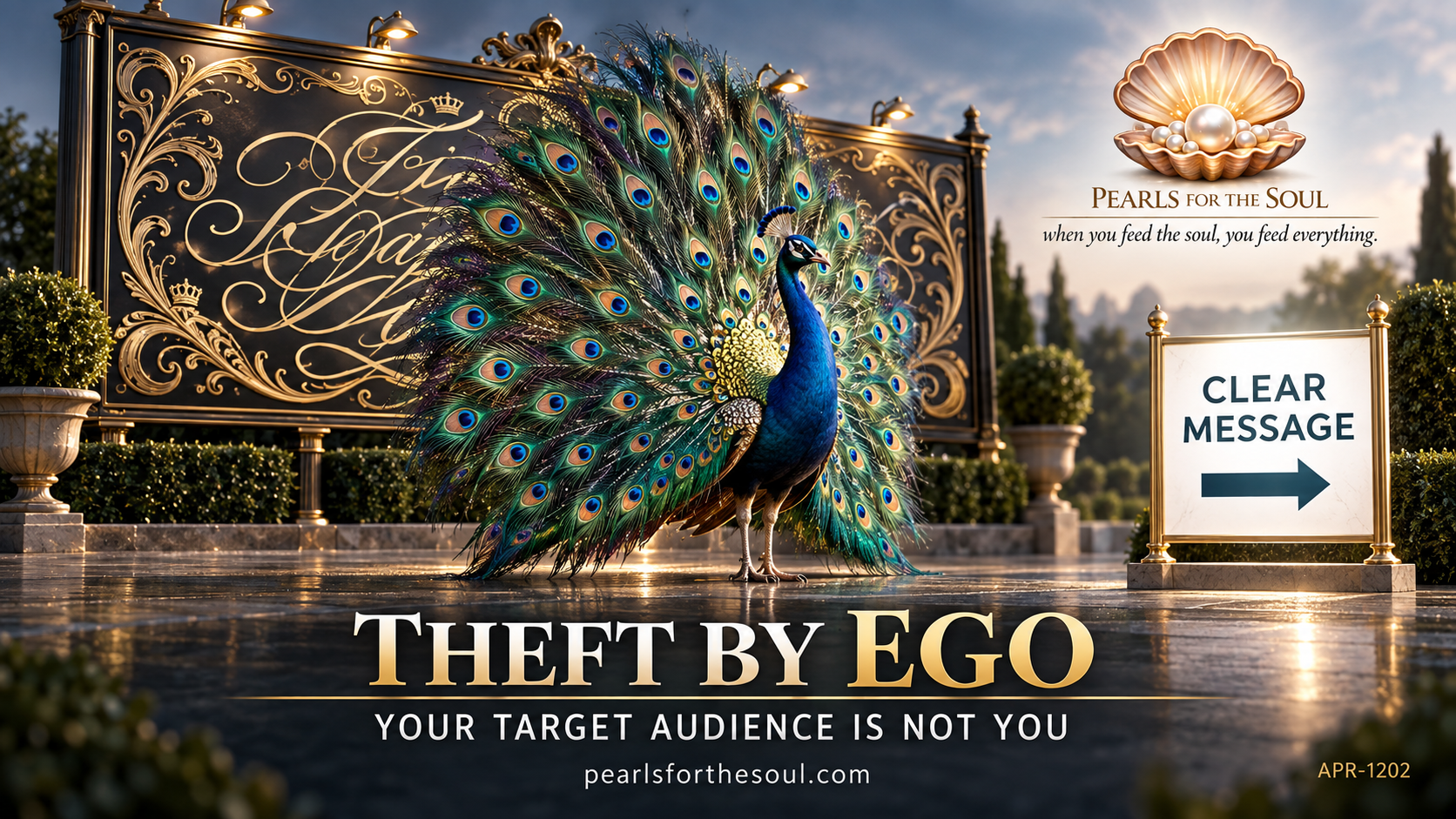
If people notice how fancy your message looks but cannot understand what it says, your ego has stolen the sale.
Your target audience is not you.
It is always about them.
Have you ever seen signs, billboards, business cards, name tags, websites, advertisements, emails, résumés, or social-media posts filled with fancy lettering, symbols, colors, animations, swirls, and distortions?
They certainly attract attention.
The problem is that nobody can figure out what is being offered.

CAN’T MAKE IT OUT
Instead of receiving clear information about the product, service, person, or purpose, the public receives an exhibition of somebody’s ego.
The creator is delighted.
The audience is puzzled.
The design may be pleasing to the person who made it, but the people it was supposed to reach are asking:
“What are they selling?”
“What do they do?”
“Why should I care?”
“How do I contact them?”
If people must investigate your message before they can understand your message, something has already gone wrong.
PAUSE FOR CAUSE.
Being noticed is not the same as being understood.
YOUR TARGET AUDIENCE IS NOT YOU
A peacock spreads its magnificent tail because displaying magnificence is what a peacock does.
That works wonderfully for a peacock.
It is not always a sound business plan.
You create something that looks impressive to you. You are confident that no one could possibly miss how original, artistic, sophisticated, clever, or important it is.
Meanwhile, the public is still wondering what the product or service might be.
Do you really want prospective customers to guess?
Vanity says:
“Look how impressive I am.”
Communication says:
“Here is what I can do for you.”
WORTHY EXAMPLE: THE RÉSUMÉ
Years ago, many people believed the best résumé was the one containing the most information possible.
Cram in every job.
Every duty.
Every accomplishment.
Every club, class, certificate, skill, and personal characteristic.
Surely no employer could resist hiring YOU after reading all that!
The résumé sometimes produced the opposite result.
Its destiny upon arrival was the trash can.
Meanwhile, the applicant waited for a telephone call that never came.
WHAT WAS HUMAN RESOURCES THINKING?
Human Resources was thinking about the available job—not about fulfilling your need to tell your complete life story.
A résumé with breathing room, relevant bullet points, selected experience, and an opening directed toward the position had a better chance of receiving the coveted second look.
Less got it done.
Not tricks.
Not gimmicks.
Not a parade.
Relevant information.
FIRST IMPRESSIONS—NOT JUST FOR PEOPLE
You thought first-impression dynamics applied only to people?
WRONG.
Everything representing you makes an impression before you have an opportunity to explain it.
Consider these examples:
- VEHICLE AND BENCH ADVERTISING
I have seen advertising on cars and benches that I could not make out.
It caught my eye—but then immediately lost it.
All I could think was:
“What was that?”
If the vehicle has passed before the public understands the message, the decoration traveled farther than the information.
- BUSINESS CARDS
Some business cards contain so many colors, fonts, titles, slogans, comments, and symbols that the purpose disappears.
If you cannot explain what is on your card in two seconds, neither can anyone else.
Your name.
What you do.
How to reach you.
Now we are in business.
- STATIONERY AND LOGOS
Some logos are as large as a bird’s wings.
Others are as small as an ant’s boot.
One overwhelms the message.
The other cannot be identified.
A logo should support recognition—not compete with the information for survival.
- EMAIL SIGNATURES
Then come the over-the-top email signatures:
Founder.
President.
Visionary.
Chief Inspirational Everything.
King and Queen So-and-So signing off.
Who?
Your credentials may matter, but they should never bury the reason for the communication.
- BUSINESS SIGNS
Some business signs are so fancy and self-centered that nobody knows what the business actually does.
Beautiful mystery may work in an art gallery.
It does not always help somebody looking for a plumber, restaurant, accountant, mechanic, counselor, or bakery.
- VOICEMAIL GREETINGS
Long, cute voicemail performances may delight the person recording them.
The caller wants to know three things:
Did I reach the correct person?
Can I leave a message?
Will someone call me back?
Everything else delays the beep.
Click!
- BUSINESS NAMES
Some business names have nothing to do with the business.
They sound exotic, mysterious, and sophisticated—but a passing customer has no idea what is being sold.
Mystery without curiosity produces indifference.
- ELEVATOR SPEECHES
Some elevator speeches spend so much time on the speaker’s name, cause, background, philosophy, and personal journey that the listener forgets why the conversation started.
You lost me at your name.
Why are you here?
- WEBSITES AND SOCIAL MEDIA
Today, the same problem appears online.
A beautiful website opens with dramatic video, poetic slogans, moving graphics, and impressive photography—but never clearly says what the organization does.
A social-media profile may look polished while leaving visitors unable to understand the offer.
The visitor should not require detective training.
Clarity first.
Creativity second.
WHAT THE BIG BOYS DO
Successful brands generally make recognition easy.
A name is repeated.
A logo becomes familiar.
The product category is understood.
The message gels.
Cars display a recognizable maker and model.
Burger and pizza establishments use simple signs because hungry people already understand the invitation.
Ice cream does not need a twelve-minute explanation.
Those two words go to work.
“REAL ESTATE—BOUGHT AND SOLD.”
Oh, I understand.
I have a real-estate question.
Simple does not mean unsophisticated.
Simple means the work of understanding has already been done for the customer.
HERE IS HOW IT WORKS
Make your point or introduction clearly.
If someone wants to know more, have the additional information ready to go.
That is where the real work begins and the deal may be sealed.
Do not begin by shoving everything down someone’s throat.
Do not bury the offer beneath small talk.
Do not waste their time proving how interesting you are.
You are part of the product.
People often decide whether they trust the person before they evaluate the service.
Unless you are a movie star, famous singer, celebrated chef, or renowned historian, nobody arrived specifically to purchase your ego.
They came to discover whether you can help them.
RESPECT THEIR ATTENTION
Do not test people’s attention spans.
Respect them.
Your message must compete with countless other messages, demands, screens, signs, notifications, and distractions.
Come up with your own clear business model and approach.
Test it.
Observe it.
Improve it.
Place a juicy worm on the end of the fishing line and see whether the right fish bite.
LOL.
The point is not to trick anyone.
The point is to present something relevant enough to deserve attention.
THE CLARITY TEST
Before publishing, printing, posting, or presenting anything, ask:
Can someone identify what I offer within a few seconds?
Is the most important information also the easiest information to find?
Does the design support the message—or overpower it?
Am I answering the audience’s question, or admiring my own performance?
What can be removed without weakening the meaning?
If someone does not understand your message, do not immediately blame the audience.
Examine the sender.
NO EXCUSES HERE.
PEARLS INSIGHT
Ego wants the audience to admire the messenger.
Service wants the audience to receive the message.
One asks, “How do I look?”
The other asks, “How can I help?”
Good communication is an act of consideration.
You simplify because another person’s time matters.
You clarify because their understanding matters.
You remove unnecessary decoration because the purpose matters more than your vanity.
RICHIE SPEAKS
If the customer remembers the swirls but forgets the service, the swirls won.
If the employer remembers the crowded résumé but forgets your qualifications, the crowding won.
If the visitor admires the website but cannot explain what you do, the website lost.
Do not let your ego steal the very message you paid to deliver.
FINAL THOUGHT
Your presentation should be attractive enough to invite attention and clear enough to reward it.
Beauty and clarity can work together.
But whenever they fight, clarity must win.
FINAL SAY
WHO IS IT ALWAYS ABOUT?
THEM—NOT YOU.
Tell people what you do.
Show them how it helps.
Make the next step obvious.
Then allow your work—not your vanity—to make the lasting impression.
— Richie
Pearls for the Soul
when you feed the soul, you feed everything.
https://pearlsforthesoul.com

Been expecting you