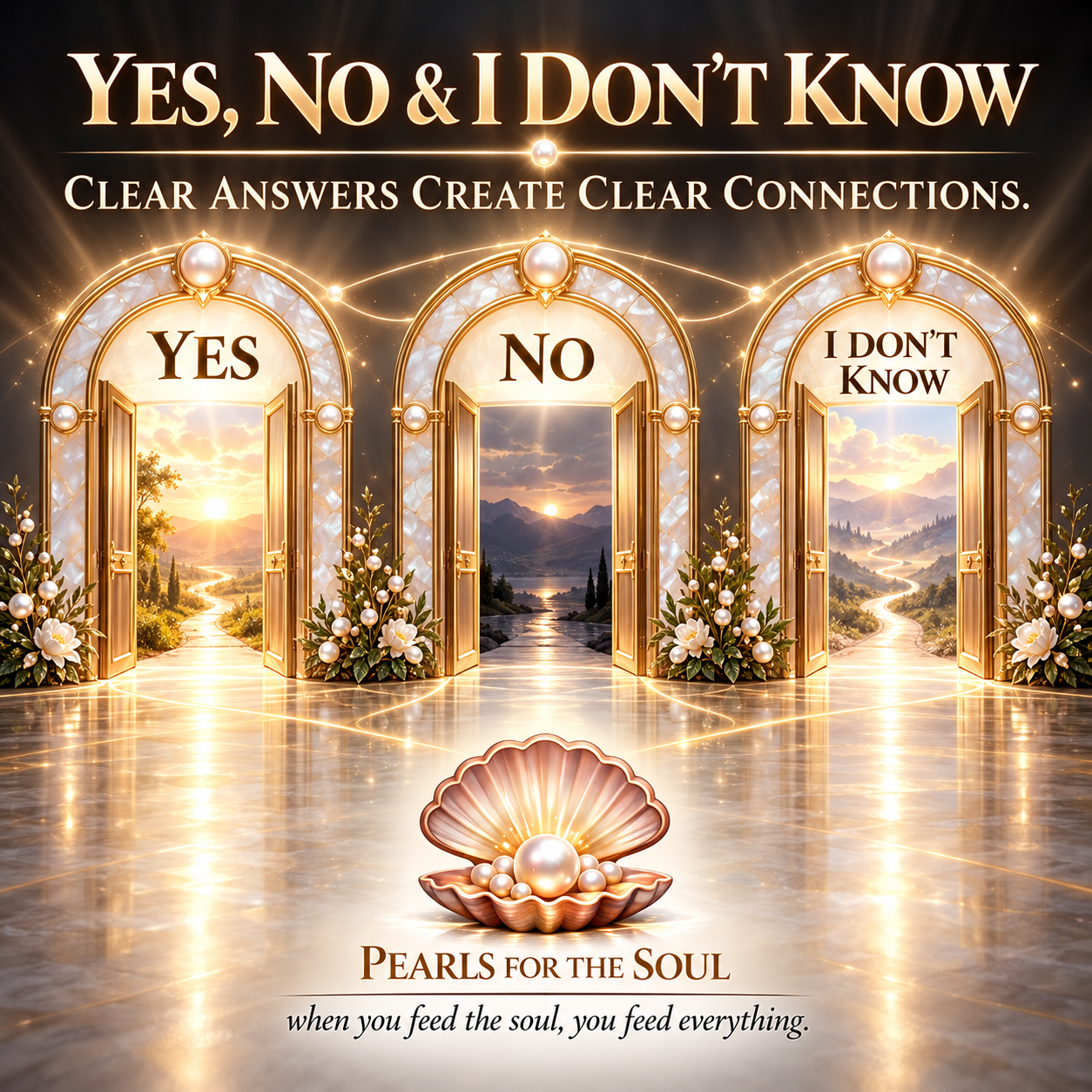
Sometimes the clearest, kindest and most respectful answer is simply:
YES.
NO.
I DON’T KNOW.
Why do we work so hard to make three honest answers so complicated?
How many times have you asked a yes-or-no question and did not get back a YES or a NO?
Too many, I believe.
If you have raised children, the number may be somewhere in the millions… LOL! To their credit, children can also deliver an “I don’t know” with remarkable confidence.
Adults are not always much better.
In business, relationships and everyday conversation, a clear yes or no can make communication easier. Even an honest “I don’t know” gives the other person something real to work with.
It may not be the strongest line on a résumé… LOL! But when it is honest, it invites another question, another thought and perhaps a meaningful conversation.
ANSWER THE QUESTION
Why do some people treat a yes-or-no question as an invitation to tell an entire story?
To begin an argument?
To make an excuse?
To answer with another question without answering the first one?
Sometimes we are buying time. Sometimes we are avoiding responsibility. Sometimes we are afraid the truth will disappoint someone.
Whatever the reason, the original question is still waiting for an answer.

NOTEWORTHY
In a courtroom, a witness may be directed to give a responsive yes-or-no answer when the question permits one. If neither answer would be truthful or complete, the witness must be allowed to explain.
The important word is truthful.
NOTEWORTHY
Matthew 5:37 reminds us:
“Let your ‘Yes’ be ‘Yes,’ and your ‘No,’ ‘No.’”
There is power in words that mean what they say.
NOTEWORTHY
When someone asks for a straight answer, begin with one:
Yes.
No.
I don’t know.
If more explanation is needed, it can follow. Starting with clarity helps everyone know where the conversation stands.
IF K.I.S.S. IS APPLIED… SMOOCHING IS RETURNED
Keep It Simple—“Stupid” is optional.
There are other honest and useful responses:
- “Would you please repeat the question?”
- “I don’t know.”
- “I’d rather not answer.”
- “I don’t recall.”
Each can be completely respectable when it is sincere and not used as a stall, dodge or dismissal.
THE POWER OF YES, NO & I DON’T KNOW
When somebody gives you a clear answer, do you feel relieved?
Respected?
Connected?
Perhaps even surprised?
A direct answer completes the human communication cycle: one person sends, the other receives, and both know something was exchanged.
When that cycle remains incomplete, confusion can enter quickly.
PEOPLE READ THE ENTIRE YOU
People do not hear only the words coming from your lips. They notice your voice, expression, timing, posture and intention.
They often know whether you mean your answer.
Keeping it real is neither a myth nor an option when trust is involved.
This is where respect enters—or where resentment starts looking for a way in.
Watch it!
CONSIDER THIS PLEASE
For the next week, when someone asks you a yes-or-no question, begin by answering:
Yes.
No.
I don’t know.
Can you do that?
If your answer is YES, we are done.
If your answer is NO, you might follow with, “Why do you ask?”
That can begin a worthwhile conversation.
If your answer is I DON’T KNOW, notice the humility that enters the room. An honest admission leaves space for learning.
Look at the power we possess.
LET’S SUM IT ALL UP
If someone wants to know more about your yes, your no or your “I don’t know,” that person can ask.
If you still have something important to add, try:
“Would you like to know more?”
Or:
“May I explain my answer?”
This orderly, respectful and direct way of speaking was once considered normal.
It was called civil discourse.
Love, when practiced properly, can accompany every part of it. Why?
Because love does much of the work.
FINAL THOUGHT
A direct answer does not have to be cold or rude. When delivered with honesty and respect, it may be one of the kindest things we can give another person.
PEARLS INSIGHT (SEO)
Clear communication begins with honest answers. Saying yes, no or “I don’t know” directly can strengthen trust, improve relationships, reduce misunderstandings and restore respectful civil discourse.
PEARLS FROM THE BOOKS
Second chances often begin when we stop defending, delaying and disguising—and finally give ourselves and others an honest answer.
That spirit of truth, reflection and renewal also lives within Epilogue of Ebenezer Scrooge: A Second Chance.
PEARLS CONNECTION
Think about one conversation in your life that remains unsettled.
Is there a yes, a no or an “I don’t know” that still needs to be spoken?
PAUSE FOR CAUSE before answering. Let honesty choose the words, and let kindness choose their delivery.
RICHIE SPEAKS
We spend a lot of time searching for the right words when three perfectly good answers have been waiting for us all along.
Yes.
No.
I don’t know.
Let’s bring them back.
FINAL SAY
When your words are clear, sincere and respectful, people do not have to guess where you stand.
Yes, no or I don’t know?
— Richie
Pearls for the Soul
when you feed the soul, you feed everything.
https://pearlsforthesoul.com

Been expecting you