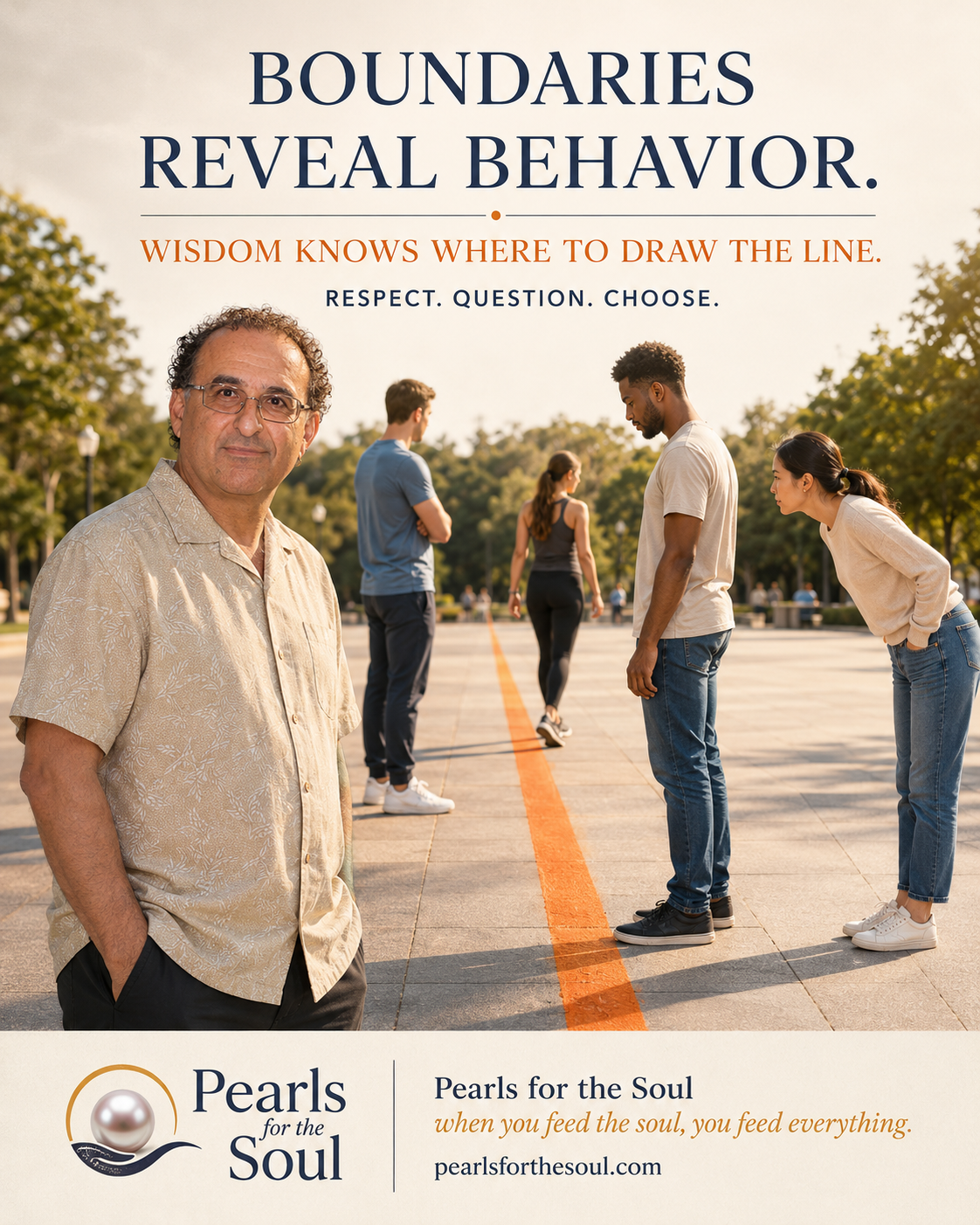
Draw a line on the ground.
Tell people:
DON’T CROSS IT.
Then watch what happens.
Some move away.
Some stand right on the edge.
Some cross it just to see what happens.
Boundaries do more than restrict behavior.
THEY REVEAL IT.

Boundaries fascinate me.
Physical boundaries.
Emotional boundaries.
Social boundaries.
Legal boundaries.
Personal boundaries.
Spiritual boundaries.
Even invisible boundaries.
They are everywhere.
And perhaps even more interesting than the boundaries themselves is how differently people respond to them.
THE ORANGE LINE
I once heard about an experiment involving children on a playground.
They were told they could go outside and play…
But they were not to cross a large orange line.
Then observers watched.
Some children immediately moved far away from the line.
Others played somewhere in the middle.
Some went directly toward it.
A few stood as close as possible.
Toes almost touching.
What does that tell us?
One simple boundary…
Many different responses.
WE ALL RESPOND DIFFERENTLY
The child who moves far away may be saying:
I WANT TO OBEY.
Or:
I DON’T WANT TROUBLE.
Or:
I LIKE CLEAR RULES.
Or perhaps:
I’M AFRAID OF WHAT HAPPENS IF I GET TOO CLOSE.
The child standing directly on the line might be thinking:
WHY CAN’T I CROSS?
HOW CLOSE CAN I GET?
WHAT HAPPENS IF I DO?
WHO MADE THIS RULE?
That child may be rebellious.
Or curious.
Or independent.
Or testing authority.
The behavior alone does not tell us everything.
Sometimes you have to ask:
WHY?
BOUNDARIES REVEAL SOMETHING
That is one of the useful things about boundaries.
They reveal tendencies.
Do you respect limits?
Ignore them?
Test them?
Need them?
Fear them?
Negotiate them?
Challenge them?
Different situations may bring out different responses.
And that is why self-awareness matters.
BOUNDARIES… PRO AND CON
Boundaries can create:
Order.
Safety.
Predictability.
Trust.
Fairness.
Privacy.
Responsibility.
But not every boundary is automatically wise simply because somebody created it.
There have been bad laws.
Unfair rules.
Unhealthy family boundaries.
Controlling relationships.
Policies that needed to change.
So maturity does not mean:
OBEY EVERY LINE.
It means understanding why the line exists.
Then deciding whether it deserves respect, negotiation, or responsible challenge.
MY SPACE
Personal space is one of the most obvious invisible boundaries.
We all carry a small zone around ourselves.
Step too close to a stranger and you can usually see the reaction.
They move.
Lean back.
Turn.
Create distance.
No sign says:
DO NOT CROSS.
But the boundary is real.
Yet when somebody is invited into that same space…
Everything changes.
A handshake.
A hug.
A kiss.
An embrace.
Closeness becomes welcome.
Interesting.
The distance did not change.
CONSENT DID.
RELATIONSHIP BOUNDARIES
Relationships need boundaries too.
Friends.
Spouses.
Parents.
Children.
Coworkers.
Business partners.
Without boundaries, expectations become muddy.
What is private?
What is acceptable?
What is disrespectful?
What requires permission?
What belongs to me?
What belongs to you?
What belongs to us?
Healthy relationships eventually answer those questions.
Sometimes directly.
Sometimes through experience.
PRIVACY IS A BOUNDARY
Children eventually want privacy.
Close the door.
Don’t read my messages.
Don’t come into my room without knocking.
Parents want boundaries too.
Respect the house.
Tell me where you are going.
Come home when agreed.
Different rights.
Different responsibilities.
Boundary negotiation begins early.
SPORTS MAKE BOUNDARIES OBVIOUS
Sports could not exist without boundaries.
Lines.
Courts.
Fields.
Zones.
Rules.
Cross the line and something happens.
OUT.
FOUL.
OFFSIDE.
PENALTY.
GAME OVER.
The boundary creates the game.
Remove every line and suddenly nobody knows what counts.
Boundaries do not merely limit play.
They make meaningful play possible.
LIMITS CAN CREATE FREEDOM
That sounds contradictory.
But think about it.
A road with lanes lets thousands of drivers move more freely because everyone understands where they belong.
A basketball court creates organized competition because everybody understands the playing area.
A contract creates business freedom because responsibilities are defined.
Sometimes structure creates more freedom than chaos.
NATURE HAS BOUNDARIES TOO
Nature sets boundaries whether we like them or not.
Climb high enough and the air changes.
Go without water long enough and the body protests.
Approach wild animals carelessly and they may respond.
Walk into extreme heat or cold and consequences arrive.
Gravity remains unimpressed by opinion.
Nature does not negotiate everything.
It has conditions.
Respect them…
Or learn from them.
WATER HAS ITS OWN RULES
Water seeks its own level.
Weather follows forces larger than our personal schedules.
The ocean has tides.
Seasons turn.
Nature demonstrates that boundaries are not always commands issued by people.
Sometimes they are simply properties of reality.
OUR HERITAGE OF BOUNDARIES
Human history is full of boundaries.
Property lines.
City limits.
County lines.
State lines.
National borders.
Airspace.
Maritime zones.
Contracts.
Laws.
Religious commandments.
House rules.
Every organized society develops them.
Why?
Because when many people share space, somebody eventually has to answer:
WHERE DOES ONE PERSON’S FREEDOM END AND ANOTHER’S BEGIN?
That is a boundary question.
BIBLICAL BOUNDARIES
The Bible itself contains powerful boundary imagery.
The Garden of Eden includes a prohibition.
The Ten Commandments establish moral boundaries.
Do this.
Do not do that.
Honor.
Do not steal.
Do not murder.
Do not bear false witness.
Whether viewed spiritually, morally, or historically, the structure is unmistakable:
FREEDOM EXISTS WITH LIMITS.
COUNTRIES HAVE BOUNDARIES
Nations take boundaries seriously.
Land borders.
Airspace.
Territorial waters.
Cross certain lines without permission and consequences may follow.
Why?
Because sovereignty depends partly on defining where authority begins and ends.
Again:
The boundary creates order.
PEOPLE TEST BOUNDARIES
Children test them.
Employees test them.
Customers test them.
Teenagers test them.
Countries test them.
Spouses test them.
We all test them sometimes.
How late can I be?
How much can I get away with?
How far can I push?
Will anybody say anything?
That is human behavior.
But repeated boundary testing eventually teaches people something about you.
TRUST NEEDS PREDICTABILITY
If somebody continually violates boundaries, they become difficult to trust.
Why?
Because you cannot predict what they will respect.
Promises?
Privacy?
Property?
Time?
Personal space?
Rules?
A person who respects reasonable boundaries becomes easier to rely upon.
Not because they are obedient robots.
Because their behavior has structure.
INTOXICATION CAN WEAKEN BOUNDARIES
Alcohol and drugs can impair judgment and reduce inhibition.
That matters.
A person may say things they normally would not say.
Take risks they normally would not take.
Ignore limits they would ordinarily respect.
That is one reason altered judgment deserves caution.
Good boundaries require awareness.
SOMETIMES YOU NEED TO SAY NO
Boundaries are not only lines other people create.
You need your own.
No.
I will not accept that.
No.
You cannot speak to me that way.
No.
That is private.
No.
I do not lend money under those conditions.
No.
I need time.
No.
That is not my responsibility.
A healthy NO can protect a healthy YES.
YOU ALSO NEED TO HEAR NO
There is another side.
People who establish boundaries need respect too.
If someone says:
NO.
STOP.
I’M NOT COMFORTABLE WITH THAT.
PLEASE DON’T.
That information matters.
You do not need to agree with every preference.
But another person’s legitimate boundary deserves consideration.
BOUNDARIES SHOULD BE CLEAR
A hidden boundary creates confusion.
You never told me.
I didn’t know.
I thought it was okay.
Then anger erupts because somebody crossed a line they could not see.
Whenever possible:
SAY IT.
Clarify.
Explain.
Do not expect people to read invisible signs you never posted.
FLEXIBILITY MATTERS TOO
Some boundaries are firm.
Safety.
Consent.
Violence.
Theft.
Certain legal or ethical standards.
Others need flexibility.
Schedules.
Preferences.
Traditions.
Family customs.
Good judgment knows the difference.
Too few boundaries creates chaos.
Too many creates confinement.
The art lies somewhere in between.
FINAL THOUGHT
Boundaries are fascinating because they reveal both the person who creates them…
And the person who encounters them.
Some protect.
Some organize.
Some clarify.
Some deserve challenge.
But whether you obey, test, negotiate, or cross one…
KNOW WHY.
Respect good boundaries.
Create healthy ones.
Question bad ones intelligently.
And understand something very important:
A life without boundaries becomes chaos.
A life with nothing BUT boundaries becomes a prison.
Wisdom knows where to draw the line.
PEARLS INSIGHT
Healthy boundaries establish expectations around safety, privacy, responsibility, consent, and behavior. Effective boundaries are clear, proportionate, and appropriate to the situation. Mature judgment involves respecting reasonable limits while also recognizing that some boundaries may require negotiation, revision, or responsible challenge. Too little structure creates unpredictability; too much structure can become controlling.
PEARLS FROM THE BOOKS
A recurring principle throughout Pearls for the Soul is:
KNOW WHERE YOU STAND.
Boundaries help define that.
Where does my responsibility begin?
Where does yours end?
What do I permit?
What do I refuse?
What belongs to us?
Clarity protects relationships.
PEARLS CONNECTION
This Pearl connects directly with:
RULE PLAYER OR RULE SLAYER… HOW DO YOU PLAY?
and
WHY WE NEED ETHICS, MORALS AND RIGHTEOUSNESS
Rules define shared limits.
Ethics define internal limits.
Boundaries define where one person, responsibility, freedom, or behavior meets another.
Together they create order.
RICHIE SPEAKS
Draw a line.
Then watch people.
Some run away from it.
Some stand right on it.
Some cross it just because somebody said:
DON’T.
Fascinating.
But don’t make the mistake of thinking every boundary is bad…
Or every boundary is sacred.
Ask:
WHY IS THIS LINE HERE?
Does it protect?
Organize?
Clarify?
Control?
Then use judgment.
Respect the good lines.
Challenge the bad ones properly.
And remember:
WISDOM KNOWS WHERE TO DRAW THE LINE.
— Richie
Pearls for the Soul
when you feed the soul, you feed everything.
pearlsforthesoul.com

Been expecting you