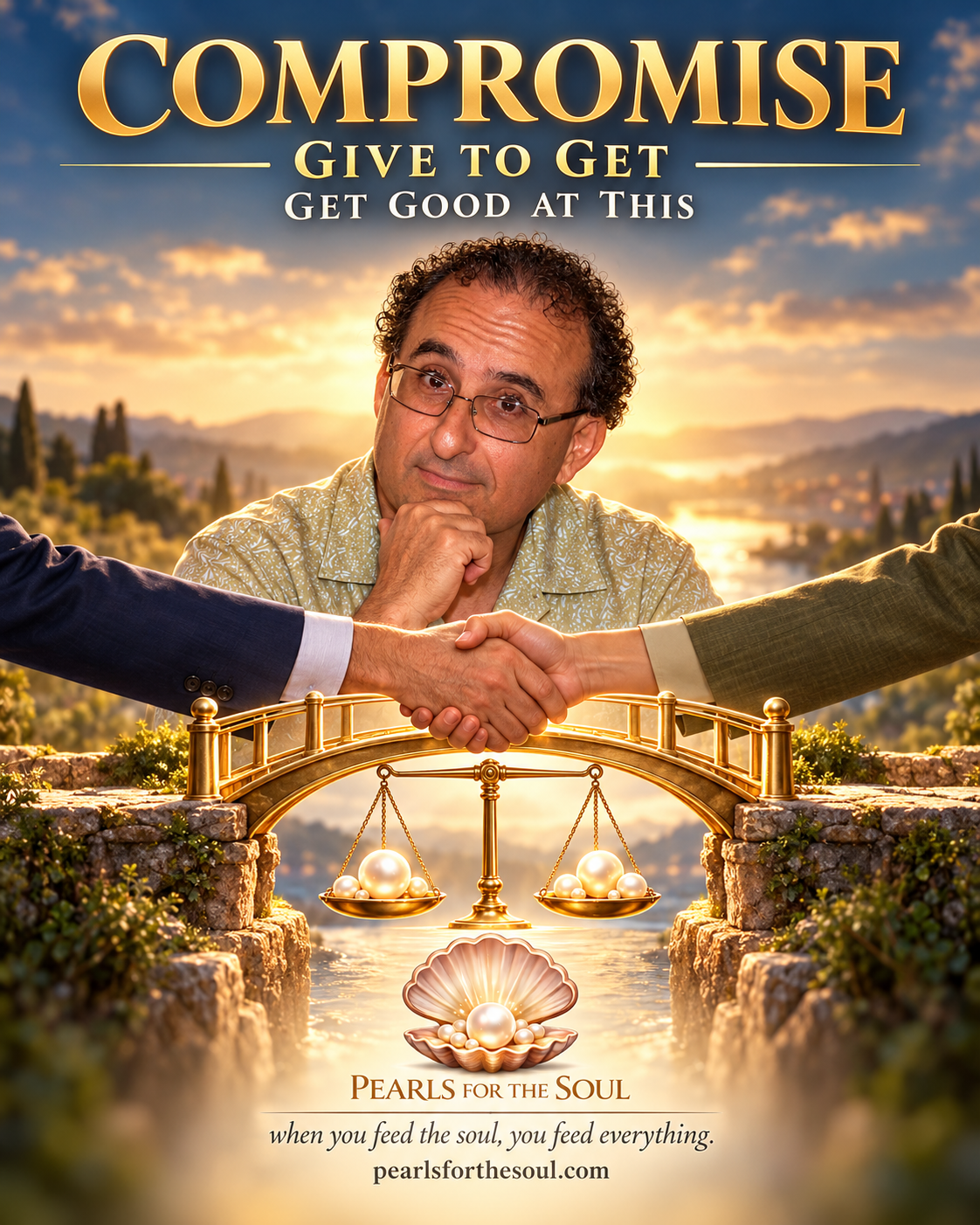
Compromise is not about deciding who loses.
It is about discovering what each person can give so that both have something worth receiving.
Who wants to give in?
Who wants to go first?
At some point, somebody has to move.
We have complicated compromise and turned it into a win-or-lose game. Selfish strategy enters the room, and suddenly every concession feels like defeat.
But compromise will be with us for our entire lives.
Marriage.
Family.
Business.
Employment.
Friendship.
Buying.
Selling.
Giving.
Receiving.
We cannot avoid it, so we may as well GET GOOD AT IT.

IT WOULD BE NICE
Two people may sincerely believe their way is the best way.
There is just one problem:
EVERYBODY believes their way is the best way.
That makes complete inflexibility impossible if we expect to reach a solution.
Give-and-take must enter the conversation.
Before negotiating, ask yourself what is genuinely important. Form a list beginning with your MUST HAVES and ending with:
“It would be nice if I could also get this.”
Those two categories are not the same.
A MUST HAVE protects something essential.
An “it would be nice” protects a preference.
If you treat every preference like a necessity, you leave no room for another person’s needs.
Watch greed.
Watch selfishness.
Watch the ego quietly changing every small desire into a life-or-death requirement.
KNOW YOUR LIST
Try arranging your needs into three groups:
1. MUST HAVE
The things required for safety, fairness, responsibility or the agreement to work.
2. WILLING TO EXCHANGE
The things you value but may trade to obtain something more important.
3. NICE TO HAVE
The extras you would enjoy but can live without.
A person who does not understand their own list cannot negotiate wisely.
They either give away too much—or demand everything.
Neither produces healthy compromise.
TAKE YOURS AND GO HOME
Be prepared to exchange something on your list for something on the other person’s list.
Anyone playing “my way or the highway” is not ready to compromise.
They are stuck.
They cannot move forward because they have removed every road except their own.
“He who has the gold makes the rules” has no place in a fair system. A person may possess money, power or leverage and still leave spiritually poorer for the way they used it.
Need and want respect no one.
The other person has needs too.
WORTHY NOTE: Poverty of spirit is no myth.
Gain everything and lose your soul?
WOE.
CONCESSIONS
It is okay to GIVE in order to GET.
Be honest about it.
During a job interview, the employer expects certain needs to be met. In return, the employer must meet acceptable terms for the employee.
If neither side can agree, the process goes no farther.
But when both parties negotiate and make reasonable concessions, common ground may appear.
Concession does not automatically mean weakness.
It may demonstrate confidence, realism and respect.
You are saying:
“This matters greatly to me.”
“That matters greatly to you.”
“Let us see what can be exchanged without damaging either one of us.”
Now we are negotiating.
SPLIT THE BABY
“Splitting the baby” is an expression—not an instruction. LOL.
It means finding a fair middle ground when both sides are competing for an outcome.
Knowing when and how to divide the difference can lead to success. It sends a healthy signal of fairness, fair play and WIN-WIN.
If you enjoy winning—if you appreciate the feeling and rewards that come with it—remember something important:
SO DOES THE OTHER GUY!
A settlement that humiliates the other person may end the immediate argument but create the next one.
A strong compromise gives both parties a reason to honor the agreement afterward.
MARRIAGE—OH BABY
Marriage disagreements can be especially difficult because the emotional stakes distort reality.
Love—as sacrifice—must be up and moving around.
One person may need to remain cool while both search for “peace in the valley.”
Give-and-take cannot be phony.
You may believe you got away with something, but in marriage, buried resentment has a way of digging itself back up.
Not a good day when it does.
The objective is not to defeat your spouse.
You still have to live with the person you just “beat.”
MOST WORTHY NOTE:
If you refuse to argue honestly, listen carefully or compromise fairly, marriage may be a very difficult place for you.
Two people cannot build an US while one person insists on winning every decision.
I KNOW WHAT YOU WANT—BECAUSE I WANT IT TOO
We are all searching for the HAPPY PLACE where everybody agrees they received something fair.
The traditional outcome is:
I win—and you win.
Greed and vanity distort that goal because people do not merely want to win. They want to win BIG, win completely and receive the maximum.
We forget that the other person attended the same human school we did.
They want value.
They want respect.
They want security.
They want to feel heard.
They want to walk away believing the agreement was worth making.
Amazing how quickly we forget that while demanding those very things for ourselves.
INCLUDE THEIR LIST
When creating your MUST HAVES, leave room for THEIR list.
Ask:
What is essential to them?
What are they afraid of losing?
What would make this agreement feel fair?
Where can I move without violating what matters most?
What could they offer that I value more than what I surrender?
Compromise improves when curiosity replaces assumption.
You may believe you know what the other person wants.
ASK ANYWAY.
Their answer may surprise you.
DARK COMPROMISE TACTICS
Almost everything in life is negotiable.
Everything except your PRINCIPLES.
Do not compromise honesty.
Do not bargain away your integrity.
Do not trade righteousness for an immediate advantage.
There is enough opportunity for everyone, but temptation offers a shortcut:
Lie.
Cheat.
Steal.
Manipulate.
Hide information.
Pressure the vulnerable person.
If you use those methods, you may win the transaction while losing something far more valuable.
You win—but LOSE.
That is not compromise.
That is corruption wearing negotiation clothes.
WINNING AT ANY COST?
Could you comfortably live with the idea of winning at any cost?
Could you lie, keep lying and face yourself and others every day?
That is a haunting concept to me.
Winning at any cost resembles making a deal with the devil—and those deals never go well.
The reward arrives carrying guilt.
The gain carries a stain.
The victory leaves a blemish on the soul.
Only God can help you there.
A good deal should allow you to sleep afterward.
If your conscience remains awake all night, the price was too high.
WHEN NOT TO COMPROMISE
Healthy compromise does not require accepting:
Abuse.
Deception.
Exploitation.
Danger.
Repeated betrayal.
The abandonment of your deepest principles.
There are situations where walking away is not stubbornness. It is wisdom.
The goal is common ground—but there must actually be ground safe enough for both people to stand on.
Do not confuse peace with surrendering your dignity.
Do not confuse flexibility with having no boundaries.
WHAT GOES AROUND
When seeking the promised land—the place where happiness and fairness reside—include the other person’s list beside your own.
Your MUST HAVES matter.
THEIRS do too.
This is how relationships survive decisions.
This is how business agreements become repeat business.
This is how conflict turns into cooperation.
Fairness offered today has a way of returning tomorrow.
A SIMPLE COMPROMISE CHECK
Before accepting an agreement, ask:
Were both sides heard?
Did both sides give something?
Did both sides receive something meaningful?
Were the facts presented honestly?
Were any principles violated?
Can both sides explain the agreement without embarrassment?
Can I sleep peacefully with the result?
If the answers are yes, you may have found common ground.
END RESULT?
Sleep deep.
Walk tall.
Be at peace.
You did not need to take everything.
You did not give away everything.
You exchanged fairly, protected your principles and left enough dignity for everyone to carry home.
That is a WIN-WIN.
FINAL THOUGHT
Compromise is not the art of losing half of what you wanted. It is the wisdom to recognize what matters most—and to make room for what matters to someone else.
PEARLS INSIGHT
Successful compromise combines clear priorities, honest communication, healthy boundaries and respect for the other person’s needs. It is strongest when both parties leave with value—and neither must sacrifice integrity to obtain it.
PEARLS FROM THE BOOKS
“I have been young, and now am old; yet have I not seen the righteous forsaken, nor his seed begging bread.”
— Psalm 37:25
PEARLS CONNECTION
Before your next disagreement, write two short lists:
What do I truly need?
What might the other person truly need?
Then circle the items that can coexist.
Common ground often appears when we stop staring only at our own side.
RICHIE SPEAKS
You do not have to surrender your principles to reach an agreement.
Bring your MUST HAVES.
Invite the other person to bring theirs.
Then build a bridge strong enough for both of you to cross.
FINAL SAY
Give to get.
Listen to be heard.
Respect to be respected.
And if you like winning, remember:
SO DOES THE OTHER GUY!
Get good at compromise.
You will be using it for the rest of your life.
— Richie
Pearls for the Soul
when you feed the soul, you feed everything.
https://pearlsforthesoul.com

Been expecting you