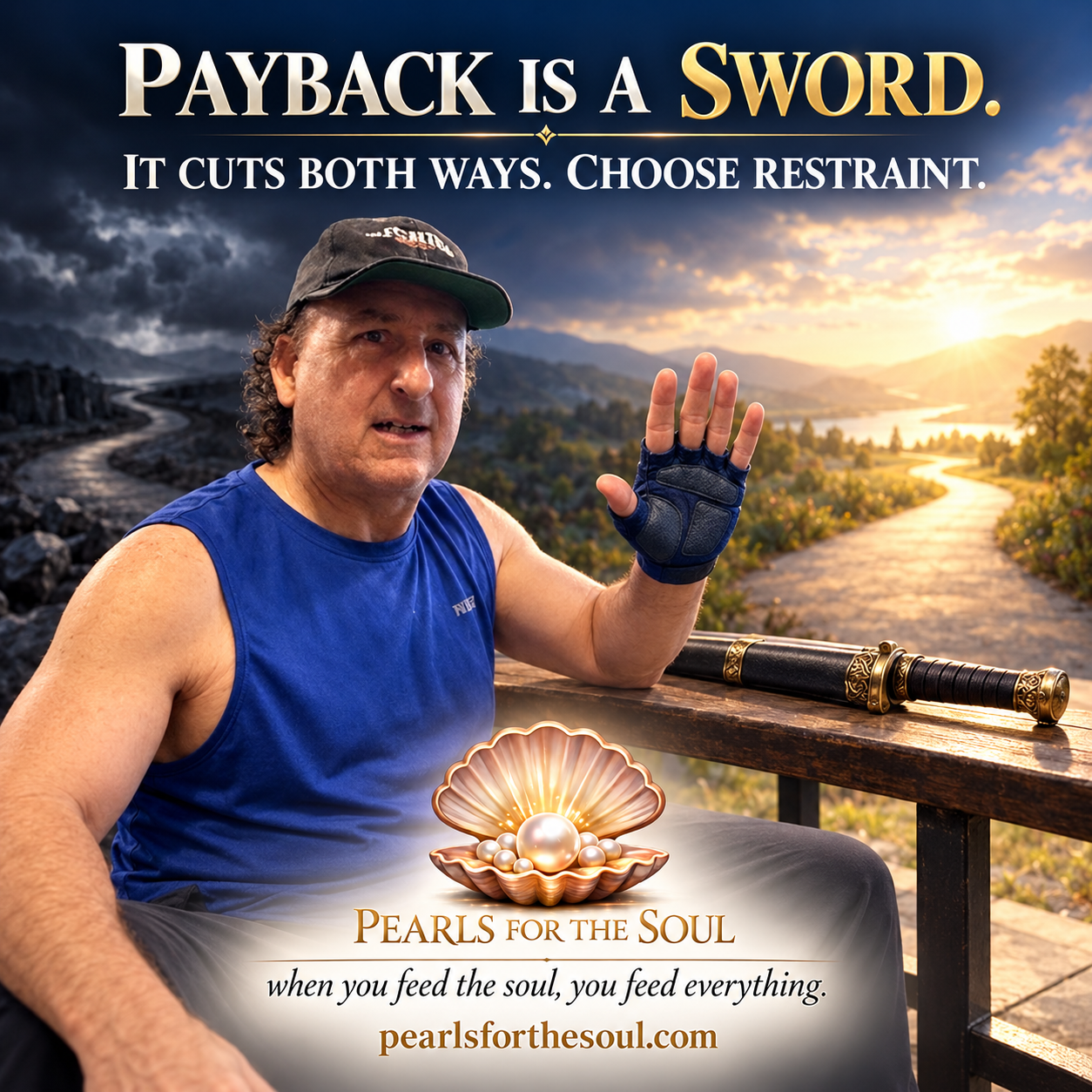
Revenge promises to place the sword in your hand.
What it does not tell you is that the blade has two edges—and one may be pointed back at your own life.
YES, YOU GET A TURN TO TAKE REVENGE HOWEVER,
SO DOES THE OTHER PERSON. WHERE DOES IT ALL END?
It takes more strength to maintain discipline and composure in an unpleasant situation than to lose control and make everything worse.
The pull to retaliate can be powerful.
Human nature says:
“You hurt me. Now I will hurt you.”
That reaction may produce an immediate sense of power, but it rarely delivers the best result.
It may also place you in conflict with your conscience, the law, your future, and the person you were trying to protect.
MANY DIFFERENT DYNAMICS ARE AT WORK
Let us be clear.
There are situations in which you must protect yourself or another person from immediate harm.
That is not what I am calling revenge.
Immediate safety and payback after the fact are different matters.
When danger is present, seek safety and contact emergency services when possible. Use only the level of response that is lawful and necessary under the circumstances.
Self-defense laws vary by location and situation. This post is a principle about restraint—not legal advice.
Another test may occur when the person who harmed you is later placed within your reach.
That is where anger may say:
“Now is your chance.”
Restraint says:
“Choose the appropriate measure, not the emotional one.”
That decision can change several lives.

THE LAW HAS ITS OWN RULES
The law does not operate entirely upon personal feelings about fairness.
It works through statutes, evidence, procedures, witnesses, definitions, and standards that may differ from what you assumed.
You may believe you were completely right in the moment.
The legal system may examine the same moment differently.
That is why restraint matters.
Preserve evidence.
Document what happened.
Contact the proper authorities.
Seek qualified legal advice when necessary.
Do not assume that being morally offended automatically protects every response you might make.
The law can be cold and technical.
Watch it.
A SERIOUS INCIDENT PRESENTED ITSELF
A close friend once called me when he had been pushed near the limit of his endurance.
His child had been physically mistreated by the boyfriend of his former wife.
First, my friend had enough sense to call before reacting.
Bravo.
That telephone call created distance between anger and action.
Second, he remained open to reason, guidance, and the search for the best available solution.
That mattered.
When harm involves someone you love—especially your child—objectivity becomes difficult.
Pain moves close.
Anger demands immediate release.
But he paused.
He asked for help.
He allowed another voice into the moment.
WORTHY NOTE: Objectivity is valuable under ordinary conditions. When it is tested and still maintained, it becomes even more valuable.
RESTRAINT CHANGED THE OUTCOME
My friend reported the incident rather than taking revenge.
The police responded and addressed the adult who had gone too far.
My friend’s restraint helped keep attention on the original conduct instead of shifting it toward something he might have done in anger.
The incident was documented.
A warning was delivered.
Most importantly, the child was all right.
The message was clearly sent and received:
This behavior was unacceptable and would not be ignored.
My friend protected his child without turning himself into the next person under investigation.
That is strength.
WORTHY NOTE: Authorities can examine your conduct as well as the conduct you reported. Restraint, documentation, witnesses, and prompt reporting may protect both the injured person and the person seeking justice.
PROTECTION IS NOT PAYBACK
Protection attempts to stop harm.
Payback attempts to recreate harm in the opposite direction.
Protection focuses on safety.
Payback focuses on emotional satisfaction.
Protection asks:
“What must be done now?”
Payback asks:
“How can I make them suffer later?”
One may be necessary.
The other can become a second wrong carrying your name.
STAY COOL, CALM, COLLECTED, AND FOCUSED
This is difficult.
I am not pretending otherwise.
When you have been insulted, betrayed, cheated, robbed, threatened, abused, or harmed, your mind and body may flood with reaction messages.
Act now.
Make them pay.
Teach them a lesson.
Do not allow yourself to be disrespected.
Let those messages pass before they become commands.
Pause.
Breathe.
Create distance.
Call someone trustworthy.
Write down what happened.
Protect the vulnerable.
Contact the proper authority.
Then decide from a clearer place.
WORTHY NOTE: I used to visit courts often. I noticed something very simple:
There was not a person in there who wanted to be there.
Remember that before anger purchases you a seat.
“VENGEANCE IS MINE”
For years, I wondered about the biblical words:
“Vengeance is Mine; I will repay.”
When something happens directly in front of us, we may feel that if we do not act, justice will disappear.
But the verse is not instructing us to ignore danger or refuse lawful action.
It warns us against appointing ourselves the final judge, jury, and executioner.
Human judgment is influenced by pain, pride, limited knowledge, and emotion.
God’s judgment, within the faith expressed here, sees what ours cannot.
That is where the situation becomes less about weakness and more about surrendering a role we were never equipped to perform perfectly.
PAYBACK
Payback is an after-the-fact dynamic.
It plans revenge according to personal justice and gives little attention to consequences, proportion, law, conscience, or collateral damage.
It says:
“I will decide what you deserve.”
But wounded people rarely measure punishment accurately.
Pain adds weight to the scale.
Humiliation adds more.
Pride adds still more.
Soon, the punishment becomes greater than the offense—and another cycle begins.
PAUSE FOR CAUSE
Forgiveness does not mean pretending nothing happened.
It does not require immediate trust.
It does not remove healthy boundaries.
It does not prevent reporting a crime, seeking restitution, protecting a child, ending a relationship, or pursuing lawful accountability.
Forgiveness means refusing to let revenge keep controlling your inner life.
Justice and revenge are not identical.
Boundaries and hatred are not identical.
Restraint and weakness are not identical.
Know the difference.
PEARLS INSIGHT
The moment you retaliate recklessly, the original offender may no longer be the only person answering for wrongdoing.
That is how the sword cuts both ways.
RICHIE SPEAKS
If you have been burned, hurt, harmed, cheated, robbed, or abused, your thoughts, emotions, and senses may be bombarded by reaction messages.
Let them pass—for your sake.
Do what protects.
Do what documents.
Do what brings lawful accountability.
But do not hand your future to the same event that already injured your past.
FINAL SAY
Real strength is not proven by how quickly you can strike back.
It is proven by whether you can remain cool, calm, collected, and focused while choosing the response that protects what matters.
Leave the sword sheathed.
Use truth.
Use boundaries.
Use lawful action.
Use faith.
Payback cuts both ways.
Remember.
— Richie
Pearls for the Soul
when you feed the soul, you feed everything.
https://pearlsforthesoul.com

Been expecting you