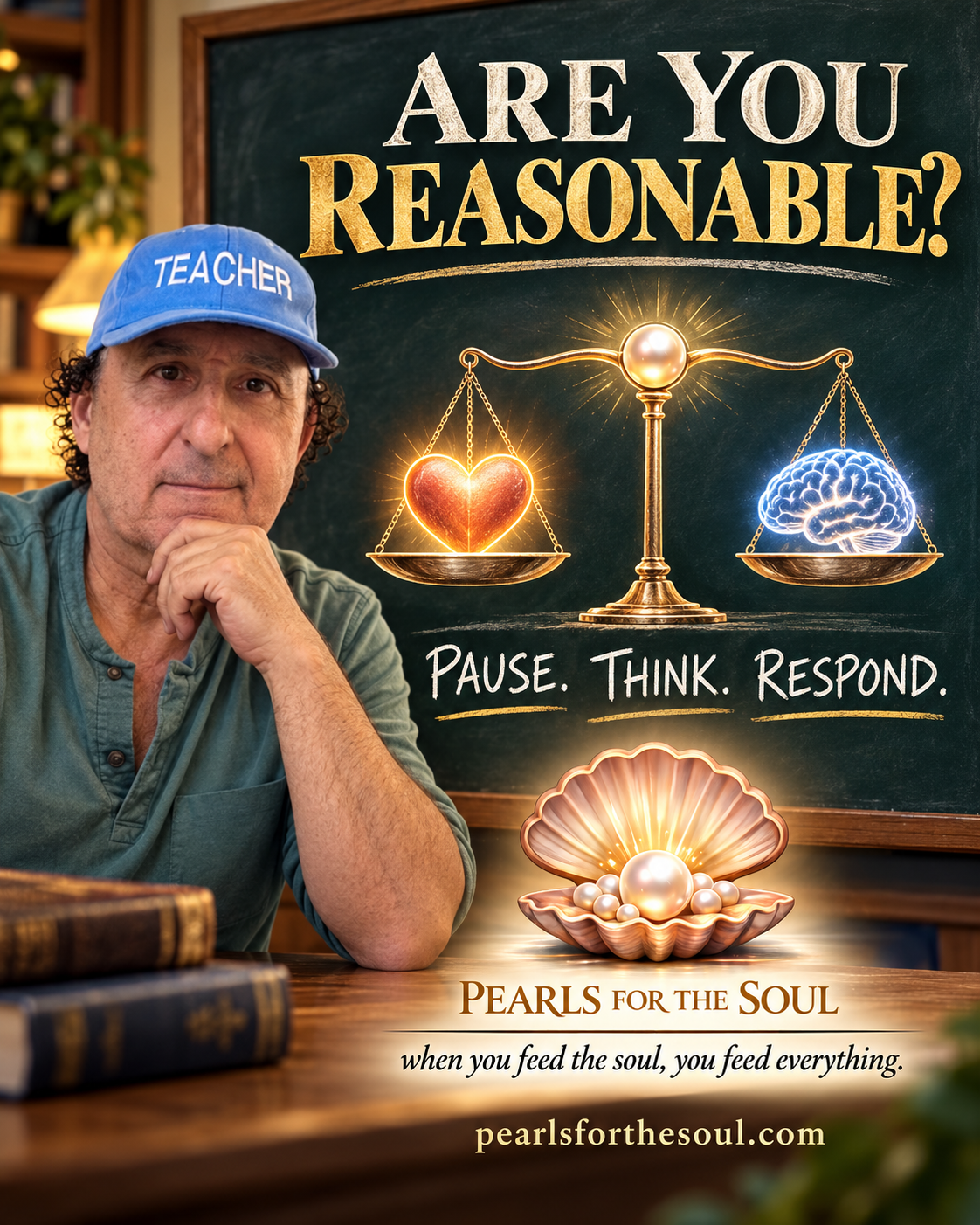
Reason is not silence.
It is the active work of fairness, sound judgment, and a response that improves the outcome.
Of course you are reasonable!
At least, you already possess the ability.
You may not use it well. You may not recognize its power or understand its benefits. You may even believe you are reasoning when you are actually defending what you already decided.
Reason is similar to its cousin, responsibility.
Responsibility is the ability to respond.
Reasonable means having the ability to reason.
Both abilities are built into us, but they must be used.
We must respond.
We must reason.
Otherwise, what good are these gifts?
Reason exists for a reason.
OH, THAT!

Are you reasonable?
PAUSE FOR CAUSE before answering.
A reasonable person practices sound judgment and tries to be fair and sensible.
Close cousins include being logical, rational, and willing to consider facts beyond personal preference.
A reasonable person’s behavior is governed by sound thinking and beliefs that are not excessive or extreme.
Let me tell you something:
You will recognize what is NOT reasonable when you encounter it.
Guaranteed!
Unreasonableness works against life, relationships, cooperation, and worthwhile results.
It resides within a person before it damages the people around that person.
REASON TO BELIEVE
Reasoning something through benefits everyone involved.
It promotes well-being.
It encourages fair play.
It gives meaning and depth to what is taking place.
WHY?
Because people and their outcomes matter.
Many believe they are reasonable simply because they do not argue.
That is not necessarily true.
Remaining silent can be wise, but reason itself is active.
Reason examines.
Reason listens.
Reason asks questions.
Reason compares claims with facts.
Reason may even require you to take a stand—provided the stand is reasonable rather than stubborn.
I KNOW IT WHEN I SEE IT
The ability to reason and bring that ability into an actual situation requires effort.
For now, let us concentrate on the individual.
To become known as a person of reason, you must practice reason consistently.
It can be detected when present.
Its absence can be detected too.
Does the person listen?
Can the person reconsider?
Will the person admit an error?
Can facts enter the discussion without being thrown back out the window?
Does everyone receive a fair opportunity to speak?
There are the clues.
EXAMPLES OF A LACK OF REASON
Someone who charges an outrageous price merely because another person has no alternative may be taking advantage rather than reasoning fairly.
People who continually overreact, underreact, practice injustice, show indifference, or maintain a “devil may care” attitude may not approach the word reason—let alone use it.
Reason can be disrespected.
But it is usually disrespected to your own detriment.
When reason leaves, consequences often enter.
MY WAY OR THE HIGHWAY
“My way or the highway” is a deliberate stance that leaves little room for reason.
Several things may be operating:
Greed.
Selfishness.
Ignorance.
Pride.
Fear.
A lack of love or respect.
If the behavior is operating through you, it taints your judgment.
If it is operating through someone else, that person has developed a blind side.
You may still need boundaries.
You may still need to say no.
But a firm decision can remain reasonable when it is supported by truth, necessity, fairness, and responsible judgment.
REASON AT WORK
Reason appears when someone searches for honest middle ground.
It appears when a person protects the larger purpose instead of fighting over every petty detail.
It appears when someone releases what does not matter, admits what does matter, and gives another person’s interests a fair turn.
These are reasonable efforts.
The signals can be properly received only by another person willing to reason.
One reasonable person can open the door.
It usually takes two to walk through it.
UNREASONABLENESS—WOE!
A person committed to being unreasonable may be difficult to reach.
They may temporarily prevail because of another “golden rule”:
They have the gold, so they make the rules.
LOL—but only slightly.
Money, position, pressure, or authority may force a temporary outcome, but those things cannot manufacture depth, fairness, respect, or lasting trust.
Time eventually exposes dysfunction.
Purpose and unreasonableness remain at odds, much like order and chaos.
One builds something.
The other keeps knocking pieces loose.
EMOTIONS AND REASON
Strong emotions and clear reasoning do not always mix easily in the same moment.
Emotion can seize hold of a person for a legitimate reason.
Anger may signal injustice.
Fear may signal danger.
Grief may reveal love and loss.
These feelings matter.
But emotions should not hold every office in the government of YOU.
They can deliver their report.
Then reason, conscience, facts, faith, and wisdom must also receive a turn.
THINK:
Are you releasing pressure—or releasing destruction?
Are you reacting—or responding?
When the emotional storm settles, reality becomes easier to examine.
Reason can now enter the room without being shouted down.
WE ALL HAVE HAD A TURN
Now let us return to the question:
ARE YOU REASONABLE?
I will go first.
YES, I am reasonable.
I am very reasonable.
I also recognize that life comes in turns.
Sometimes it is my turn to receive and benefit.
Sometimes it is someone else’s turn.
Sometimes I am right.
Sometimes another person sees what I missed.
That is a perfect example of putting legs on reason.
COME, LET US REASON TOGETHER
If you are pushy, manipulative, deceptive, willful, coy, or quick to take advantage, do not look for the word REASON in your own mouth.
Those tactics may look clever, but they are not reasonable.
Reason is something we join.
It promotes humility.
It requires fairness.
It allows a greater will and purpose to go to work.
Reason does not ask:
“How can I defeat you?”
It asks:
“What is true?”
“What is fair?”
“What protects the people involved?”
“What outcome serves the greater good?”
FINAL THOUGHT
Being reasonable does not require surrendering your convictions.
It requires examining whether your convictions can stand beside truth, fairness, sound judgment, and the rights of other people.
A reasonable person can be strong.
A reasonable person can say no.
A reasonable person can establish a boundary.
The strength comes from knowing why.
PEARLS INSIGHT
Reason is the bridge between feeling something and doing something about it.
Before crossing, make sure the bridge leads somewhere worth going.
PEARLS FROM THE BOOKS
A continuing message throughout Pearls for the Soul is that awareness must become responsible action.
Wisdom listens to what the heart reports, examines what the mind understands, and then chooses what feeds life rather than damages it.
PEARLS CONNECTION
The Pearls formula asks us to pause, return to our center, examine what is operating within us, and choose the response that serves truth, purpose, and the soul.
Reason gives that pause somewhere productive to go.
RICHIE SPEAKS
If facts cannot enter your decision, reason probably left before the meeting started.
FINAL SAY
Give me reason.
Give me anyone willing to practice it.
I will show you a better conversation.
A better relationship.
A better decision.
A better outcome.
And—person by person—a better world.
Now ask yourself again:
ARE YOU REASONABLE?
More importantly:
Are you willing to reason?
— Richie
Pearls for the Soul
when you feed the soul, you feed everything.
https://pearlsforthesoul.com

Been expecting you