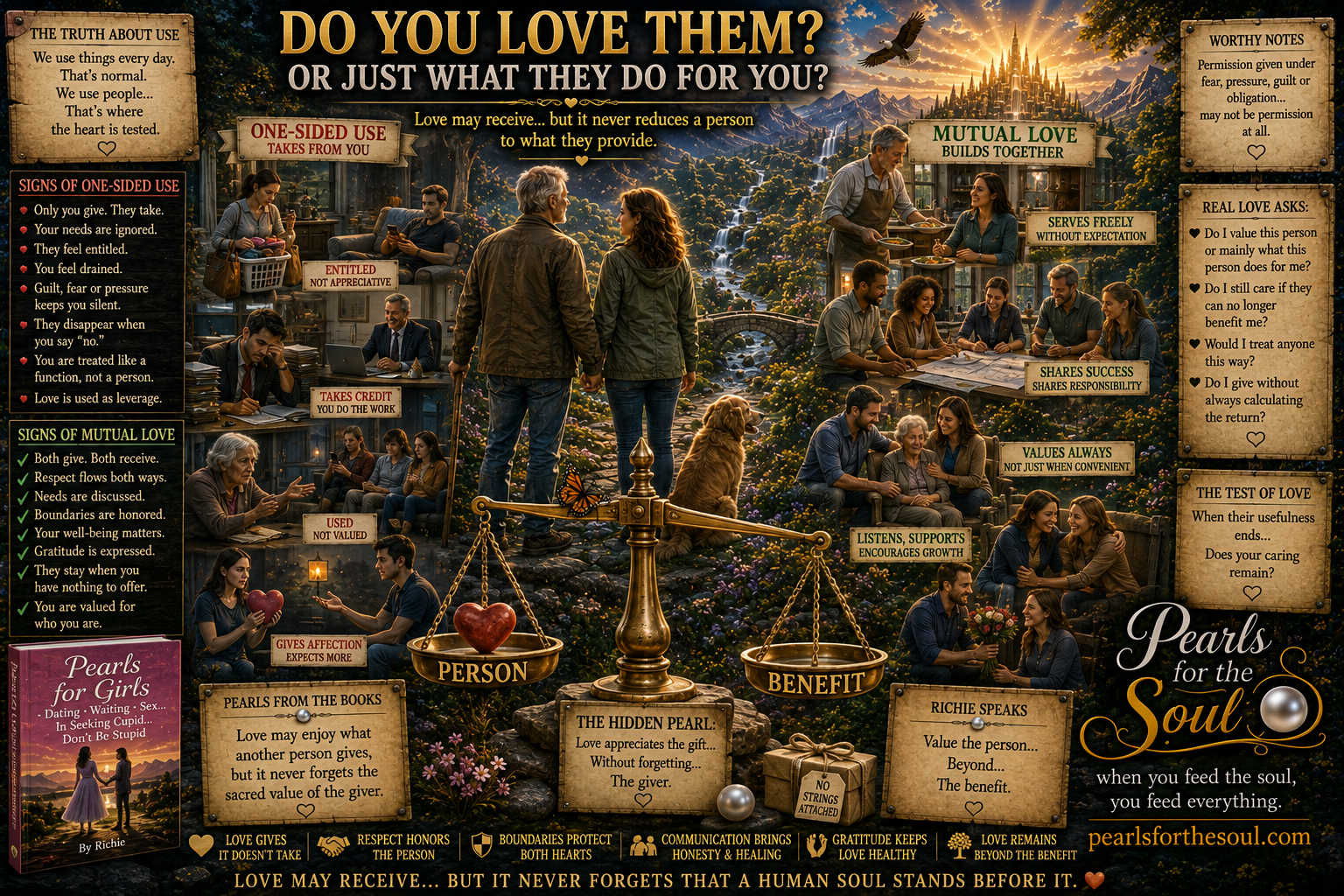
Love gives.
Use takes.
Yet most relationships contain…
A little of both.
The question is not whether we benefit from one another.
The question is…
Does the benefit eventually become more important…
Than the person?

CAN YOU LOVE SOMEONE…
AND USE THEM TOO?
This is a haunting question.
Can you love someone…
And use them too?
Do not answer too quickly.
The question is shaped like an arrow.
Once released honestly…
It travels directly toward the conscience.
Perhaps the answer will be uncomfortable.
Good.
Some discomfort does not arrive to punish us.
It arrives to change us.
THE WORD USE
We use things every day.
Tools.
Cars.
Phones.
Furniture.
Money.
Food.
Resources.
There is nothing unusual about that.
Things are often created for use.
People are not.
That is where the question changes.
USING PEOPLE
Human beings continually help one another.
Employers use the talents of employees.
Employees use employment to earn a living.
Customers use businesses.
Businesses depend upon customers.
Families divide responsibilities.
Friends exchange encouragement.
Spouses support one another.
Mutual benefit is not automatically exploitation.
Healthy relationships naturally include giving…
Receiving…
Depending…
And contributing.
The danger begins when the exchange becomes one-sided.
When one person keeps taking…
And the other person slowly disappears.
MUTUAL USE OR MUTUAL SERVICE?
Perhaps “use” is not always the best word.
A healthier phrase may be…
Mutual service.
I help you.
You help me.
We both know what is happening.
We both willingly participate.
We both receive value.
Neither person is secretly injured.
Neither is reduced to a function.
That can be fair.
Honorable.
Even loving.
But when the person becomes merely useful…
Love has already begun losing its place.
THE CENTRAL QUESTION
Can you love someone…
While using them?
Perhaps.
But another question must immediately follow.
Do I still care about their well-being…
When they can no longer benefit me?
That question exposes much.
If affection disappears when usefulness ends…
Was it love?
Or merely a favorable arrangement?
HUMAN COMPLEXITY
Human beings are not simple.
We are mental.
Emotional.
Physical.
Psychological.
Spiritual.
We carry memories.
Needs.
Fears.
Desires.
Expectations.
Wounds.
Strengths.
Weaknesses.
We are also continually changing.
The person before you today…
May not occupy the same inner place tomorrow.
That complexity deserves respect.
No person should be reduced to:
“What can you do for me?”
LOVE AND BENEFIT
Love often brings benefits.
Companionship.
Comfort.
Security.
Affection.
Encouragement.
Help.
Pleasure.
Support.
Shared responsibility.
There is nothing wrong with receiving those things.
The problem begins when we love only because those benefits continue.
Love appreciates the gift…
Without forgetting the giver.
SUBJECTIVITY
The line between mutual benefit and exploitation can be thin.
One person may believe an arrangement is fair.
The other may feel trapped.
One may think:
“They never complained.”
The other may be silently enduring.
That is why conscience matters.
So does conversation.
So does observation.
Ask:
“Is this still working for you?”
“Do you feel appreciated?”
“Am I asking too much?”
“Are we both being served by this relationship?”
Love does not fear those questions.
NOTE THIS
Someone who loves you may allow you to take advantage of them.
Not because they enjoy it.
Because they fear losing you.
Someone intimidated by you may remain silent.
That silence is not necessarily agreement.
Someone dependent upon you may say yes…
Because no feels unsafe.
A willing heart is different from a frightened surrender.
WORTHY NOTE
Permission given under fear, pressure, guilt, or emotional punishment…
May not be permission at all.
DO YOU NOTICE?
The person doing the using must ask:
Do I see what this is costing them?
Do I care?
Would I still ask…
If I had to pay the same emotional price?
Indifference is often where using quietly becomes abuse.
NON-HUMAN APPLICATIONS
We say we love nature.
Mountains.
Forests.
Lakes.
Oceans.
Wildlife.
Yet we also use them.
We camp.
Fish.
Build.
Harvest.
Travel.
Explore.
The question is not whether we use creation.
The question is how.
Responsible campers understand this.
Leave the campsite as you found it.
Perhaps even better.
Allow the next traveler to experience its beauty too.
Love does not merely consume.
Love protects what it enjoys.
INTERPERSONAL APPLICATION
The same principle applies to people.
If you enter another person’s life…
Do you leave them strengthened?
Or depleted?
Respected?
Or diminished?
Freer?
Or more dependent?
Seen?
Or merely useful?
Every meaningful interaction leaves something behind.
ONE-ON-ONE RELATIONSHIPS
Friendships.
Family relationships.
Business partnerships.
Courtship.
Marriage.
Each begins with expectations.
Some are spoken.
Others remain hidden.
Problems often arise when one person changes the arrangement…
Without telling the other.
What was once freely given…
May later become burdensome.
What was once acceptable…
May be withdrawn.
Love listens when the conditions change.
Entitlement does not.
YOUR SPOUSE
Marriage brings this question very close to home.
Do we begin believing that commitment gives us unlimited access…
To another person’s time…
Body…
Energy…
Attention…
Labor…
Forgiveness…
And emotional strength?
A spouse is not household equipment.
Not a paycheck.
Not a cook.
Not a servant.
Not a permanent source of affection on demand.
Not someone required to keep proving their worth.
Marriage creates responsibility toward another person.
It does not create ownership over them.
WHAT ARE THE FLOWERS FOR?
Flowers.
Candy.
Gifts.
Kind words.
A helpful gesture.
Beautiful things.
But sometimes generosity carries an unspoken invoice.
“I gave you this…
Now you owe me.”
That is not pure giving.
It is disguised negotiation.
There is nothing wrong with romance leading toward mutual affection.
But love also needs moments with no hidden motive.
No expected return.
No opportunity being purchased.
Just appreciation…
For appreciation’s sake.
LOVE FOR LOVE’S SAKE
Imagine saying:
“I brought this because I thought of you.”
“I helped because you looked tired.”
“I listened because your heart mattered.”
“I stayed because you should not face this alone.”
“I gave…
Without preparing a bill.”
That is love becoming cleaner.
Freer.
Safer.
THE TEST OF USEFULNESS
What happens when someone becomes less useful?
A spouse becomes ill.
A parent grows old.
An employee loses speed.
A friend enters hardship.
A child disappoints us.
A person can no longer give what they once gave.
Does our love remain?
That is where relationship reveals itself.
When usefulness decreases…
True love often becomes more visible.
WHEN USE BECOMES ABUSE
Use becomes abuse when another person’s dignity, safety, freedom, or well-being is repeatedly sacrificed for our gain.
Manipulation.
Threats.
Coercion.
Humiliation.
Financial control.
Emotional punishment.
Sexual pressure.
Exploitation.
These are not expressions of love.
The words “I love you” cannot purify harmful conduct.
Love must be measured by what it does…
Not merely by what it claims.
WORTHY NOTE
Love does not require another person to remain available for mistreatment.
Boundaries may be one of love’s most honest expressions.
ASK YOURSELF
Do I love this person…
Or mainly what they provide?
Do I listen when they say no?
Do I appreciate them apart from their usefulness?
Do I give without always calculating the return?
Do they become freer around me…
Or smaller?
Would I continue caring…
If the benefits changed?
Those answers may reveal more than our declarations ever will.
FINAL THOUGHT
Yes…
People can love one another…
And still use one another.
We are imperfect.
We sometimes become selfish.
We take without noticing.
We expect without appreciating.
But awareness gives us another opportunity.
Stop.
Look honestly.
Correct the imbalance.
Value the person…
Beyond the benefit.
Because love may receive…
But it never forgets…
That a human soul stands before it.
— Richie
Pearls for the Soul
when you feed the soul, you feed everything.

Been expecting you