Take a moment to consider what a child’s world is like.
Tax your memory if necessary. Visit a kindergarten or preschool and observe.
What do children know?
Their world is what has been presented to them—no more and no less.
Then peers begin speaking up, comparing, noticing, and acting differently.
That is when a child may discover that what felt normal at home does not look normal to everybody else.
Sometimes poverty hurts twice:
First when you experience what you do not have.
Then again when somebody makes you ashamed of it.

CHILDHOOD
Childhood is brief.
It does not last long, and it does not answer many important questions while you are living through it.
It simply presents a world and asks the child to accept it.
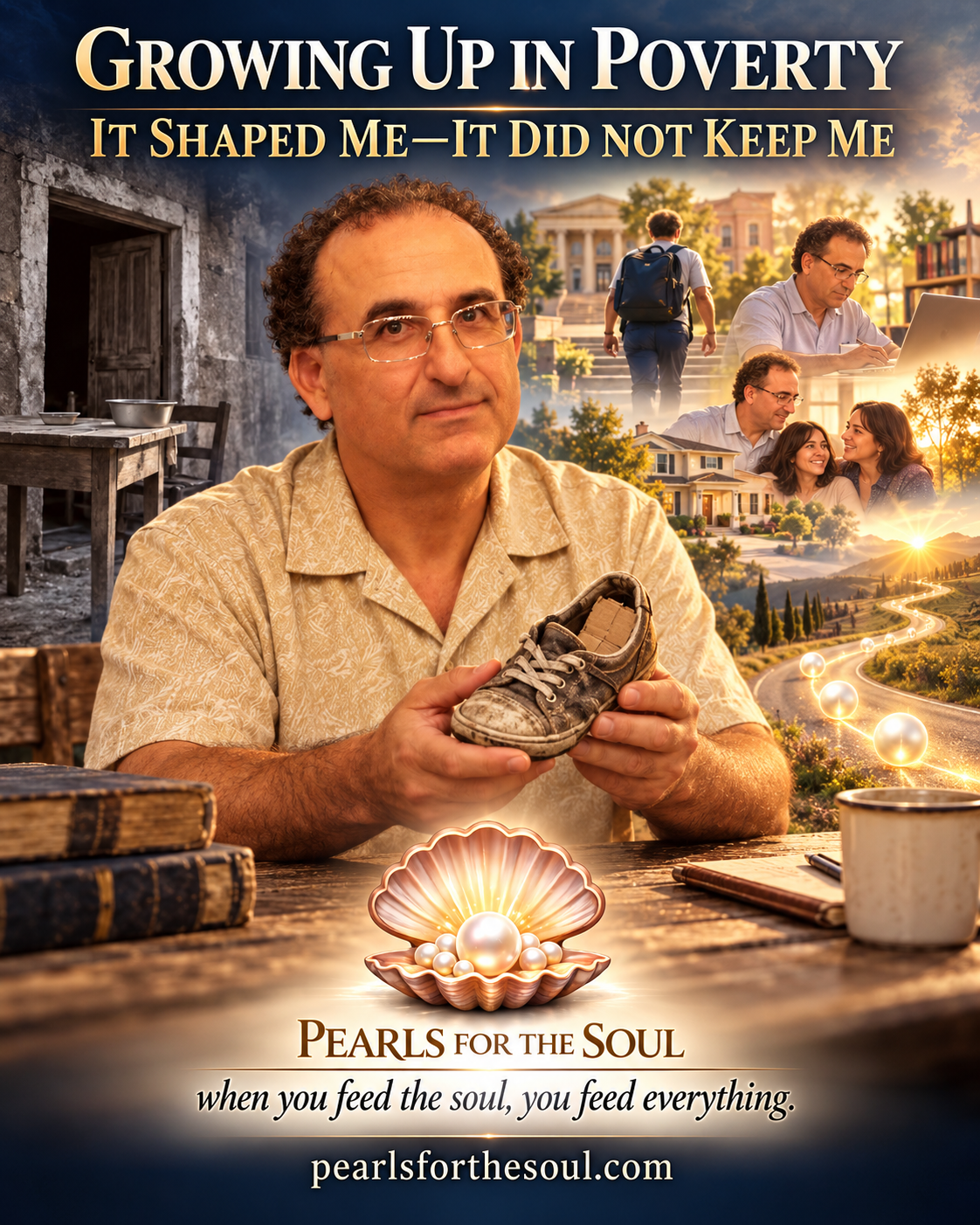
In my case, holes in my shoes were normal.
I continued wearing them without making a peep.
Why?
Why not?
They were the only shoes I had.
We placed cardboard inside them, and I made them work.
A child does not begin by comparing his life with every other life.
He begins by living the one placed before him.
OTHER KIDS’ OPINIONS
Eventually, another child—or perhaps two—pointed out that my shoes were falling apart.
Here is the strange part:
When I saw those shoes myself, I felt one way.
When other children saw them, I felt another way.
And that feeling was bad.
I became ashamed.
The shoes had not changed.
My understanding of what they meant had changed.
That is one of poverty’s hidden injuries.
A child may tolerate the lack.
It is the judgment attached to that lack that can begin damaging how the child sees himself.
NEW SHOES VISITED ME
At some point, my mother took over.
She spoke with my father, and shortly afterward, a new pair of shoes visited with me.
I gave the matter no further thought.
Problem solved—at least on the outside.
Looking back, I also realize that I was frequently hungry.
I was not always getting enough to eat.
The childhood explanation was simple:
You eat if food is there.
If it is not there—well, you do not.
Children adapt because they have no other choice.
The body remembers, however.
So does the mind.
PARENTS WITH FIVE CHILDREN
My parents had five children.
As a young boy, I did not fully understand what that required of them.
In my early twenties, I became painfully aware that my brothers and sisters had lived through many of the same shortages—with some differences and exceptions.
That realization hurt.
It also allowed me to glimpse how difficult life must have been for my parents.
They were working with their knowledge, resources, pressures, limitations, and circumstances.
My adult understanding does not erase the childhood pain.
But it adds compassion to the picture.
Life looks different when it becomes your turn to provide for other people.
THE FIRST PAYCHECK
I remember my first job.
I remember the paycheck.
I gave some money to my mother.
Then I went out and bought my fill of food and other things I needed.
For the first time, I had an answer for some of my wants and needs.
The answer was work.
And it worked—literally.
That paycheck represented more than money.
It represented movement.
It showed me that I was not completely powerless.
I could take action and change part of my situation.
THE EFFECTS OF POVERTY
Growing up poor affected me in both negative and positive ways.
It contributed to low self-esteem.
It created feelings of unworthiness and never being good enough.
It brought fears that followed me even when the immediate shortages were over.
It also affected my relationship with food.
After growing up hungry, I had difficulty stopping when food became available.
The body may be full while the memory of hunger continues eating.
I became aware of my own ignorance and the limitations within my family.
I also began discovering that knowledge can be acquired.
Skills can be developed.
Habits can be changed.
A person can learn what was never taught.
Getting a job did not cure everything, but it gave me a place to begin.
POVERTY IS A GREAT MOTIVATOR
When you urgently need work, you often take what you can find.
You need the money.
You need experience.
You need an entrance into the system.
So you take the job and get moving.
Eventually, you begin climbing the ladder.
You search for better work.
More pay.
A shorter commute.
More stability.
Perhaps something you actually enjoy doing.
Poverty can motivate because the memory of having nothing creates a powerful desire to build something.
But motivation is not the whole story.
People also need opportunities, guidance, education, support, health, timing, and sometimes a little luck or charity—another word for love.
I worked, but I did not travel alone.
LONELINESS JOINS IN
While learning through trial and error, another need introduced itself.
Companionship.
I wanted somebody with whom I could travel through life.
A steady date.
A helpmate.
Perhaps a wife.
Perhaps a family.
Human beings need more than a paycheck.
We need connection.
We need somebody who knows the story and stays for the next chapter.
MARRIAGE BECAME ANOTHER MOTIVATOR
Marriage gave my life another clear purpose.
I was no longer alone, although I was still ignorant and naïve about many things.
The short-term goal was straightforward:
Get a good job.
Settle down.
Build a life different from the one in which I had been raised.
My wife and I became responsible for our well-being and quality of life.
Being responsible for a household also helped me understand my parents more clearly.
When it becomes your turn, you begin seeing what the previous generation carried.
Fortunately, youth covered quite a few problems.
Mine held up and did just fine.
THE CHILDREN MADE ME WORK HARDER
My newlywed wife and I had a good life.
Then pregnancy arrived.
Now we wanted and needed more.
I got to the business of finding it for the sake and well-being of our children.
I remembered how poor I had been.
My response was immediate:
None of that for them.
Never them.
That determination became fuel.
I wanted my children to have secure shoes, enough food, a safe home, good schools, opportunities, and the confidence that their needs mattered.
I could not rewrite my childhood.
But I could help write theirs.
INCLUDE YOURSELF, READER
Perhaps parts of this story belong to you too.
Most people I met wanted many of the same things:
A dependable automobile.
A home.
Clothing.
Travel.
Enough money to breathe.
A good school.
A safe neighborhood.
A better future for their children.
We learn from one another while pursuing these things.
We learn what to do.
We also learn what not to do.
Opportunity matters.
So do systems that allow people to grow, work, learn, change direction, and prosper.
Not everyone begins from the same place, and not every road contains the same obstacles.
But every genuine opportunity can become a doorway.
THE SYSTEM WE ENTER
A car—or perhaps two.
A home.
Clothes.
Travel.
Taxes.
Savings.
Schools.
Neighborhoods.
Career advancement.
These pursuits often begin automatically once we start building an adult life.
The system can work when we work—but hard work alone does not guarantee identical results for everyone.
Illness, discrimination, disability, family responsibilities, economic conditions, and unexpected losses can change the road.
That should make successful people grateful rather than judgmental.
After experiencing successes and losses of my own, I wanted a college education.
One step revealed another possible step.
Progress expanded my understanding of what could be pursued.
ALL THINGS ARE POSSIBLE
Many things are possible.
Many are doable.
There may be more than one way to accomplish them.
Enjoy the opportunity.
Work with what you have.
Learn what you do not know.
Accept help when it arrives.
Offer help when you are able.
Eventually, some of what you worked for may be sitting in front of you.
Luck may visit.
Charity may visit.
Love may visit.
Encouragement may arrive just when your strength is getting low.
Once your needs are being met, remember to enjoy some of the fruit produced by the journey.
Relax a little.
Survival habits may continue long after survival is no longer the daily question.
I CAME IN POOR
I came into this life poor.
That poverty affected my body, confidence, habits, fears, and choices.
It also gave me determination, resourcefulness, compassion, and appreciation.
I blame no one.
I carry no desire to remain angry at my beginning.
My past came, performed its part, and went.
Then it became my turn to decide what came next.
Poverty in spirit and flesh tried to lay claim to me upon arrival.
Eventually, I waved goodbye and continued the journey without allowing either one to own me.
I became richer for the experience—not because poverty itself was good, but because I refused to waste what I learned while passing through it.
FINAL THOUGHT
A difficult childhood can explain parts of who we become, but it does not have to control everything we become.
The child wearing shoes lined with cardboard could not see the entire road ahead.
He saw only the next step.
Sometimes that is enough.
Take the next step.
Learn the next skill.
Accept the next honest opportunity.
Help the next person.
Then look back occasionally—not to live in the past, but to recognize how far you have traveled.
PEARLS INSIGHT
Childhood poverty can continue influencing self-worth, food habits, relationships, and financial decisions long after income improves. Healing begins when we recognize that survival habits once protected us but do not have to govern us forever.
PEARLS FROM THE BOOKS
A recurring lesson within Pearls for the Soul is that our beginnings may shape our journey without being granted ownership of our destination.
PEARLS CONNECTION
What childhood shortage, embarrassment, or difficulty later became part of your motivation—and does any part of it still need healing?
RICHIE SPEAKS
I remember the holes.
I remember the cardboard.
I remember the hunger.
But I also remember the first paycheck, giving money to my mother, buying food, building a marriage, raising children, and discovering that another life could be created.
The worn shoes were part of my story.
They were never the title of the whole book.
FINAL SAY
Do not be ashamed of where you began.
Do not romanticize the pain either.
Learn from it.
Heal what you can.
Use the strength it developed.
Give your children and the people around you something better.
Then wave goodbye to whatever tried to keep you poor in body, confidence, hope, or spirit.
I came in poor.
I continued richer for the journey.
Wishing the same to you.
— Richie
Pearls for the Soul
when you feed the soul, you feed everything.
https://pearlsforthesoul.com

Been expecting you