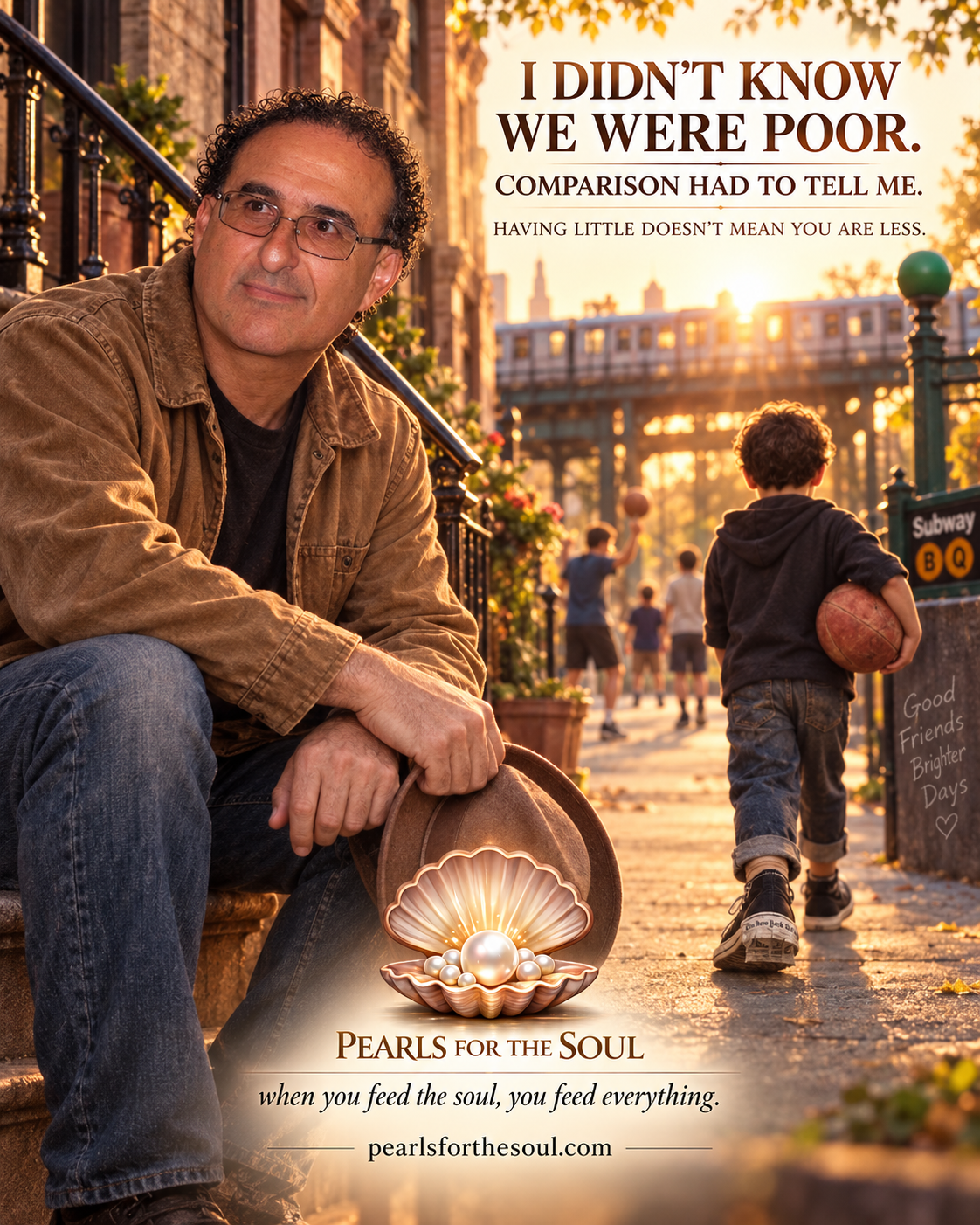
I had holes in my sneakers.
I put newspaper inside them.
When that wore through…
I tried cardboard.
Problem solved.
At least I thought so.
Then one little girl looked at my shoes and said something that introduced me to a world I had not yet discovered:
THE WORLD OF HAVE… AND HAVE NOT.

There is a magic about being a kid that has very little to do with money, status, possessions, or explanations.
Children, when allowed, seem to enter the moment almost completely.
See something?
EXPLORE IT.
Find a ball?
PLAY.
Friend knocks on the door?
GO OUTSIDE.
There is not much analysis involved.
You simply join the life that is happening around you.
That was childhood as I remember it.
And I could not get enough of it.
SUCH A SHORT TIME
Being a kid seemed like it would last forever.
Of course…
It doesn’t.
Walking great distances.
Running.
Climbing.
Jumping.
Exploring.
Going somewhere just because you wondered what was over there.
Those things came naturally.
Nobody had to explain:
“Richie, today we are going to practice enjoying life.”
We already knew how.
It was the default setting.
Then somehow adulthood arrives and we spend years trying to remember what children never had to learn.
EASY PEASY… NICE AND EASY
A ball could occupy an entire afternoon.
Sometimes you needed friends.
Sometimes you didn’t.
Neighborhood games formed themselves.
You knew where everybody lived.
You knew which mother might give you something to eat.
You knew where the kids gathered.
A sandwich was a meal.
A television program was an event.
A movie was something to talk about afterward.
Simple things were enough because we had not yet been trained to believe that enjoyment required enormous amounts of stuff.
THE NEIGHBORHOOD WAS OUR WORLD
Children can make an entire universe out of a few city blocks.
This corner.
That building.
That alley.
That playground.
That store.
That friend’s house.
Those places carried stories.
You did not need reservations.
Admission tickets.
A travel consultant.
You went outside.
And THERE IT WAS.
Life.
WHY SCHOOL?
Now school…
That was another matter.
To my young mind, school interfered with being a kid.
I accepted it because there were certain benefits.
Milk.
Cookies.
Lunch.
Recess.
Tag.
Ball.
Friends.
The rest?
I had trouble understanding why I should sit inside learning about life from books when REAL LIFE was operating outside the window.
Obviously, I eventually discovered the value of education.
But the child in me had an argument:
WHY READ ABOUT THE WORLD WHEN I CAN GO LOOK AT IT?
Not a completely foolish question.
TRAINS… I GREW UP WITH TRAINS
The subway was around the corner.
I remember when you could travel remarkable distances around New York for very little money.
To a kid, the subway was not transportation.
It was POSSIBILITY.
Get on here.
Come out somewhere completely different.
New neighborhood.
New people.
New sights.
What was down there?
Where did that train go?
I wanted to know.
And yes…
Like many kids, I occasionally experimented with childhood ways of getting where I wanted to go that were considerably more creative than they were proper.
We’ll leave those techniques in the archive.
EXPLORATION WAS THE REWARD
I would ride.
Travel.
Explore.
Then figure out how to get back home when I was supposed to.
That was part of the game.
The adventure had boundaries.
Home was waiting.
But between leaving and returning…
THE WORLD WAS BIG.
And I wanted to see it.
HOW WOULD A KID KNOW HE WAS POOR?
This is where the story gets interesting.
What does a child know about being poor?
From where I stood…
I was doing approximately what the other kids around me were doing.
Playing.
Going places.
Eating.
Laughing.
Exploring.
Living.
I was CONTENT.
I did not wake up thinking:
I AM ECONOMICALLY DISADVANTAGED TODAY.
I was a kid.
Then one day…
Somebody pointed something out.
“YOU HAVE A HOLE IN YOUR SNEAKERS”
A young girl looked at my shoes and said:
“You have a hole in your sneakers.”
Now I already KNEW there was a hole in my sneakers.
That was obvious.
What affected me was the way she said it.
There was something in the tone.
Something like:
THAT IS NOT SUPPOSED TO BE THAT WAY.
Interesting.
Until then, the hole was an inconvenience.
After her comment…
It became INFORMATION ABOUT ME.
That was different.
I HAD ALREADY SOLVED THE PROBLEM
The old black-and-white lace-up sneakers were wearing out.
Fine.
What did we do?
Newspaper.
Put some inside.
Problem solved.
Newspaper eventually wears through?
Upgrade.
CARDBOARD.
Look at that.
Engineering.
I was proud of the solution.
My foot was no longer hitting the ground through the hole.
What more did we need?
THEN COMPARISON ARRIVED
That little girl’s observation did something.
It introduced comparison.
Maybe my shoes were not simply worn.
Maybe they said something about what we could afford.
Maybe there were people who replaced shoes BEFORE the bottom disappeared.
Who knew?
That idea had not occupied much space in my little world.
Now it did.
YEP… THEY’RE GONE
Her comment stayed with me.
A few days later, I finally mentioned the sneakers to my mother.
She looked.
Apparently I had taken the newspaper-and-cardboard repair program about as far as it could go.
New shoes arrived.
Problem solved again.
But something had changed.
I had learned that possessions could be used to measure people.
That lesson lasts longer than sneakers.
I DIDN’T FEEL POOR
This is the important distinction.
Were we limited materially?
Yes.
There were things we did not have.
There were things other families could afford that perhaps we could not.
That is real.
Material poverty can create very real hardship.
I do not romanticize that.
But as a child…
I did not necessarily EXPERIENCE myself as poor.
There is a difference between:
HAVING LITTLE
and
FEELING LIKE YOU ARE LESS.
The second one often requires comparison.
CHILDREN DON’T AUTOMATICALLY KEEP SCORE
Children learn scorekeeping from somewhere.
Your house is bigger.
My shoes are newer.
Their car is better.
You have this.
I don’t.
Eventually the measuring system gets installed.
Before that?
A cardboard patch can be a brilliant repair.
A ball can be enough.
A sandwich can be satisfying.
A neighborhood can be a kingdom.
WHEN DID ENOUGH STOP BEING ENOUGH?
That may be the larger question.
At what point do human beings stop asking:
DO I HAVE WHAT I NEED?
and begin asking:
DO I HAVE AS MUCH AS THEY DO?
Those are very different questions.
The first can produce gratitude.
The second can become endless.
Because there will always be somebody with:
More.
Newer.
Larger.
Faster.
More expensive.
If your peace depends upon winning that race…
Good luck.
There is no finish line.
MATERIAL POVERTY IS ONE KIND
As I grew older, I discovered that poverty can be measured materially.
Food.
Housing.
Clothing.
Security.
Opportunity.
Those things matter.
Nobody should pretend they do not.
But then I discovered another kind of poverty.
One that money does not necessarily fix.
Poverty of character.
Integrity.
Compassion.
Purpose.
Spirit.
A person can own everything visible…
And remain terribly poor in the invisible places.
YOU CAN BE RICH AND EMPTY
Big house.
Beautiful car.
Bank account.
Clothes.
Trips.
Fine.
Enjoy them.
But none of those guarantees:
Character.
Peace.
Love.
Credibility.
Purpose.
Honesty.
A wealthy person can be spiritually starved.
A person of modest means can possess enormous inner richness.
That is another paradox.
THE SNEAKERS WERE TEMPORARY
Those sneakers disappeared a long time ago.
So did the replacement pair.
And the pair after that.
Everything material eventually passes through our hands.
Cars wear out.
Homes change owners.
Clothes wear through.
Money gets spent.
Objects come.
Objects go.
That does not make material things meaningless.
It puts them in perspective.
WHAT DID THE KID ACTUALLY HAVE?
Looking backward…
Maybe the better inventory is this:
Curiosity.
Freedom.
Energy.
Friends.
A neighborhood.
Imagination.
A mother who replaced the shoes when the problem finally became obvious.
A subway nearby.
Places to explore.
A world I wanted to know.
That kid had quite a bit.
He simply was not measuring it yet.
DON’T LET COMPARISON ROB CONTENTMENT
Comparison can be useful.
It can show us what is possible.
It can reveal legitimate needs.
But unchecked comparison can also take something perfectly satisfying and suddenly make it feel inadequate.
Yesterday:
I LIKE MY SHOES.
Today:
WHAT’S WRONG WITH MY SHOES?
Same shoes.
Different measurement.
Interesting.
LIVE WITH GRATITUDE… NOT DENIAL
Gratitude does not mean pretending hardship does not exist.
If something needs fixing…
FIX IT.
If you need better shoes…
GET THEM.
If a family needs help…
HELP.
But while improving circumstances, do not allow the pursuit of MORE to erase appreciation for what already exists.
That becomes another kind of poverty.
WHAT ARE YOU TEACHING THE CHILDREN?
Children notice what adults value.
If every conversation revolves around:
Money.
Brands.
Status.
Who has what.
Who lives where.
Children learn that scoreboard.
What if they also hear:
Was that fun?
What did you learn?
Who did you help?
Did you make a friend?
Did you notice something beautiful?
Did you say thank you?
That teaches another kind of wealth.
FINAL THOUGHT
I didn’t know we were poor.
Somebody had to point it out.
And perhaps that tells us something.
My sneakers had holes.
But my childhood wasn’t necessarily full of holes.
There was life in it.
Adventure.
Friends.
Exploration.
Simple pleasures.
Then one day the comparison system started arriving.
Sneakers come and go.
Kids grow up.
Possessions pass through.
But the deeper question remains:
WHAT KIND OF WEALTH DID YOU BUILD INSIDE?
Because someday all the material inventory changes hands.
Character is another matter.
PEARLS INSIGHT
Children do not necessarily experience material limitation in the same way adults conceptualize socioeconomic status. Their sense of well-being can be strongly influenced by relationships, security, play, belonging, exploration, and the expectations of the people around them. Social comparison can change how possessions are perceived, turning something previously accepted into a symbol of inadequacy. Gratitude and material awareness can coexist without denying genuine financial hardship.
PEARLS FROM THE BOOKS
A recurring principle throughout Pearls for the Soul is:
EVERYTHING IS ON LOAN.
Shoes.
Money.
Homes.
Possessions.
Even our portion of time.
Use them.
Enjoy them.
Care for them.
But do not confuse what passes through your hands with what you ARE.
The soul keeps another inventory.
PEARLS CONNECTION
This Pearl connects directly with:
WITH BEANS AND RICE… YOU CAN RULE YOUR WORLD
QUALITY, QUANTITY AND KEEPING IT ALL SIMPLE
and
HUMAN BEINGS REMAIN COMPLEX AND SIMPLE… A PARADOX
Rice and beans taught appreciation.
Simplicity taught enoughness.
Childhood taught something before we even had words for it:
YOU DON’T NEED EVERYTHING TO EXPERIENCE EVERYTHING.
RICHIE SPEAKS
Hole in the sneaker?
Newspaper.
Newspaper wore out?
CARDBOARD.
Problem solved.
At least until somebody told me there was a bigger problem.
Funny thing.
Before comparison entered the picture…
I WAS FINE.
Improve what needs improving.
But be careful who gets to tell you whether your life is rich or poor.
FINAL SAY
Maybe poverty should never be measured only by what is missing from the closet.
Ask what is present in the person.
Love?
Character?
Curiosity?
Faith?
Gratitude?
Integrity?
Those are riches too.
Sneakers come and go.
Kids grow up.
But what you put into the soul…
THAT’S ANOTHER KIND OF WEALTH.
— Richie
Pearls for the Soul
when you feed the soul, you feed everything.
pearlsforthesoul.com

Been expecting you