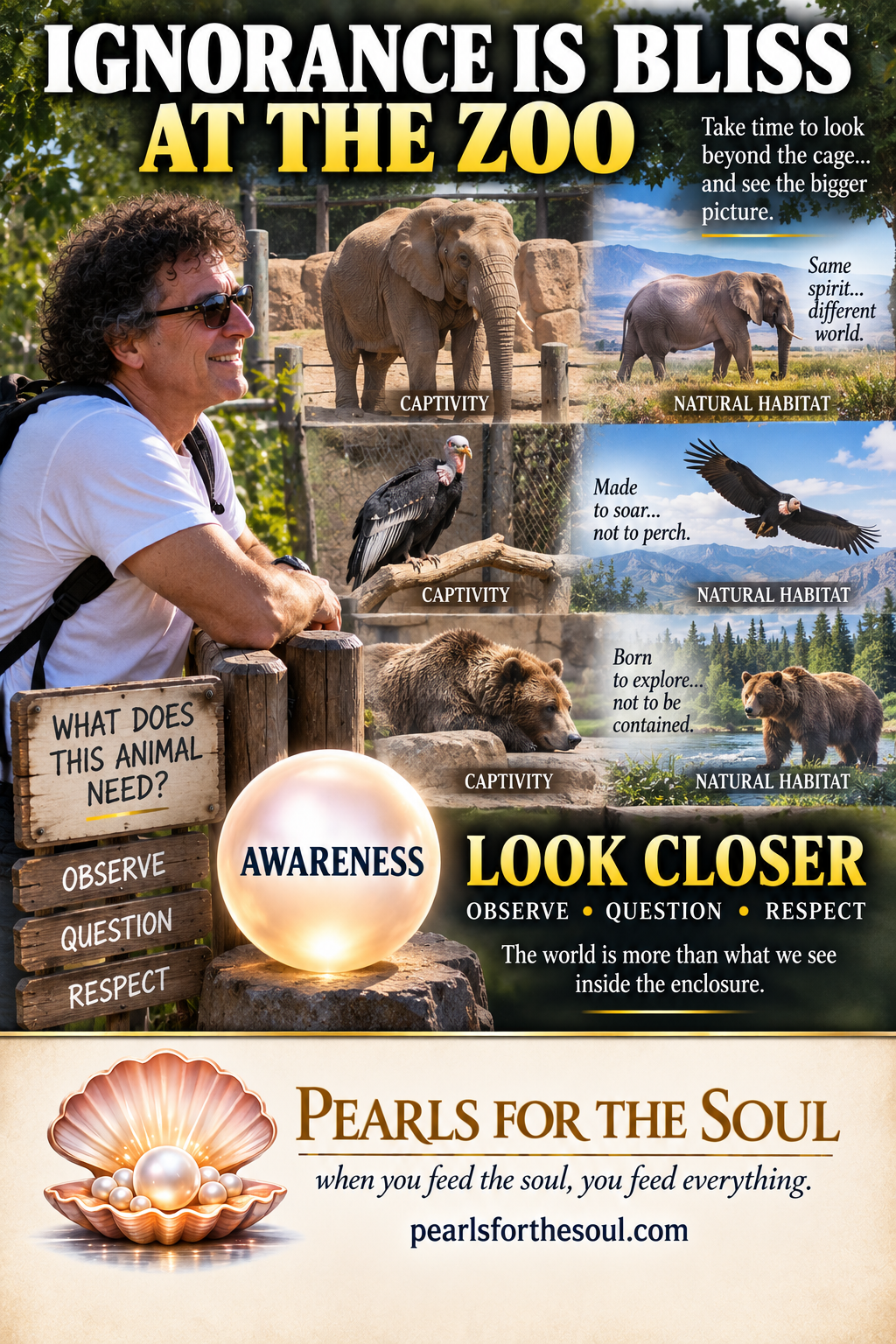
I love the zoo.
The walking.
The observing.
The learning.
But if you look long enough…
you may begin seeing something else.
Every time I share some of my observations about this subject…
somebody gets offended.
Fine.
If this subject bothers you…
DON’T READ IT.
Go to the next post.
LOL.
But human nature being what it is…
many of you will stay.
And that is good because this is not about attacking people.
It is about looking.
Observing.
Asking questions.
And noticing what may be right in front of us.

I love the zoo.
I enjoy:
walking,
snacking,
watching,
pondering the size,
shape,
behavior,
and origins
of all the different animals.
Then…
after a while…
I begin noticing the obvious.
WHAT THEY ONCE WERE
Some of these animals do not look like the animals I imagine living in the wild.
Majestic creatures designed to:
roam,
hunt,
swim,
fly,
climb,
migrate,
socialize,
explore,
mate,
and respond to a constantly changing environment…
can appear strangely inactive in captivity.
Now…
PAUSE FOR CAUSE.
Not every animal lying down is miserable.
Not every zoo is the same.
Not every captive animal is suffering.
Modern accredited zoos can contribute to:
conservation,
breeding programs,
education,
veterinary care,
and research.
That matters.
But there is still a legitimate question:
WHAT DOES CAPTIVITY DO TO AN ANIMAL WHO EVOLVED TO MOVE THROUGH A MUCH LARGER WORLD?
That is worth examining.
BEHAVIORS HAVE BEEN MODIFIED
Humans create artificial environments around wild animals.
Even when those environments are designed carefully…
they are still controlled.
The animal does not decide:
where to migrate,
where to hunt,
when to leave,
which territory to claim,
or how far to travel.
That is a major change.
Some captive animals develop repetitive behaviors called stereotypies.
Pacing.
Rocking.
Swaying.
Repetitive head movements.
These behaviors can be associated with stress, frustration, restricted environments, or lack of stimulation.
So when I see something like that…
I pay attention.
THE CALIFORNIA CONDOR
Take the California condor.
This is an enormous bird.
A wingspan approaching ten feet.
Built to soar.
Built to ride thermal currents.
Built to scan vast terrain.
Seeing one up close is impressive.
But it also creates a strange contrast.
You are admiring a creature designed for immense space…
while looking at it inside a human-defined boundary.
Now, there is another side to this story.
California condors were brought back from the edge of extinction through intensive captive breeding and release programs.
Without human intervention…
they might not be flying wild today at all.
That matters.
So this is not a simple:
ZOO BAD.
WILD GOOD.
The truth is more complicated.
Captivity can restrict…
and conservation programs can save.
Both can be true.
THE ELEPHANT ROCKING
I once watched an elephant standing in one place…
rocking back and forth.
I left.
Came back later.
Same motion.
That bothered me.
Elephants in the wild can travel significant distances and live in complex social groups.
They use:
memory,
touch,
sound,
smell,
movement,
and social relationships
to navigate their world.
So repetitive rocking deserves attention.
It can sometimes be a stereotypic behavior associated with long-term captivity or frustration.
That does not allow me to diagnose one particular elephant from observation alone.
But it certainly gives me permission to ask:
WHY IS IT DOING THAT?
And:
WHAT IS THE ENVIRONMENT PROVIDING…
OR NOT PROVIDING?
THE BEARS
Bears fascinate me.
Powerful.
Curious.
Built to roam.
Climb.
Dig.
Search.
Smell.
Explore.
Their sense of smell is extraordinary.
Their bodies are designed for movement through large, varied terrain.
Now place that animal into a limited enclosure.
Even a sophisticated enclosure cannot fully reproduce:
miles of territory,
seasonal changes,
foraging,
hunting,
or the full complexity of the wild.
Again…
good zoos use enrichment.
Hidden food.
Changing environments.
Pools.
Logs.
Climbing structures.
Scents.
Puzzles.
Those things help.
But the question remains:
HOW MUCH OF THE ORIGINAL LIFE CAN REALLY BE RECREATED?
That is the part I ponder.
THE RHINOCEROS
I once watched a rhinoceros moving around its enclosure.
Then suddenly…
it came alive.
It ran.
For a moment…
there was power.
Speed.
Purpose.
Then…
boundary.
It ran out of room.
And the movement stopped.
That image stayed with me.
A creature capable of much more…
meeting the edge of the world humans created for it.
That does something to you if you let yourself notice it.
I AM NOT AN ACTIVIST…I AM OBSERVING
I am not presenting myself as an animal behaviorist.
I am not claiming every zoo is cruel.
I am not claiming every animal in captivity is miserable.
I am saying:
LOOK.
WATCH.
ASK.
Do not let the popcorn…
the signs…
the gift shop…
and the family outing
prevent you from observing the animal itself.
What is it doing?
What is normal for the species?
How much space would it normally use?
What behaviors does the enclosure allow?
What behaviors does it prevent?
Those are fair questions.
“LIVELY” TO WHOM?
A tour guide may say:
Come back later.
The animals become more active in the evening.
Fine.
Many animals ARE naturally more active at certain times of day.
That is biology.
But activity alone does not answer the welfare question.
An animal moving more is not automatically an animal thriving more.
We need more than:
LOOK…IT MOVED!
LOL.
We need to understand:
behavior,
environment,
health,
social needs,
and species-specific requirements.
WHAT ARE ZOOS FOR?
This may be the better question.
Entertainment?
Education?
Conservation?
Research?
Rescue?
Breeding?
Public awareness?
Probably some combination.
The strongest justification for modern zoos is not merely:
PEOPLE LIKE LOOKING AT ANIMALS.
It is:
CAN HUMAN CARE PRODUCE A NET BENEFIT FOR THE ANIMALS AND SPECIES INVOLVED?
That is a harder standard.
And probably the right one.
THE WILD IS NOT A DISNEY MOVIE EITHER
Now…
another correction.
The wild is not endless happiness.
Animals in nature face:
starvation,
disease,
predation,
injury,
drought,
competition,
parasites,
and harsh weather.
Freedom does not guarantee comfort.
Captivity does not automatically guarantee misery.
The real question becomes welfare.
Is the animal healthy?
Is it stimulated?
Can it express important natural behaviors?
Is it socially housed appropriately?
Does the environment meet its physical and psychological needs?
That is more useful than romanticizing either side.
IGNORANCE REALLY CAN BE BLISS
If you go to the zoo and never ask questions…
the day stays simple.
Look at the lion.
Look at the bear.
Look at the elephant.
Eat something.
Go home.
But once you begin observing behavior…
the experience becomes different.
You start asking:
IS THIS ANIMAL THRIVING…
OR MERELY EXISTING?
That question can follow you home.
It followed me.
RICHIE SPEAKS
Here is one Richie rule:
Admiring an animal is not the same as understanding what that animal needs.
Another:
The closer we bring wild creatures to ourselves…
the greater our responsibility becomes.
And one more:
If captivity is justified…
the animal’s welfare should matter more than our convenience.
PEARLS FROM THE BOOKS
From the spirit of Pearls for the Soul:
“Observation becomes responsibility when what we see can no longer be ignored.”
From the spirit of God I AM:
“Creation deserves more than admiration; it deserves respect for the nature placed within it.”
From the spirit of It Is Finished:
“Do not preserve an old practice merely because it is familiar when a better way becomes visible.”
PEARLS INSIGHT
Zoo animal welfare is more complicated than simply calling captivity good or bad.
Modern zoological institutions vary greatly.
Some participate in serious conservation, species recovery, veterinary care, research, and public education.
At the same time, captivity can restrict movement, social choice, migration, hunting, and other natural behaviors.
The strongest approach is to evaluate welfare species by species and facility by facility.
Questions about enclosure design, enrichment, behavioral health, social structure, conservation value, and quality of life are legitimate and necessary.
PEARLS CONNECTION
This connects directly with ASKING QUESTIONS UNTIL SATISFIED…IS VERY SATISFYING.
The zoo becomes a different place when you stop merely looking and begin asking:
WHY?
HOW?
It also connects with PONDER THE MYSTERY OF DOING NOTHING CORRECTLY.
Observation without immediately forcing an answer can reveal quite a bit.
And THESE FOUR THINGS HELP MANKIND ALONG reminds us that awareness changes the quality of an experience.
FINAL SAY
I still enjoy the zoo.
But I do not look at it exactly the same way anymore.
I see magnificent animals.
I also see human responsibility.
I see conservation success.
I also see limitation.
I see education.
I also see questions.
Maybe that is the point.
Do not stop looking because the answer becomes uncomfortable.
Look closer.
Ask what the animal was designed to do.
Ask whether the environment allows enough of that life to remain.
Ask whether captivity is truly serving conservation and welfare…
or merely serving us.
Because ignorance may make the visit easier.
But awareness makes the visit mean something.
And once you begin really seeing the animal…
you may never look at the enclosure quite the same way again.
— Richie
Pearls for the Soul
when you feed the soul, you feed everything.
https://pearlsforthesoul.com

Been expecting you