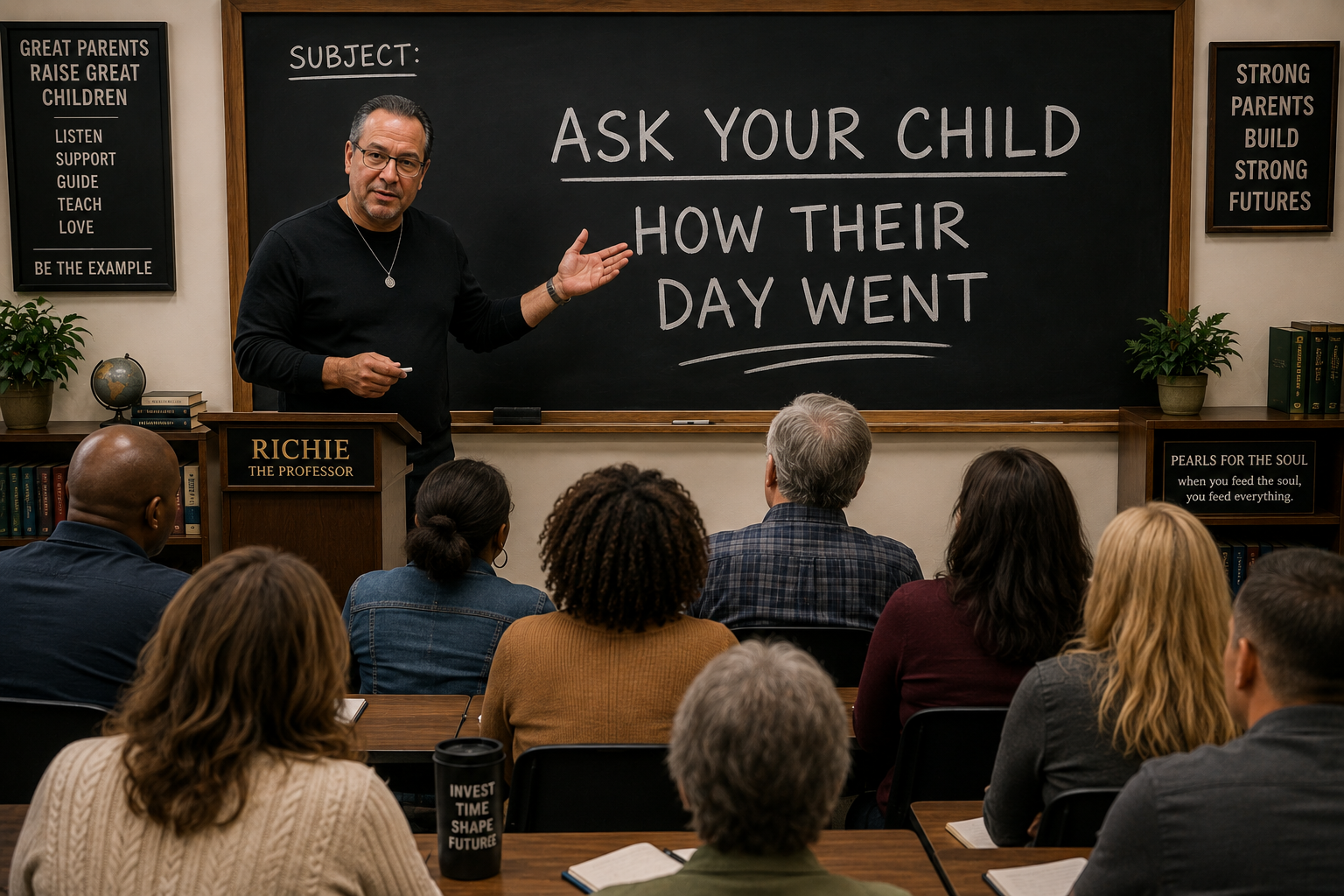
A child cannot learn well while constantly scanning the room for danger.
When school stops feeling like a place to grow and starts feeling like a place to survive, something has gone seriously wrong.

In PART 1, I introduced the reality of children being intimidated, isolated, threatened, embarrassed, and bullied by other children.
And for many adults reading this, the subject may stir up memories of their own.
Being picked on.
Being humiliated.
Trying to disappear.
Counting the hours until school ended.
Wanting desperately for somebody to notice.
For some children today, the emotional pain can become so severe that hopeless thoughts—even thoughts about death or self-harm—can enter the picture.
That is not drama.
That is a child reaching the point where they no longer see a way out.
Whenever a child begins talking that way, withdrawing dramatically, or showing signs that hope is disappearing, adults need to take it seriously and get qualified help involved immediately.
THEY SAY IT’S YOU — AND YOU KNOW SOMETHING IS WRONG
One of the most frustrating experiences for a parent can be reporting what their child says is happening and feeling as though the conversation somehow turns back on the child.
What happened?
What did your child say?
Did your child provoke anything?
Could there be another version?
Some of those questions may be necessary.
But they can sound very different to a frightened child who already believes nobody is going to help.
The child may hear:
“They don’t believe me.”
That is why adults handling bullying reports have to be careful.
Investigate fairly.
Absolutely.
But do not make the child asking for help feel like they are standing trial simply because the facts still need sorting out.
HARD TO PROVE WHAT KIDS DO TO EACH OTHER
Bullying often happens in places where evidence is thin.
Hallways.
Bathrooms.
School buses.
Locker rooms.
Online conversations that disappear.
A quick shove when nobody is looking.
A whispered threat.
A humiliating comment.
One child’s word against another.
That makes investigation difficult.
But difficult does not mean insignificant.
Verbal intimidation can repeat day after day without leaving a bruise.
A child can be deeply affected even when there is no photograph of the event.
That is why patterns matter.
Repeated names.
Repeated places.
Repeated complaints.
Repeated changes in behavior.
Repeated fear around the same student or group.
One small incident may be difficult to interpret.
Twenty similar incidents are information.
THE DAMAGE IS BEING DONE
This is where we need to stop looking only for blood and bruises.
Physical evidence is important when it exists.
But bullying can damage a child in other ways too.
Mentally, the child may become constantly alert and distracted.
Emotionally, they may no longer know what response is safe.
Speak?
Stay quiet?
Fight back?
Run?
Report?
Psychologically, repeated humiliation can begin attacking self-worth.
The child may start believing:
“Something must be wrong with me.”
“Maybe I deserve this.”
“Maybe nobody likes me.”
“Maybe nobody can help.”
That is the part adults cannot afford to miss.
And remember where this is happening.
SCHOOL.
A place where the child is supposed to be concentrating on learning.
Instead, the lesson becomes:
How do I get through today?
WHEN ADULTS SAY, “THERE’S NOTHING WE CAN DO”
Families sometimes hear some version of:
“We didn’t see it.”
“We cannot prove it.”
“We spoke to the students.”
“We’ll keep an eye on things.”
Sometimes that may genuinely reflect the limits of the information available.
But to the child, it can feel like:
“You’re on your own.”
That is dangerous territory.
Adults may not be able to guarantee that every cruel word will be prevented.
But there is always something useful that can be done:
Listen.
Document.
Increase supervision.
Separate students when appropriate.
Check in repeatedly.
Involve counselors or administrators.
Watch patterns instead of isolated incidents.
Create safer routes, spaces, or procedures.
Follow up.
The most damaging message is not necessarily:
“We don’t know everything yet.”
It is:
“Nobody cares enough to keep looking.”
JUVENILES ARE COMPLICATED TO DISCIPLINE
Bullying involving children is complicated because we are dealing with developing human beings.
They are still learning.
That does not mean consequences disappear.
It means correction has to do more than punish.
A warning may work for one child.
It may do absolutely nothing for another.
Suspension may temporarily separate students without changing the behavior underneath.
A child who repeatedly bullies others may need accountability, supervision, behavioral intervention, family involvement, counseling, or other forms of structured help.
Simply telling a bully:
“Don’t do that again”
and hoping the matter disappears is not always enough.
Especially when the bully has learned how not to get caught.
WHAT DO YOU DO?
My own experience growing up was not always pleasant.
I remember one time when I stood up for myself after being bullied.
I thought I had handled things pretty well.
Then later, in the bathroom, three boys grabbed me and humiliated me by pulling my pants down.
They laughed.
But there was a message underneath the laughter:
“What are you going to do about it?”
I was shaken.
That is the kind of moment that stays with you.
The physical incident ends.
The mind keeps replaying it.
Where do I go now?
Who do I tell?
Will they do it again?
Will telling make it worse?
That is the private world bullied children often live inside.
EDUCATION GETS PUT ON HOLD — IT BECOMES SURVIVAL SCHOOL
I remember teachers who seemed indifferent.
Adults who looked away.
Kids who quickly learned which places were safe and which were not.
Bullies learned too.
When children believe adults are not watching or will not intervene, everybody adapts.
But they adapt to the wrong lesson.
Instead of:
Learn.
Explore.
Ask questions.
Grow.
Make friends.
The lesson becomes:
Avoid that hallway.
Don’t use that bathroom.
Don’t sit there.
Don’t look at those kids.
Get through lunch.
Make the bus.
Get home.
That is not education.
That is survival training.
And when survival becomes the child’s primary goal, academics naturally move to the back seat.
RICHIE SPEAKS
Here is the part adults need to understand:
A frightened child is not weak because they cannot concentrate on algebra while wondering who is waiting outside the classroom.
LOL…but there is really nothing funny about it.
Safety comes before learning.
If the child’s nervous system is screaming:
“WATCH OUT!”
the teacher may be saying:
“Turn to page 47,”
but the child is somewhere else completely.
FINAL THOUGHT
The absence of visible injury does not mean the absence of damage.
Sometimes the deepest wounds are being carried quietly through the hallway.
The job of adults is not to panic.
It is not to immediately condemn anybody without facts either.
The job is to stay involved long enough to understand what is happening and protect the child’s ability to feel safe, learn, and develop normally.
PEARLS INSIGHT
Bullying can interfere with a child’s sense of safety, self-worth, concentration, relationships, and ability to learn. Effective responses require adults to look beyond isolated incidents and pay attention to patterns, behavioral changes, repeated fear, and the emotional impact on the child.
PEARLS CONNECTION
PART 1 was about hearing the child.
PART 2 is about understanding what happens when the child no longer believes the environment is safe.
Fear changes behavior.
Repeated humiliation changes self-perception.
And when school becomes survival school, education itself becomes collateral damage.
The next question becomes:
How do we begin rebuilding confidence, safety, and the child’s ability to respond?
Please continue to PART 3.
— Richie
Pearls for the Soul
when you feed the soul, you feed everything.
https://pearlsforthesoul.com

Been expecting you