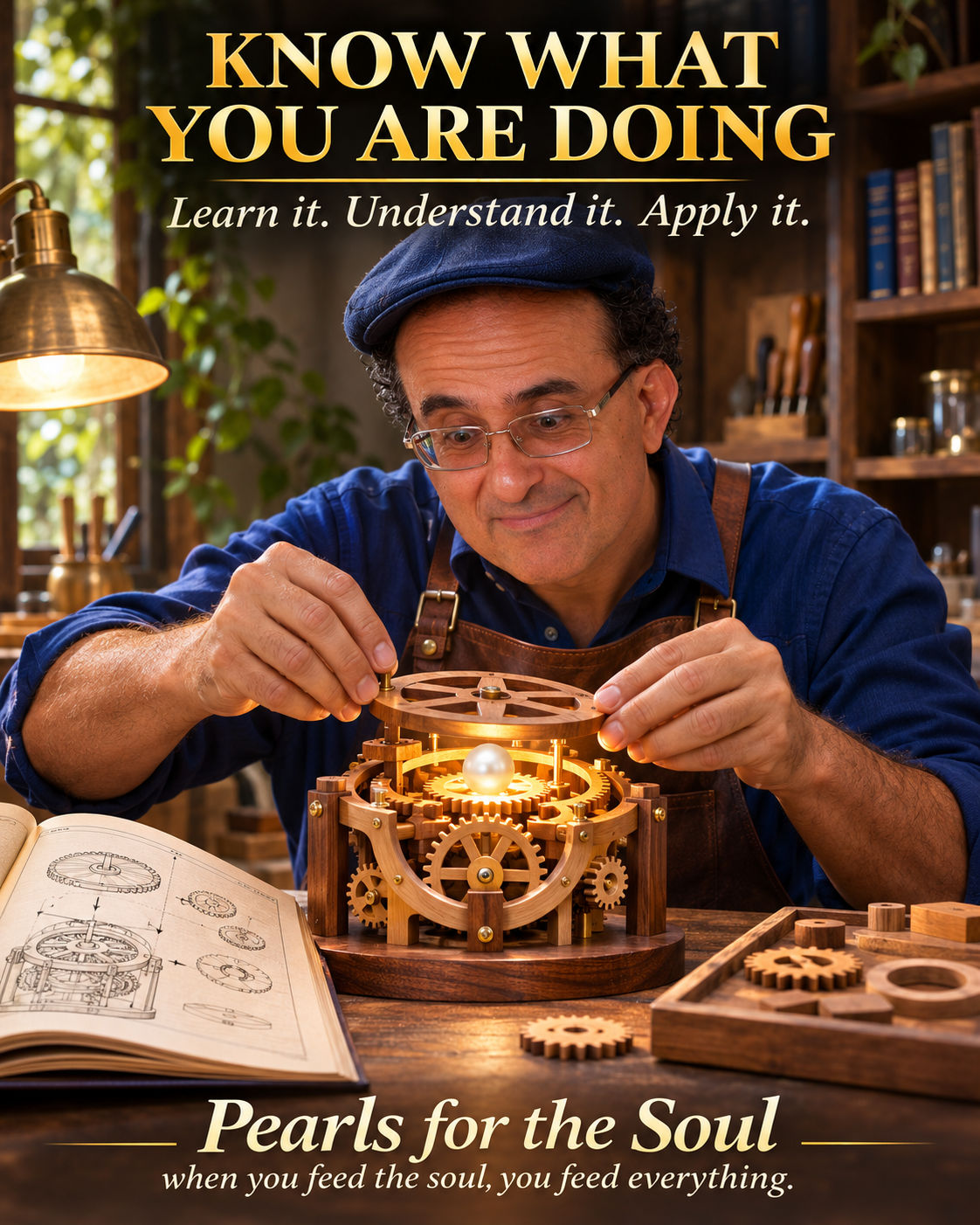
Information tells you what someone else discovered.
Experience shows you what happens when you try it.
Understanding allows you to know what you are doing.
KNOW WHAT YOU ARE DOING—LEARN IT, UNDERSTAND IT, AND APPLY IT
Pause and let the title have its way with you.
Know what you are doing.
This subject applies to everyone reading it.
It is not limited to one area.
Choose a subject and enter it.
Examine how well you are doing.
Discover how you might improve.
Tweak that one.
Then proceed to the next.
You will never run out of subject matter.
ALL FIRST TIME
No one has ever been here before.
This exact life, day, circumstance, age, and moment has not been personally lived by us in advance.
Starting from that truth, what do we really know?
Do not confuse knowing with merely being exposed to information.
Some abilities appear naturally.
Other subjects are introduced through necessity, education, culture, family, employment, or experience.
The journey toward maturity advances as we proceed.
We learn while living something we have never previously lived in exactly the same way.
Think about that for a moment.
EXPOSURE
Much learning begins through what we call a learning curve.
Human beings gave it a name, but the process existed long before anyone identified it.
When exposed to something repeatedly, we can develop familiarity, comfort, and predictability.
Eventually, other people may recognize us as knowledgeable.
We have learned how to learn.
A musician may begin with awkward notes.
Through repetition, listening, correction, and practice, the instrument becomes more familiar.
A person immersed in another language begins recognizing sounds, patterns, expressions, and meanings.
Exposure alone does not guarantee mastery.
Exposure combined with attention and practice creates opportunity.

PUT A VALUE ON IT
At some point, knowledge and experience acquire value.
Other people may pay for what you have studied, gathered, practiced, handled, or learned.
A mechanic recognizes a sound.
A teacher explains a difficult idea.
A musician performs.
A cook understands timing.
A caregiver notices a meaningful change.
A craftsperson sees what is not aligned.
Their value includes information joined with experience.
These dynamics connect with our gifts, skills, and abilities.
Many people may possess similar training.
Only one person applies it through your exact combination of experience, character, limitations, interests, and perspective.
NATURAL AND FORCED SKILLS
I have seen natural skills at work.
I have also seen someone force themselves to perform in an area that never becomes comfortable.
We often recognize the difference.
Natural ability may flow with less visible effort.
Forced performance may require continual struggle.
Do not misunderstand this.
Natural talent still requires discipline.
Difficult learning is not automatically a sign to quit.
Some worthwhile abilities feel awkward before becoming familiar.
The question is whether effort produces growth, usefulness, satisfaction, or a reason to continue.
A natural starting point can help.
Practice still carries the skill forward.
WHAT “KNOW” MEANS
The “know” I am referring to includes an intimate understanding that feels personally evident.
It may arrive as:
“Aha!”
“Bingo!”
“I’ve got it!”
Something clicks.
The pieces relate.
The person no longer merely repeats the instructions.
They understand what the instructions are accomplishing.
This can feel satisfying and reassuring.
It may even produce awe.
Still, the feeling of certainty is not perfect proof.
Human beings can feel absolutely certain and still be mistaken.
Knowing becomes more dependable when inner recognition agrees with evidence, experience, reality, and results.
WHAT “KNOW” IS NOT
Knowing is not the same as guessing.
It is not merely offering an opinion with a confident voice.
It is not analyzing forever without reaching a usable understanding.
Honesty lives comfortably among three answers:
Yes.
No.
I don’t know.
“I don’t know” is not the enemy of knowledge.
It is often the doorway.
Pretending to know prevents the question that could have taught us.
KNOWLEDGE
Knowledge involves retaining, understanding, or applying information, procedures, and approaches.
Repetition can help establish it.
We repeat the steps.
The result becomes more predictable.
Experience develops.
Knowledge acquires practical value.
Not everyone has equal access to education, time, tools, health, safety, or opportunity.
The ability to learn is broadly human.
The conditions supporting learning are not equally distributed.
That gives those who possess knowledge another responsibility:
Share it where appropriate.
WISDOM IS KNOWLEDGE WITH UNDERSTANDING
Knowledge and wisdom are related but not identical.
Knowledge may tell us how something works.
Wisdom considers whether, when, why, and how it should be used.
Knowledge can build a powerful tool.
Wisdom asks what the tool will do in human hands.
Knowledge may provide several options.
Wisdom considers consequences.
Understanding joins information with context.
Confidence becomes useful when it rests upon competence, humility, and the willingness to keep learning.
We can often recognize wisdom at work.
We can also recognize its absence.
KNOWING CANNOT BE FORCED
Deep understanding cannot always be commanded on demand.
We can prepare for it.
We can study.
Practice.
Observe.
Ask questions.
Test ideas.
Wait.
Then something may connect.
The spiritual part of Richie’s understanding sees this wordless recognition as part of the relationship between Creator and creation.
A person of faith may experience knowing through prayer, conscience, wonder, or spiritual insight.
Others may describe intuition, pattern recognition, accumulated experience, or sudden comprehension.
The description may differ.
The experience of something “clicking” remains familiar to many people.
REASON OPENS DOORS
Reason is one of our most useful and productive tools.
It should be used properly.
Reason examines facts, relationships, assumptions, and conclusions.
It does not need to eliminate emotion.
Emotion can provide information about values, needs, fear, attachment, or hope.
Reason helps determine what that information means and what response is justified.
A natural conclusion should not be accepted merely because it feels obvious.
Ask:
What evidence supports it?
What might contradict it?
What else could explain what I see?
What happens when I test it?
Reason opens doors by preventing confidence from locking us inside an error.
THE WORLD OF NATURAL KNOWING
As we proceed through life, awareness develops.
Reality helps verify what awareness receives.
Human beings are excellent receivers of what they observe.
Healthy questions can lead to additional discovery and adventure.
Who?
What?
Where?
When?
Why?
How?
Becoming childlike can help—not childish, but curious.
A child without a hidden agenda can ask the question everyone else was too proud to ask.
“What is that?”
“Why does it work?”
“Can I try?”
“What happens next?”
Curiosity keeps knowledge moving.
THE DIFFERENCE BETWEEN KNOWING AND DOING
A person can know what to do and still refuse to do it.
Knowledge alone does not guarantee action.
Someone may understand healthy eating and choose otherwise.
Know how to apologize and remain silent.
Know how to perform a task and avoid beginning.
Know the rule and break it.
This is where character, discipline, desire, and circumstance enter.
Knowing what you are doing includes recognizing what the action is producing.
Application gives knowledge a result.
THE DANGER OF FALSE CERTAINTY
Confidence can be impressive.
It can also be misleading.
A confident person may still possess incomplete information.
Before declaring that you know, make room for correction.
“I know based upon the evidence currently available.”
“This is what my experience suggests.”
“I may need more information.”
Humility does not weaken knowledge.
It keeps knowledge reachable by truth.
FORGIVE THEM
“Forgive them, for they know not what they do” contains a powerful observation.
People can cause harm without understanding the full meaning or consequences of their actions.
Ignorance does not make every action harmless or remove accountability.
Understanding the ignorance may help explain what occurred and guide the response.
Forgiveness, where possible and appropriate, does not require denying damage, abandoning boundaries, or preventing justice.
It recognizes that human beings sometimes act without truly knowing what they are doing.
FINAL THOUGHT
Do not demand mastery before beginning.
Learn.
Practice.
Observe.
Question.
Understand.
Then apply what you know with enough humility to remain teachable.
PEARLS INSIGHT (SEO)
Knowing what you are doing develops through exposure, repetition, education, experience, feedback, reasoning, and practical application. Knowledge becomes wisdom when it is joined with understanding, context, consequences, and humility. Intuition can support decisions, but reliable knowing should remain open to evidence and correction.
PEARLS FROM THE BOOKS
A pearl can be described, photographed, weighed, and studied.
Holding it creates another kind of knowledge.
Information introduces the subject.
Experience brings it closer.
Understanding connects the two.
PEARLS CONNECTION
Choose one subject you believe you know.
Ask:
What did I learn from instruction?
What did experience teach me?
What results demonstrate my understanding?
Where could I still be wrong?
What is the next refinement?
Turn information into one responsible application.
RICHIE SPEAKS
Do not confuse saying it with knowing it.
Do not confuse knowing it with doing it.
And do not confuse doing it once with mastering it.
Let the learning curve have its way with you.
When it finally clicks, enjoy the “aha”—then remain teachable.
FINAL SAY
Learn it.
Understand it.
Apply it.
Know what you are doing—and know when you still do not know.
— Richie
Pearls for the Soul
when you feed the soul, you feed everything.
https://pearlsforthesoul.com

Been expecting you