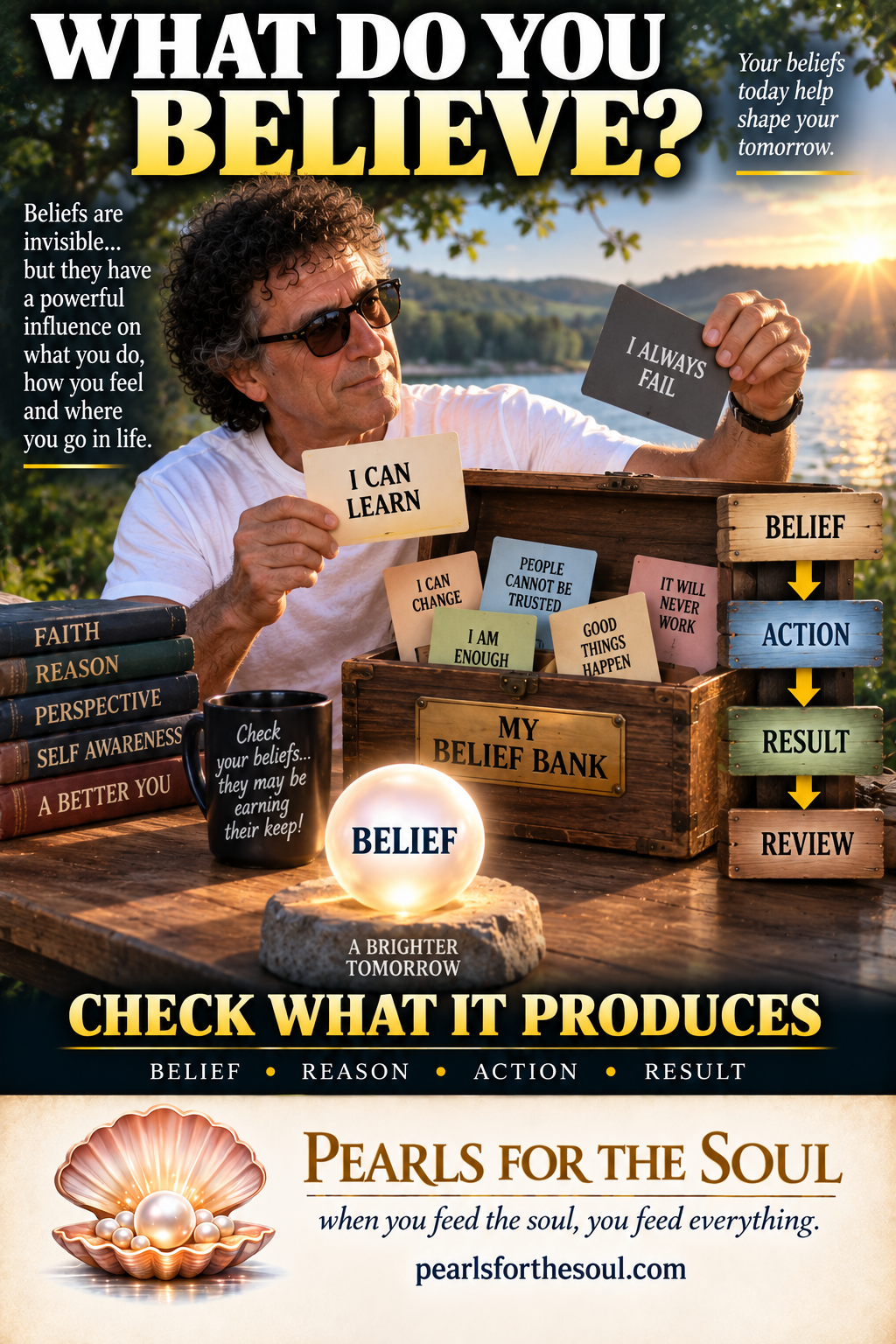
Beliefs are invisible…
but they steer a surprising amount of what we do.
So before you ask where life is taking you…
check what you are believing along the way.
This remains one of the most important things to examine in a person’s journey.
BELIEF.

Not every event in life is caused by belief.
Chance exists.
Other people make decisions.
Circumstances happen.
Illness happens.
Accidents happen.
Markets move.
Nature does what nature does.
But our beliefs still matter enormously because they influence:
what we notice,
what we attempt,
what we avoid,
how we interpret events,
how persistent we become,
and what choices we make next.
That is a lot of power for something you cannot even hold in your hand.
So spend some time examining yours.
BELIEVE THIS
Thoughts come and go all day long.
Some are useful.
Some are nonsense.
Some are fears.
Some are ideas.
Some are memories.
Some are possibilities.
The important part is not that a thought appeared.
The important part is whether you decide to:
accept it,
feed it,
repeat it,
and give it a permanent room in the house.
A repeated thought can become a belief.
And a belief can begin influencing conduct.
That is why advertising works so hard.
It sends:
images,
messages,
repetition,
associations,
emotion,
and familiarity
hoping something takes root.
The message wants a home.
LOOK OVER YOUR BELIEF BANK
Think of your beliefs as a bank.
What have you deposited there?
“I can do this.”
“I always fail.”
“People cannot be trusted.”
“Hard work pays.”
“Nothing ever works out for me.”
“I am too old.”
“I can learn.”
“I have to win every argument.”
“I deserve respect.”
Some of those beliefs may be useful.
Some may be costing you plenty.
PAUSE FOR CAUSE.
ARE YOUR BELIEFS EARNING THEIR KEEP?
That is the question.
If a belief consistently produces:
conflict,
fear,
avoidance,
self-sabotage,
or poor decisions…
maybe it is time for an audit.
OBJECTIVITY IS PRICELESS
People say:
I WANT TO CHANGE.
Good.
That statement already contains a belief:
CHANGE IS POSSIBLE.
Now the work begins.
Examine yourself.
Observe patterns.
Ask:
What do I believe about this?
Where did that belief come from?
Is it still true?
What evidence supports it?
What evidence challenges it?
What happens when I act from it?
Objectivity helps.
Closed-mindedness locks the door.
The world does not have to impose a new view on you.
You can invite better understanding in by becoming willing to examine what you already think you know.
CHILDHOOD BELIEFS
Some beliefs begin very early.
A child hears:
“You are smart.”
“You are lazy.”
“You are difficult.”
“You are responsible.”
“You never finish anything.”
“You are the good one.”
“You are the troublemaker.”
Repeat something often enough…
and a child may begin building identity around it.
That does not mean every childhood message controls the rest of life.
But early beliefs can become deeply rooted.
Later…
the belief may show up with emotion attached.
Anger.
Fear.
Shame.
Defensiveness.
That can make examination harder.
Not impossible.
Just harder.
Calm helps.
Distance helps.
Time helps.
Good feedback helps.
COME HITHER…OH MY BELOVED BELIEF
The strongest beliefs are often the ones we have personally examined.
Not merely inherited.
Not merely repeated.
Not simply accepted because somebody older said so.
We looked.
Tested.
Questioned.
Compared.
Then chose.
Those beliefs feel different.
They belong to us in a more conscious way.
And when a belief no longer serves reality…
modifying it can be painful.
Why?
Because sometimes you are not only changing an idea.
You are changing:
identity,
habit,
emotion,
memory,
expectation.
Roots are being cut.
But once an outdated belief is loosened…
new ground becomes available.
That can be liberating.
FAITH AND BELIEF
There is a fascinating thread in the New Testament where Jesus often asks people about belief and faith.
In several passages, faith is connected with healing or receiving help.
There is also the famous plea:
“I believe; help my unbelief.”
That line is powerful because it is so human.
It acknowledges both:
belief…
and doubt.
At the same time.
For people of faith, that can be reassuring.
Faith does not always mean perfect certainty.
Sometimes it means:
I want to trust…
but help me where I struggle.
That is honest.
And honesty is a good place to begin.
BELIEF IS NOT MAGIC
This part matters.
Belief is powerful…
but it is not magic.
Believing something strongly does not guarantee that reality must obey.
You can believe you will win the lottery.
That does not control the numbers.
You can believe illness is gone.
That does not replace medical care.
You can believe a business will succeed.
That does not eliminate competition, economics, execution, or risk.
So the wiser principle is:
BELIEF SHAPES PARTICIPATION.
It influences what you do with the life in front of you.
That is still powerful.
Very powerful.
EXPECTATION CHANGES BEHAVIOR
If you believe improvement is possible…
you are more likely to try.
If you believe nobody can help…
you may stop asking.
If you believe every criticism is an attack…
you may defend instead of learn.
If you believe effort matters…
you may keep going longer.
Now belief is affecting outcome indirectly through behavior.
That is where the real power becomes visible.
RICHIE SPEAKS
Here is one Richie rule:
Do not believe every thought merely because it used your voice.
Another:
A belief should be tested by what it produces.
And one more:
Faith can move you forward…
but it should not require you to abandon reason.
PEARLS FROM THE BOOKS
From the spirit of Pearls for the Soul:
“What you repeatedly accept within can begin shaping how you meet what appears outside.”
From the spirit of God I AM:
“Belief becomes strongest when faith, truth, reason, and conduct begin moving together.”
From the spirit of It Is Finished:
“Release the belief that has already proven it cannot carry you where you need to go.”
PEARLS INSIGHT
Beliefs function as mental frameworks.
They influence attention, interpretation, expectation, motivation, and behavior.
Because of that, beliefs can affect outcomes without literally causing every event that happens.
Useful beliefs tend to support:
effort,
adaptability,
learning,
persistence,
and clearer decision-making.
Harmful beliefs can reinforce:
fear,
avoidance,
conflict,
and self-defeating patterns.
The practical task is not to believe more strongly.
It is to believe more intelligently.
PEARLS CONNECTION
This connects directly with ASKING QUESTIONS UNTIL SATISFIED…IS VERY SATISFYING.
Beliefs should be examined, not merely inherited.
It also connects with THE LEARNING CURVE IS PERSONAL.
Experience gives us the opportunity to revise what no longer fits reality.
And DOING THE RIGHT THING CAN BE SUBJECTIVE…BUT RIGHT STILL MATTERS reminds us that conviction should still listen to evidence.
FINAL SAY
Beliefs are invisible.
But they are not inactive.
They influence:
what you see,
what you fear,
what you attempt,
what you expect,
what you tolerate,
and what you do next.
So check yours.
Do not ask only:
WHAT DO I BELIEVE?
Ask:
WHY DO I BELIEVE IT?
IS IT TRUE?
WHAT DOES IT PRODUCE?
DOES IT STILL BELONG IN MY LIFE?
Keep the beliefs that help you walk with:
truth,
faith,
reason,
courage,
and responsibility.
Challenge the ones that keep you locked in old rooms.
And when doubt appears…
do not be ashamed of it.
Examine it.
Learn from it.
Strengthen what deserves strengthening.
Release what deserves releasing.
Let it be done to you as you believe?
Perhaps the wiser way to say it is this:
What you believe will often shape how you participate in what happens next.
That is powerful enough.
Use it carefully.
— Richie
Pearls for the Soul
when you feed the soul, you feed everything.
https://pearlsforthesoul.com

Been expecting you