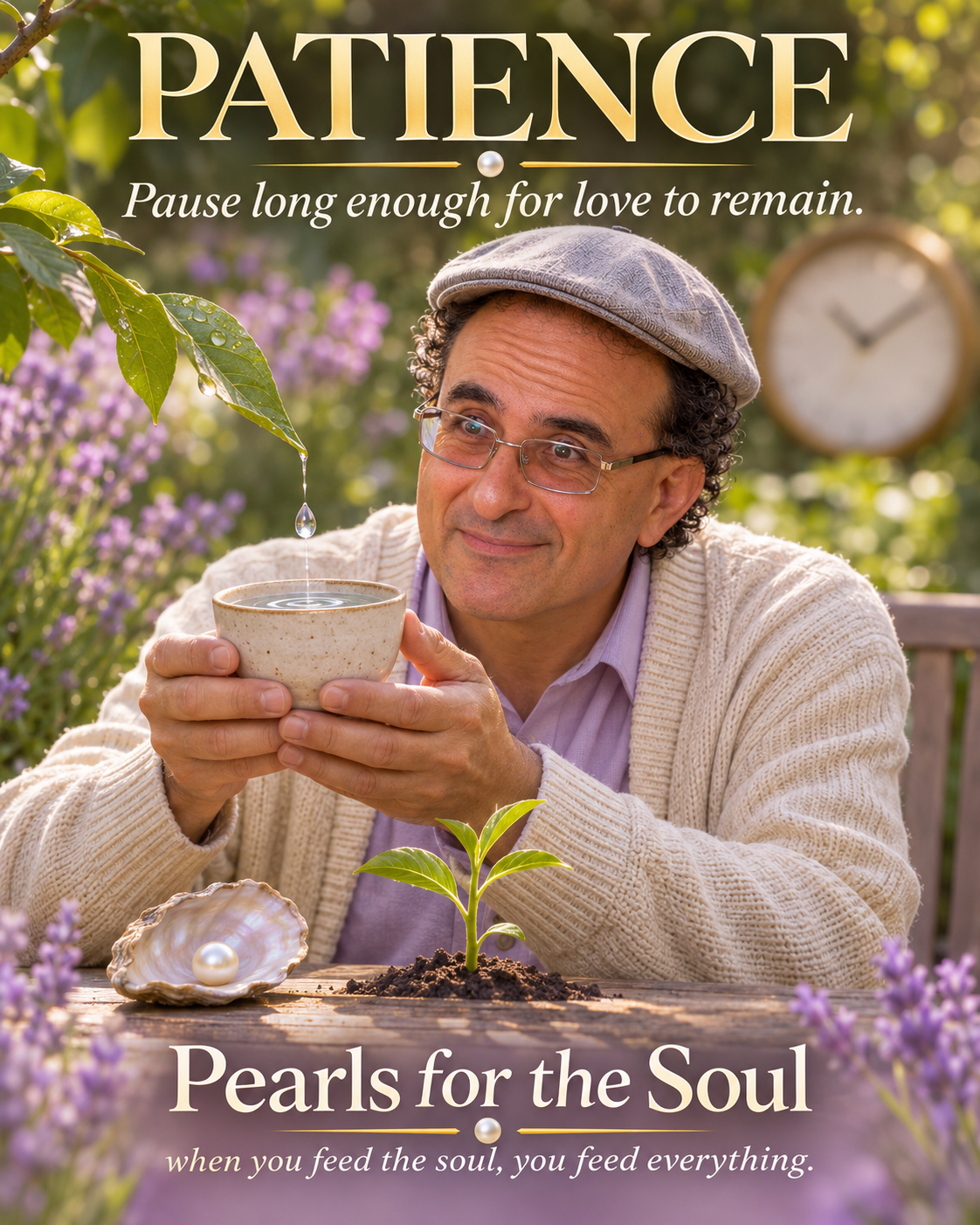
Patience is one of the ways love behaves when circumstances stop cooperating.
We discover how much we possess only after something asks us to wait.
PATIENCE—PAUSE LONG ENOUGH FOR LOVE TO REMAIN
What many people may not consider is how closely patience and love are connected.
The word patience can often substitute nicely wherever love is required.
To understand this, reverse the thinking.
Impatience may reveal a shortage of love in that particular moment.
When our cup of patience runs dry, kindness, understanding, and compassion may begin pouring out with it.
Patience and love are not identical in every situation, but patience is often one of the clearest ways love expresses itself.
WE DON’T PLAN IMPATIENCE
Stop and think about this.
We usually do not wake up saying:
“I am going to be impatient today.”
“I will refuse to love anyone.”
That would be a strange plan.
Instead, the patience we possess—or believe we possess—is called upon.
A delay appears.
Someone repeats themselves.
A machine fails.
Traffic slows.
A child refuses to cooperate.
A loved one needs more time.
Then we discover where our supply ends.
At that point, we may judge, condemn, blame, excuse, or deny our part.
The shortage becomes visible.

WHERE DOES PATIENCE COME FROM?
Richie Reverse helps shed light here.
How do we know we need more patience?
We discover that we have run out.
The moment we recognize that we could have responded more patiently is the same moment the shortage becomes visible.
It may feel as though a person or circumstance pulled the patience directly out of us.
Look again.
They may have revealed what was—or was not—available inside us at the time.
If we are willing to see it, the difficult moment has shown us something useful.
That does not excuse another person’s harmful conduct.
It reveals our threshold.
DO YOU WANT MORE PATIENCE?
Who could not use more patience—for themselves and for others?
We usually learn about the lack only after reaching the edge.
This creates a problem, but it also provides a heads-up.
Knowing your threshold allows preparation.
You can recognize the early signals:
The jaw tightens.
The voice becomes sharper.
The thoughts become less generous.
The body wants to move faster than reality allows.
The other person begins looking like an obstacle instead of a human being.
This awareness becomes an invitation to pause before the cup is entirely empty.
THE PATIENCE ARENA
Strangely enough, patience develops where patience is required.
Reading about calm while everything is going well is easy.
Practicing calm while something repeatedly presses the same button is different.
The patience arena is the circumstance where your present supply is tested.
Enter that arena with care.
Some frustrating situations provide healthy opportunities for growth.
Unsafe, abusive, or dangerous situations are not practice fields. Patience does not require remaining where protection, boundaries, departure, or immediate help is necessary.
In an appropriate arena, humility and objectivity prepare room for more patience.
THE TRIGGER
What allows patience to come forward?
Time.
The willingness to understand.
And the admission that we do not yet understand everything.
When we understand why something is happening and how it developed, judgment may soften.
In place of immediate condemnation, questions appear:
Why is this person struggling?
What do they understand?
What have they experienced?
What limitation is operating?
What information am I missing?
Understanding does not require approving every behavior.
It allows the response to fit the reality more accurately.
VERY REVEALING
When we begin seeing why something is happening and how it is unfolding, we can make reasonable allowances.
Empathy may appear.
We may want to help.
We may also recognize that responding immediately would make matters worse.
Sometimes patience means assisting.
Sometimes it means asking a better question.
Sometimes it means remaining silent.
Sometimes it means stepping away until both people can think.
Sometimes it means observing without adding more heat.
Patience is not one behavior.
It is the ability to prevent urgency from automatically controlling the response.
THE CONSCIENCE HELPS
During or after an episode of impatience, conscience may point toward our part.
“You raised your voice.”
“You stopped listening.”
“You expected the impossible.”
“You were already tired and should have taken a break.”
“You made this person pay for frustration created somewhere else.”
Other impulses may encourage blame, accusation, or denial.
If we follow them, we lose an opportunity for personal growth.
Do not deny what conscience reveals merely because the realization is uncomfortable.
Use it.
Repair what can be repaired.
YOU CAN SEE PATIENCE—OR ITS ABSENCE
Patience is invisible until behavior makes it visible.
Impatience can be seen in expressions, gestures, interruptions, volume, tone, and movement.
People recognize its unprofitable work.
Patience can also be observed.
Someone waits while another person finds the words.
A caregiver repeats an instruction kindly.
A teacher tries a different explanation.
A driver allows another car to merge.
A customer remembers that the employee did not create the entire problem.
We witness patience and sometimes marvel at it.
The example teaches without giving a lecture.
WE REMIND EACH OTHER
A patient person reminds the observer of what is possible.
“That was well handled.”
“I could use more of that.”
An impatient person may provide another lesson.
“That response made everything worse.”
“I hope I do not behave that way.”
We continually teach one another through conduct.
The lesson may be profitable or unprofitable.
Either way, the observer receives information.
REVERSE THE THOUGHT
Imagine a world completely devoid of patience and love.
Every delay becomes an offense.
Every mistake deserves immediate punishment.
Every weakness is condemned.
No one listens long enough to understand.
No one allows another person time to learn, heal, explain, mature, or recover.
Such a world would be dark and hopeless.
It would rob the most private places inside people and replace connection with fear.
Patience allows human beings enough room to remain human.
IT IS PRIVATE AND PERSONAL
We grow at different speeds.
Patience cannot be forced into someone by impatience.
Our progress—or lack of it—eventually becomes visible through behavior.
There is no shortage of examples because imperfection surrounds us and lives within us.
During our available time, we have opportunities to improve.
Another person may choose not to improve.
That choice belongs to them.
Our response belongs to us.
PATIENCE WITH YOURSELF
Patience should not be reserved only for other people.
You are also learning.
You may need time to heal, develop strength, understand a lesson, or adjust to a changed circumstance.
Self-patience is not permission to avoid responsibility indefinitely.
It means refusing to use cruelty as your primary method of self-improvement.
Correct yourself without destroying yourself.
A growing person still deserves care.
PATIENCE IS NOT PASSIVITY
Patience does not mean doing nothing.
It may be active preparation.
A person can wait while learning, saving, healing, planning, practicing, or gathering information.
Patience also does not mean tolerating mistreatment.
Boundaries can be patient.
Consequences can be patient.
A firm no can be patient.
Urgent medical, safety, or legal matters may require immediate action rather than waiting.
Wisdom distinguishes patient timing from dangerous delay.
REFILLING THE CUP
When the cup runs low, what helps refill it?
Rest.
Perspective.
Information.
Time away from the trigger.
Reasonable expectations.
Humor.
Prayer or reflection.
Physical movement.
Asking for help.
Remembering the other person’s humanity.
Remembering your own humanity.
The cup may not refill instantly.
Begin with enough patience for the next responsible response.
FINAL THOUGHT
Patience is not discovered by announcing that we possess it.
It is revealed when circumstances ask us to wait, understand, repeat, forgive, adjust, or begin again.
The moment you see the shortage is also the moment you can start refilling the cup.
PEARLS INSIGHT (SEO)
Patience improves relationships by creating time for understanding, empathy, emotional regulation, better communication, and more thoughtful decisions. Developing patience begins with recognizing personal triggers, pausing before reacting, setting realistic expectations, caring for physical and emotional needs, and maintaining healthy boundaries.
PEARLS FROM THE BOOKS
A pearl does not form according to our preferred schedule.
Layer follows layer through a continuing process.
Patience respects formation.
It allows something valuable enough time to become what it could not become instantly.
PEARLS CONNECTION
Think of one situation that regularly empties your patience.
Ask:
What is my earliest warning signal?
What expectation am I carrying?
What do I not yet understand?
What boundary or break might help?
What would one more ounce of patience look like here?
Prepare before returning to the arena.
RICHIE SPEAKS
You usually discover patience at the same place you discover you do not have enough.
Do not waste the discovery by blaming everyone in sight.
Look at the empty cup.
Ask what drained it.
Then find a responsible way to refill it before pouring your shortage upon someone else.
FINAL SAY
Pause long enough for love to remain in the room.
— Richie
Pearls for the Soul
when you feed the soul, you feed everything.
https://pearlsforthesoul.com

Been expecting you