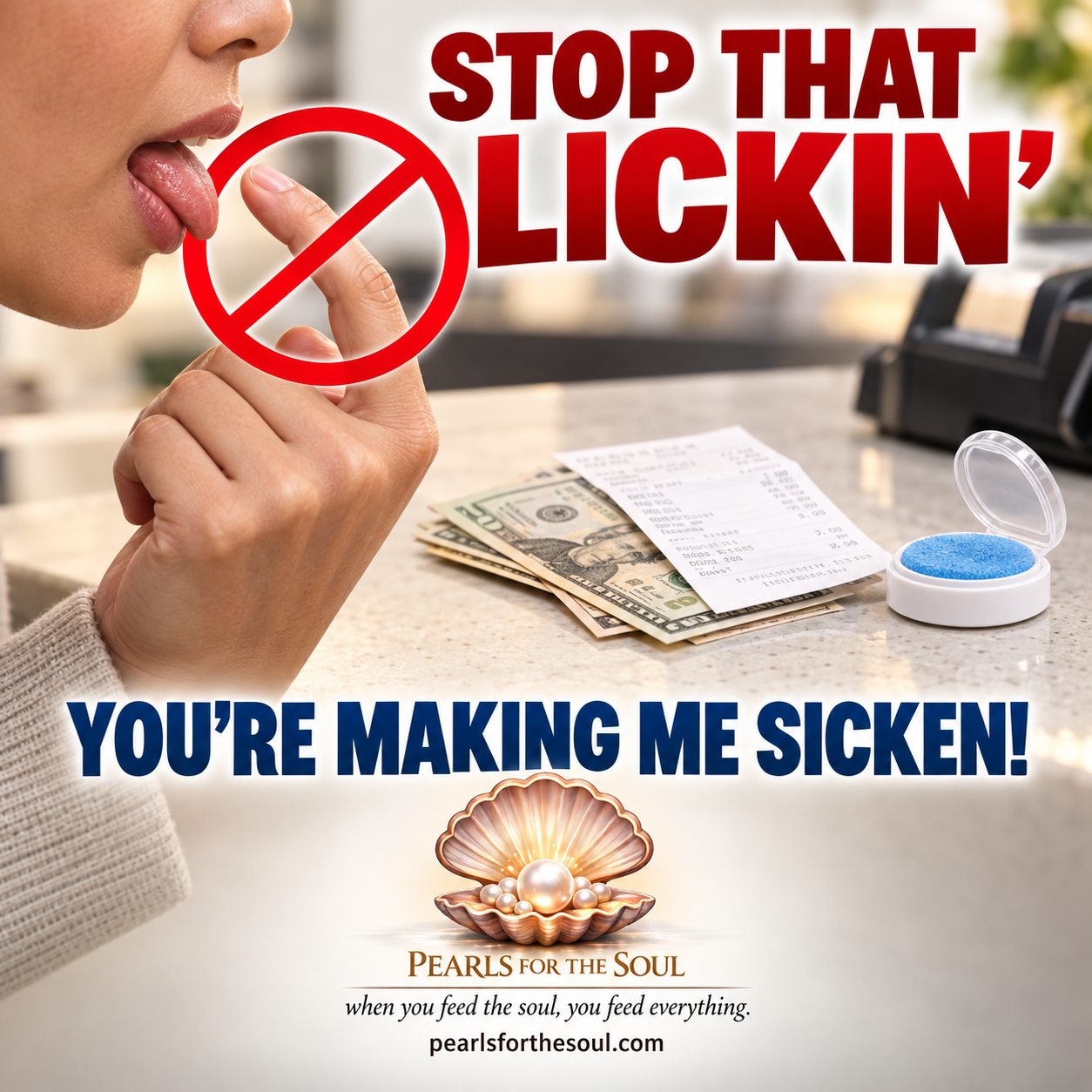
You licked your finger, separated my receipt and handed the moisture to me too?
No thank you. I only wanted the receipt!
I am talking about people who lick their fingers to separate paperwork, money, receipts, credit slips and just about anything else sticking together.
Why do they do this?
SIMPLE.
The moisture gives the fingertip a better grip and feel.
HOWEVER…THE SOURCE TURNS ME OFF
I take issue with your source of moisture.
I do not want your personal water supply applied to anything belonging to me or anything you are about to hand back to me.
I have seen people do it so nonchalantly that if you are not watching carefully, you miss the lick entirely. These people are pros. One quick touch of the tongue, papers separated, receipt handed over—and the evidence has already dried before you can object.
Almost.
THE GRIP IS NOT THE PROBLEM
I understand the problem. Paper sticks. Bills stick. Plastic bags fight back. Receipts sometimes act as if they were permanently married.
Go ahead and separate them.
Just leave your tongue out of the transaction.
There are fingertip moisteners, counting waxes and damp sponge systems made specifically for handling paper. Use one of those sanitary tools and accomplish the same mission without sharing something your customer never requested.

RELATED SUBJECT MATTER
If I am in public and see a food server sneeze into a hand, cough into it, touch the face or wipe away sweat, my appetite is interfered with—GUARANTEED.
I watch to see what happens next.
Do they wash properly and begin again?
If not, I speak up.
That ain’t my order if you coughed into your hand and then used that same hand to finish preparing it.
Cover coughs and sneezes with a tissue or your elbow—not your hands. If the hands become contaminated, wash them before returning to food preparation.
That is not being fussy. That is basic consideration for the person who will be eating what you touch.
MONEY AND FOOD
Money passes through many hands, pockets, counters, machines and unknown environments. Handling it does not automatically make somebody dangerous, but switching from money to exposed food without the proper handwashing or protective procedure is a problem.
The answer does not always require hiring a second person. It requires a safe system:
Take the payment.
Complete the transaction.
Wash your hands when required.
Then return to food preparation using clean utensils, deli tissue or properly used gloves where appropriate.
Being short-handed does not make contamination courteous.
WASH FIRST—THEN GLOVE
Gloves are useful, but let us not turn them into magical thinking.
Dirty hands placed inside clean gloves are still dirty hands.
Gloves that touch money, phones, faces, counters or contaminated equipment must not travel directly back to ready-to-eat food. Change the gloves when the task changes—and wash your hands when required.
The glove is a barrier.
Clean hands are the foundation.
PAPERWORK COUNTS TOO
I do not want paperwork carrying your saliva either.
Not my receipt.
Not my change.
Not my copies.
Not the documents I must sign.
Not the merchandise you are packaging for me.
Even when the actual health risk may be small, the behavior is unnecessary and unpleasant. Courtesy alone should be enough reason to stop.
DOCTORS UNDERSTAND THE PRINCIPLE
We have all seen doctors and surgical teams scrub their hands and forearms before an operation. After cleaning, they are assisted with sterile gowns and gloves so they do not recontaminate themselves before beginning.
That procedure makes an important point:
Cleanliness is not merely a feeling. It is a process.
The process becomes useless when someone carefully cleans their hands and then touches the very thing that contaminates them again.
We may not be preparing for surgery when we handle paperwork or serve a sandwich, but we can all improve our awareness.
SHOULD YOU SAY SOMETHING?
It can be embarrassing to speak up when you see something unsanitary. It feels like a showstopper for everyone involved.
But silence becomes acceptance.
You do not need to insult, embarrass or humiliate anyone. Simply say:
“Would you please wash your hands or replace those gloves before preparing my food?”
Or:
“Please give me another copy of that receipt without wetting your finger.”
Polite does not mean passive.
Respectful does not mean silent.
FINAL THOUGHT
Small habits reveal large amounts of consideration.
What feels harmless to the person doing it may be unpleasant—or unsafe—to the person receiving it. PAUSE FOR CAUSE before touching your face, licking your finger or moving from one task to another.
PEARLS INSIGHT
Your personal habits stop being entirely personal when they are transferred onto someone else’s food, money, paperwork or possessions.
PEARLS FROM THE BOOKS
The Pearls message continually asks us to become more conscious of how our choices affect others. Awareness is not only spiritual. Sometimes it appears in the smallest practical action—clean hands, thoughtful behavior and respect for another person’s boundaries.
PEARLS CONNECTION
Consideration does not require a dramatic gesture. Sometimes it is simply refusing to pass along something another person never asked to receive.
RICHIE SPEAKS
You can separate the papers without joining your saliva to the transaction. Use the sponge. Use the wax. Use a proper fingertip moistener.
Just stop licking!
FINAL SAY
Stop that lickin’—
You’re making me sicken!
— Richie
Pearls for the Soul
when you feed the soul, you feed everything.
https://pearlsforthesoul.com

Been expecting you