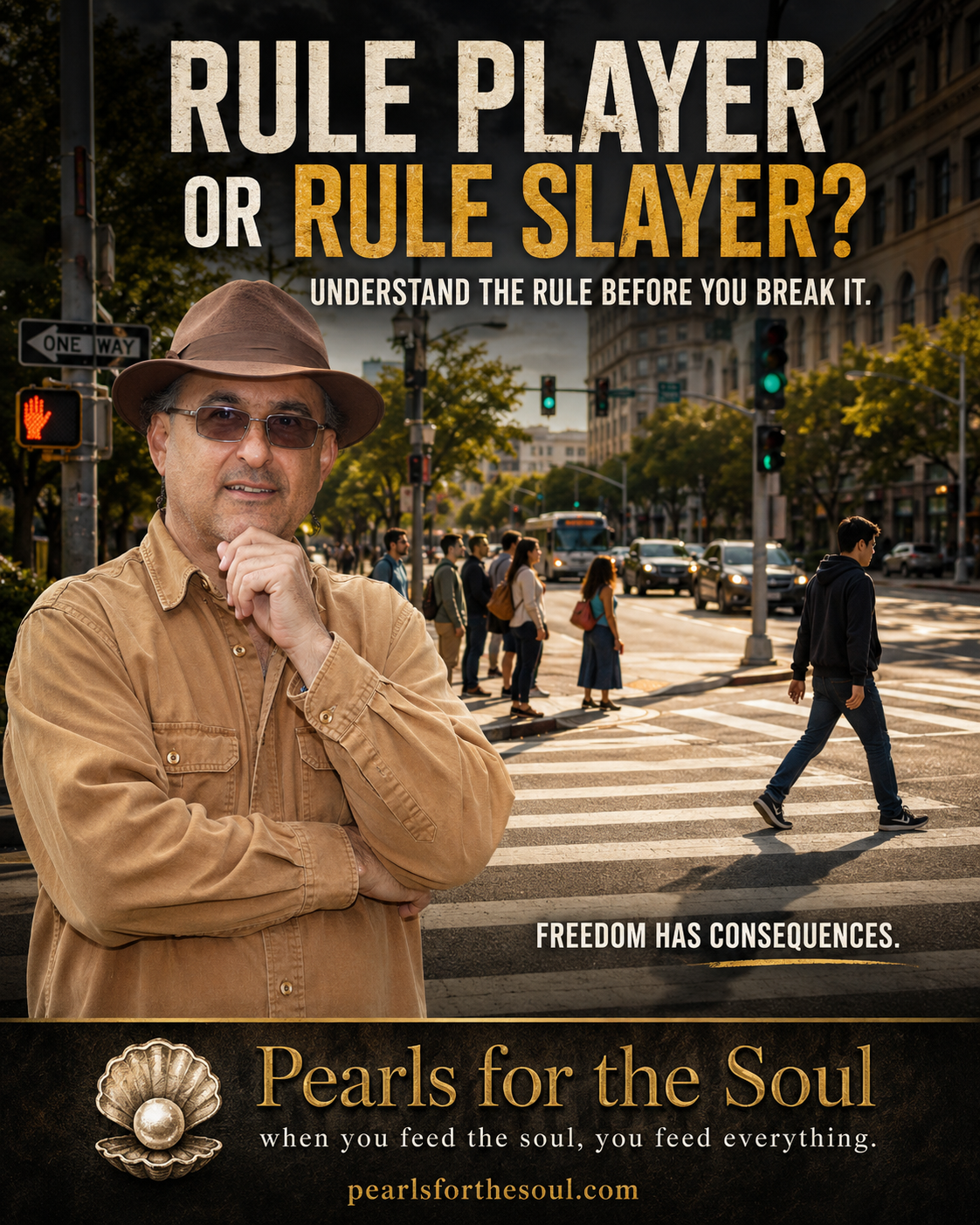
You obey the speed limit.
Someone flies past you.
One of you is following the rule.
One of you is not.

But the deeper question is:
DO YOU UNDERSTAND THE RULE… OR DO YOU JUST RESIST IT?
You are driving.
The sign says:
SPEED LIMIT 45.
You are doing 45.
Then somebody flies past you at 60.
Interesting moment.
One person is following the established rule.
One person is not.
And whether either person thinks much about it or not, both are making a statement about how they believe the road should work.
That is what rules do.
They expose choices.
Follow.
Ignore.
Challenge.
Modify.
Break.
But somewhere behind every one of those choices should be a question:
WHY?
SELF-ASSESSMENT IS WISE
It is healthy to examine what you are doing.
Why am I following this rule?
Why am I resisting it?
Is the rule reasonable?
Is it outdated?
Does it protect people?
Does it simply create unnecessary bureaucracy?
Am I making a principled exception?
Or do I just dislike being told what to do?
That distinction matters.
Self-assessment is wise.
DENYING WHAT YOU SEE IS NOT.
CHILDREN ARE WATCHING
Rules matter especially around children.
Why?
Because children watch before they understand.
They observe.
Copy.
Repeat.
If you routinely ignore stop signs…
They see it.
If you cheat because “everybody does it”…
They absorb that.
If you follow rules when convenient and discard them when inconvenient…
They notice that too.
Whatever leaves the house with them later is partly what they watched at home.
That means example becomes instruction.
RULES DEFINE THE ACTIVITY
Think about games.
Chess.
Checkers.
Monopoly.
Baseball.
Football.
Basketball.
Every one of them is defined by rules.
Change enough of the rules and eventually…
YOU ARE NOT PLAYING THE SAME GAME.
Take chess.
Move a bishop any direction you want.
Let the rook jump pieces.
Move the king six squares.
Fine.
But you are no longer playing chess.
Rules create the framework that allows everyone involved to understand what is happening.
SPORTS MAKE THIS OBVIOUS
Sports are full of rules.
Stay inside the boundaries.
Do not foul.
Do not interfere illegally.
Play the ball correctly.
Break the rule and something happens.
Whistle.
Penalty.
Flag.
Free throw.
Loss of possession.
The violation becomes visible because everybody else is operating from the same agreement.
The rule breaker stands out.
WORKPLACES HAVE RULES FOR A REASON
Workplaces operate the same way.
Safety procedures.
Insurance requirements.
Scheduling.
Handling money.
Customer privacy.
Food sanitation.
Equipment use.
Harassment policies.
Some rules protect the employee.
Some protect the customer.
Some protect the company.
Some protect everybody at once.
Ignore them casually and you introduce risk into a system other people are also depending upon.
That is the problem with private rebellion inside a shared environment.
YOUR CHOICE DOES NOT ALWAYS AFFECT ONLY YOU.
IT MAY FEEL COOL TO BREAK THE RULE
Some people enjoy being the rogue.
The rebel.
The person who refuses to conform.
Fine.
There are times when challenging the accepted way is exactly how progress begins.
But rebellion by itself is not intelligence.
If you are constantly inventing your own rules while everyone else is trying to operate from a common framework…
You become difficult to predict.
And people who cannot predict your behavior have difficulty trusting you.
That costs credibility.
OUT-OF-THE-BOX THINKING IS DIFFERENT
Now let us separate something important.
Breaking rules and thinking beyond rules are not always the same thing.
Out-of-the-box thinking can mean:
The old rule no longer works.
The circumstances changed.
A better method exists.
The regulation is outdated.
The policy creates more harm than benefit.
That deserves examination.
Innovation often begins by asking:
WHY ARE WE STILL DOING IT THIS WAY?
But good innovators do not merely smash the existing structure.
They understand it first.
Then they improve it.
DRIVING MAKES THE POINT CLEARLY
Traffic rules are a good example.
Imagine roads without:
Stop signs.
Lane markings.
Traffic lights.
Right-of-way rules.
Speed limits.
Everyone simply drives according to personal preference.
You think you should go first.
I think I should go first.
Somebody else decides the shoulder is another lane.
Now we have chaos.
Early automobiles created exactly this kind of problem until societies developed common rules.
The point was not to eliminate freedom.
It was to allow thousands of people to move without constantly colliding.
COMMON RULES MAKE COMPLEX SYSTEMS POSSIBLE
The more people involved, the more important common standards become.
Airports.
Hospitals.
Schools.
Courts.
Roads.
Businesses.
Financial systems.
Imagine everyone individually deciding:
I KNOW A BETTER WAY.
Maybe you do.
But if everyone acts independently at the same time, the system stops functioning.
Rules create coordination.
LEARN BY WATCHING THE RULES
One of the easiest ways to learn a new environment is to observe how people properly operate inside it.
I learned fine dining partly by watching others.
Which fork?
Which glass?
How is this course handled?
What happens next?
There are conventions.
Procedures.
Rules.
Why?
Not to make eating difficult.
To create a smoother shared experience.
Once you understand the rules, you stop worrying about them.
They become part of the rhythm.
IF YOU REFUSE EVERY RULE…
Then perhaps the larger issue is not the rule.
Maybe the issue is rebellion itself.
Some people resist any boundary simply because it exists.
Tell them:
DON’T.
And suddenly they want to.
Tell them:
YOU MUST.
And immediately:
WHO ARE YOU TO TELL ME?
That can become exhausting.
Not just for everyone around them.
For themselves.
Imagine spending your entire life arguing with every boundary.
That is a tremendous energy drain.
CONSEQUENCES ARE PART OF THE GAME
Traffic court.
Civil court.
Bankruptcy court.
Criminal court.
Judges spend a great deal of time asking variations of one question:
WHAT HAPPENED?
Rules existed.
Someone acted outside them.
Now circumstances have to be examined.
Sometimes there is a valid defense.
Sometimes an exception applies.
Sometimes common sense matters.
Sometimes the rule itself was wrong.
And sometimes…
YOU BROKE IT.
There are consequences.
EXCEPTIONS EXIST
Rules are created by human beings.
Human beings are imperfect.
So rules can also be imperfect.
There are outdated laws.
Bad policies.
Unfair systems.
Situations where strict obedience would produce a ridiculous or harmful result.
That is where judgment matters.
But an exception should be explainable.
Not:
I DID WHATEVER I FELT LIKE.
Rather:
Here is why the normal rule did not fit the circumstances.
That is a much stronger position.
RULE PLAYERS
People who generally follow reasonable rules perform an important social function.
They create predictability.
They demonstrate cooperation.
They lower risk.
They make shared systems easier to operate.
Their behavior also makes habitual rule-breaking more visible.
If ninety people stop at the red light…
The one person blasting through it stands out rather clearly.
RULE SLAYERS
Now the person who constantly creates a personal set of rules inside a shared system has another problem.
Everybody else has to adjust around them.
That person is swimming against the tide.
Sometimes that is courageous.
Sometimes it is necessary.
But if it is your normal operating mode…
Ask yourself why.
Are you improving the system?
Or merely resisting it?
Big difference.
FREEDOM AND RESPONSIBILITY
Freedom is important.
But freedom inside society always lives beside responsibility.
You are free to make choices.
Other people are free to respond.
The law may respond.
Your employer may respond.
Your family may respond.
The marketplace may respond.
Freedom does not mean freedom from consequences.
That is where some people get confused.
PRIVATE SPACE IS DIFFERENT
Inside your own home, your own property, your own private affairs…
You have considerably more room to create your own customs.
Fine.
Eat dessert first.
Wear pajamas all day.
Organize the kitchen backwards.
Make your own house rules.
But the moment you enter shared space…
Roads.
Workplaces.
Schools.
Businesses.
Public institutions.
Now your behavior intersects with everybody else’s.
That changes the equation.
THE NEEDS OF THE MANY
Large societies cannot function if every person insists that personal preference always outranks common agreement.
There has to be coordination.
That does not mean minorities are unimportant.
It does not mean the majority is automatically right.
It means large groups require rules capable of allowing people with different preferences to operate together.
When the rule is wrong…
Challenge it.
Change it.
Improve it.
But understand what you are doing.
RULES DEFINED
A rule is essentially:
A PRESCRIBED GUIDE FOR CONDUCT OR ACTION.
Something that governs behavior.
Not glamorous.
But useful.
The real question is not whether you will encounter rules.
You will.
The question is how you relate to them.
Blind obedience?
Automatic rebellion?
Or thoughtful participation?
FINAL THOUGHT
Do not obey every rule without thinking.
Do not break every rule because you enjoy resistance.
Understand the framework.
Understand why it exists.
Follow reasonable rules.
Challenge bad ones responsibly.
And when you choose an exception…
BE READY TO OWN THE CONSEQUENCES.
That is maturity.
So…
RULE PLAYER?
RULE SLAYER?
Maybe the best answer is:
RULE UNDERSTANDER.
Then decide how you are going to play.
PEARLS INSIGHT
Rules make shared systems predictable by establishing common expectations for behavior. Healthy judgment requires neither blind obedience nor automatic rebellion, but understanding the purpose of a rule, evaluating its consequences, following reasonable standards, and challenging outdated or unjust rules through responsible means. Personal freedom functions best when paired with accountability.
PEARLS FROM THE BOOKS
A recurring principle throughout Pearls for the Soul is that freedom and responsibility travel together.
You may choose your action.
But you do not always choose what follows from it.
That is why wisdom asks more than:
CAN I DO THIS?
It also asks:
WHAT HAPPENS IF I DO?
PEARLS CONNECTION
This Pearl connects directly with:
WHY WE NEED ETHICS, MORALS AND RIGHTEOUSNESS
and
RESIST TEMPTATION TO PAY BACK… DON’T DO IT
Rules govern external behavior.
Ethics govern behavior when nobody is watching.
Self-control governs what happens when you COULD violate the rule but choose not to.
Together they create order.
RICHIE SPEAKS
You don’t like the rule?
Fine.
Ask why it exists.
Study it.
Challenge it if it is wrong.
Change it if you can improve it.
But don’t confuse:
“I DON’T LIKE BEING TOLD WHAT TO DO”
with:
“THIS RULE MAKES NO SENSE.”
Those are not the same argument.
Follow the good ones.
Fix the bad ones.
And if you decide to break one…
OWN WHAT COMES NEXT.
RULE PLAYER?
RULE SLAYER?
HOW DO YOU PLAY?
— Richie
Pearls for the Soul
when you feed the soul, you feed everything.
pearlsforthesoul.com

Been expecting you