Simplicity is not the absence of effort, responsibility, or ambition.
It is the removal of what keeps effort from reaching what actually matters.
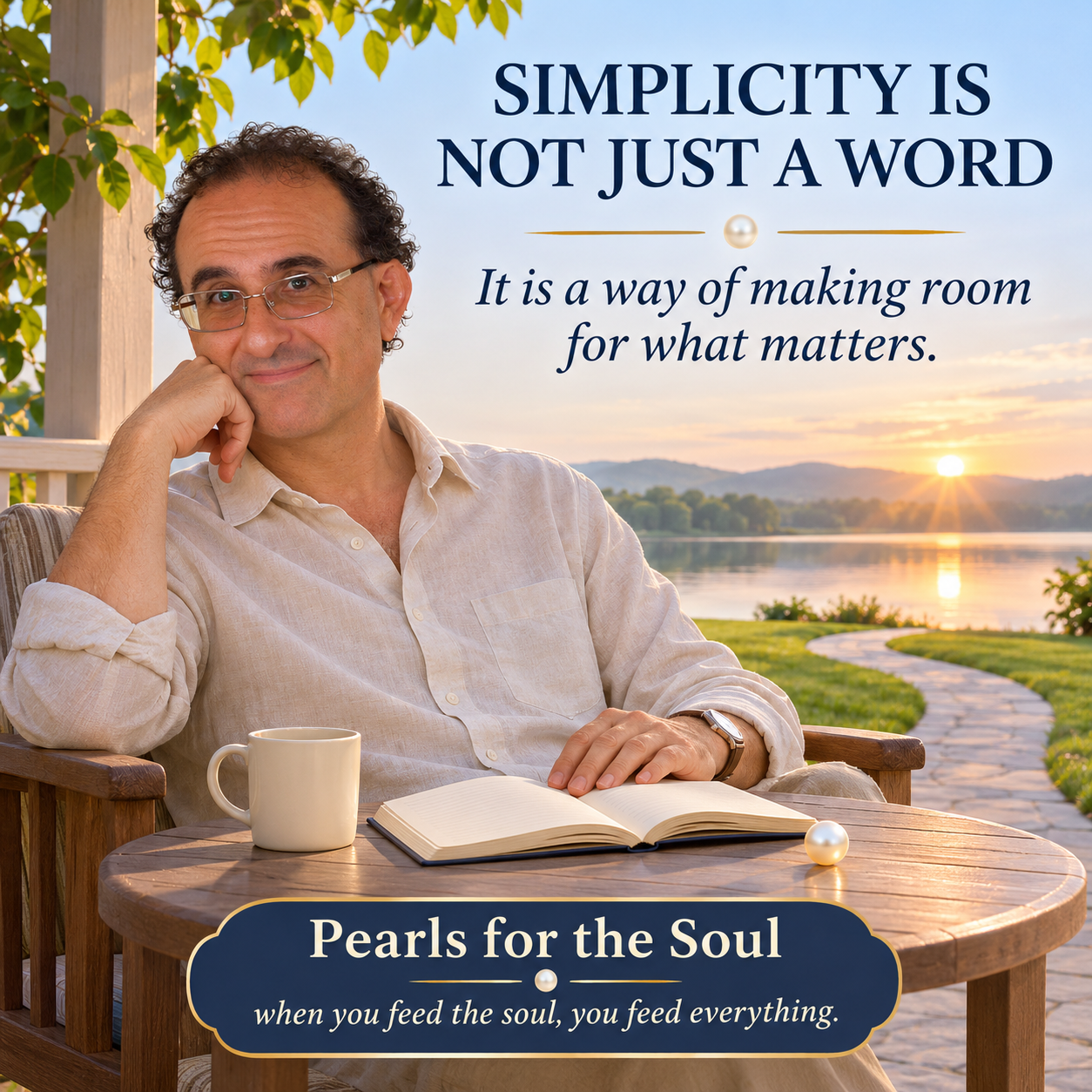
SIMPLICITY IS NOT JUST A WORD
Simplicity is a lifestyle.
When lived, it speaks for itself.
We often hear people say, “Keep it simple.” We imagine how peaceful our world would be in that state—and then return to rigid routines that say otherwise.
True freedom can come from a simplicity that has its own legs.
It moves with purpose.
It clears distractions.
It makes the next necessary action easier to recognize.
In that way, simplicity takes charge.
That is what makes it simple.
CREATED AND BORN
Small children do not have to be instructed to keep things simple.
They may not even understand what you mean if you tell them.
Why?
Because they begin in a naturally simple state of being that requires little coaching, explanation, or effort.
A child can enjoy a cardboard box after ignoring the expensive gift that arrived inside it.
A puddle becomes an adventure.
A familiar story can be heard again.
A question is asked because an answer is desired—not because someone wants to sound impressive.
The most endearing thing is that this simplicity works so well on its own.
RELAX, WILL YOU?
One sign that life has moved away from simplicity is constant stress.
You are on edge.
Everything feels urgent.
Ambition never rests.
Every task becomes a test of personal worth.
Ambition itself is not wrong. Worthwhile accomplishments often require planning, sustained effort, sacrifice, and attention.
But that does not make the process simple.
Simple is as simple does.
Because simplicity appears almost too easy, we may lack faith that it can produce anything important.
We complicate the process to prove we are working.

BEING WILLFUL
When something does not unfold according to our timeline, we may light a fire under it.
We push harder.
We interfere.
We attempt to force an outcome that may require preparation, patience, cooperation, or timing.
This is willfulness at work—and willfulness is no respecter of simplicity.
Wanting something so badly can cause us to sacrifice the very conditions that might allow it to develop.
Sometimes we apply more force than the situation requires.
Other times, effort really is necessary.
Simplicity helps us tell the difference.
ARE WE HAVING SIMPLE YET?
Remember, this discussion is about simplicity—not getting everything we want at any cost and under every condition.
When pursuing something aggressively, we must respect the difference between want and need.
Pause here.
Reflect.
There is a difference.
A want may be enjoyable, useful, or meaningful.
A need supports life, health, safety, responsibility, or genuine well-being.
Confusing the two can make every desire feel like an emergency.
WANT AND NEED
Need usually supports simplicity because it identifies what must be addressed.
Food.
Water.
Shelter.
Safety.
Medical care.
Rest.
Truth.
Necessary work.
Healthy connection.
Wants can also be pursued at a steady pace—but problems begin when we turn on the after-burners and behave as though one unfulfilled desire will destroy us.
Want to need?
Or need to want?
It is worth asking.
BEING DRIVEN?
Have you ever been so hungry that the feeling consumed your attention until you could address it?
Then the food arrived.
At first, you may have eaten quickly.
As the need was satisfied, you slowed down.
Once full, the entire event lost its urgency.
The signal had completed its purpose.
A genuine need calls for attention, but after it is responsibly addressed, it should not continue screaming as though nothing happened.
Some wants keep shouting long after enough has been reached.
Simplicity knows when to stop.
IT WILL HAPPEN—OR IT WON’T
Why must everything arrive in an urgent, upset state when some things can develop naturally through steady effort?
We often create dramatic high points that are followed by exhausting low points.
A “steady as she goes” approach may be less exciting, but it can be more sustainable.
In that framework, much of what needs to get done gets done.
Not every desired outcome will happen simply because we remain calm.
Life includes uncertainty, loss, unfairness, and circumstances outside our control.
Simplicity does not promise success.
It helps us respond without adding unnecessary confusion.
WHEN DID I BECOME NOT SIMPLE?
We possess simplicity as children without knowing it.
We rediscover it at different times throughout our lives.
As we grow older, many of us begin welcoming its return to the head of the table.
The question becomes:
Why did we leave it?
Was it comparison?
Fear?
Competition?
The need to impress?
The belief that more always means better?
Perhaps simplicity was not stolen in one dramatic event. Perhaps it was covered slowly by commitments, possessions, expectations, and habits we never stopped to question.
COMMON SENSE AND SIMPLICITY
Simplicity allows the obvious to have its way.
We tend to interfere, turn things up, turn things down, or deny what is directly in front of us.
Common sense works well with simplicity.
What needs to be done is revealed.
If we accept it and act, the next step may become clear.
Drink the water.
Make the call.
Tell the truth.
Put the item where it belongs.
Finish one task before beginning five others.
Say no when no is required.
Rest before exhaustion makes the decision for you.
It can be that simple—even when it is not easy.
FAITH
If we believe something can be approached calmly and directly, we give simplicity an opportunity to demonstrate its value.
Its secret is often timing.
The appropriate timing may differ from our preferred timing.
Faith is not passive waiting while ignoring responsibility.
It is taking the next reasonable step without demanding to control every step after it.
We move with the flow while keeping our hands available for the work that belongs to us.
WINNERS BY DESIGN
If you have matured and lived for any length of time, you have seen plans unfold in unexpected ways.
You have also seen people endure circumstances they never requested.
We were not put here merely to be defeated, humiliated, or denied human worth.
But being “winners” does not mean receiving every desired result.
Sometimes winning means completing the goal.
Sometimes it means recognizing that the goal no longer serves us.
Sometimes it means surviving.
Sometimes it means asking for help.
Sometimes it means letting go without losing ourselves.
TRUST
Life can be rewarding when we cooperate with what is true instead of arguing with every reality.
Trust yourself.
Trust the Self-Maker.
Use your reason.
Seek help when needed.
Allow the mystery of the process to reveal itself without insisting that everything arrive through stress and tedious struggle.
Some difficult episodes cannot be avoided.
Others are prolonged because we continue fighting the lesson they are trying to deliver.
BODY-SPEAK
The body often speaks when our pace, habits, or demands become unsustainable.
Tension.
Sleeplessness.
Fatigue.
Pain.
Changes in appetite.
Irritability.
Difficulty concentrating.
These signals deserve attention.
Chronic stress can affect health, but it is not the sole explanation for illness or organ failure. Medical symptoms should not be reduced to attitude, faith, or lifestyle alone.
Respect body-speak by resting, adjusting habits, and seeking appropriate medical care when needed.
Simplicity includes knowing when a problem requires professional help.
RESPECT SIMPLE
Simplicity should not be dismissed as shallow, lazy, or unintelligent.
It is not merely a pleasant location we discuss while choosing never to visit.
It should become a destination—and eventually the home sweet home of the sojourner.
Simple does not mean empty.
It means intentional.
It means removing what does not serve the life we are trying to live.
In that world, contentment and satisfaction are not endlessly postponed until one more possession, accomplishment, or approval arrives.
Enough is allowed to be enough.
Have your fill of that.
FINAL THOUGHT
Simplicity is not doing nothing.
It is doing what matters without allowing everything else to demand equal space.
Make the plan clear.
Take the next necessary step.
Then leave room to breathe.
PEARLS INSIGHT (SEO)
Simple living can reduce unnecessary decision-making, clarify priorities, and support more sustainable habits. It does not require abandoning ambition or possessions. It means intentionally directing time, energy, attention, and resources toward genuine needs and personally meaningful priorities.
PEARLS FROM THE BOOKS
Life does not always become easier when we add more. Sometimes it becomes clearer when we remove what was never necessary.
PEARLS CONNECTION
Choose one area of your life that feels unnecessarily complicated.
What is genuinely needed?
What is merely wanted?
What can be removed, delayed, delegated, or declined?
What is the simplest responsible next step?
RICHIE SPEAKS
We can turn on the after-burners, fly past the destination, run out of fuel, and then brag about how hard we worked.
Or we can slow down long enough to notice that the next right step was sitting directly in front of us.
Easy-peasy, nice and breezy does not mean careless.
It means stop making everything harder than it has to be.
FINAL SAY
Remove what distracts.
Respect what matters.
Do what is needed.
Make room to breathe.
Simplicity is not just a word.
— Richie
Pearls for the Soul
when you feed the soul, you feed everything.
https://pearlsforthesoul.com

Been expecting you