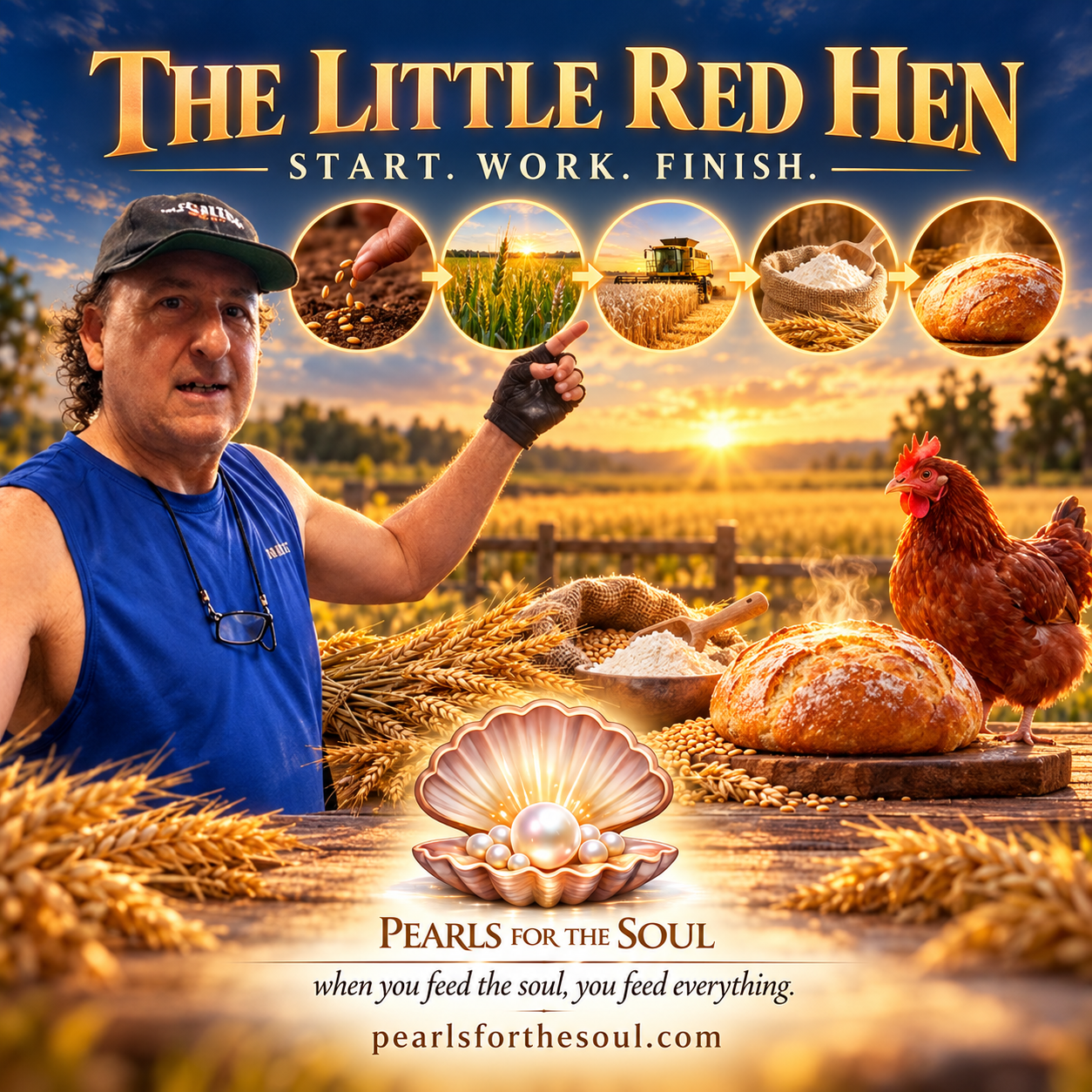
Everyone wants warm bread when it comes out of the oven.
The real question is:
Who was willing to plant, harvest, grind, mix, knead, and bake before the wonderful smell arrived?
The value contained within The Little Red Hen story is plentiful and never-ending.
It parallels our human journey.
One day, the hen decides she wants fresh bread.
She shares the idea with others and asks for help.
Instead of volunteers, she receives negative reviews, excuses, criticism, and rejection—all capable of stopping her before she begins.
So, she begins anyway.

THE PROCESS OF BREAD
The hen searches for wheat seeds.
She finds them.
She gathers them.
Then she asks:
“Who will help me plant the wheat?”
Nobody.
So she plants it.
She waters and cares for it until the green sprouts appear and grow into mature wheat.
Then she asks:
“Who will help me harvest it?”
Again, nobody.
She gathers the harvest and takes the grain toward the mill to be ground into flour.
At every stage, she continues asking for assistance.
At every stage, she is refused, dismissed, ignored, or laughed at.
But the hen stays with the process.
Seed.
Soil.
Care.
Harvest.
Mill.
Flour.
Dough.
Oven.
She wants to finish what she started.
HERE IS WHERE HELP SUDDENLY APPEARS
The hen forms the loaf and places it inside the oven.
Soon the smell of fresh bread moves throughout the farm.
Now everybody is interested.
Nobody can discuss anything else.
The aroma is powerful.
The loaf emerges golden, warm, and ready.
Suddenly the whole farm arrives to ooh and ahh.
Then comes the question:
“CAN WE HAVE SOME?”
“No,” says the hen.
“I did all the work. I asked for help along the way and was refused, ridiculed, and ignored. But I stayed the course because I wanted fresh, delicious bread.
“Now I will eat my bread myself.”
Yum.
Cannot wait.
WHO CAN DENY HER?
Who decides what you must do with your paycheck, automobile, clothing, property, time, talent, or life?
You carry responsibility for your choices.
Blame is not a plan.
Neither are envy and coveting.
Do you want something worthwhile?
Begin pursuing it.
Do you need help?
Ask.
But remember that asking does not guarantee participation. Sometimes you must continue with the resources, skills, and strength available to you.
Use your turn.
THE OTHER SIDE OF THE LESSON
The hen earned the bread.
Those who refused the work had no automatic claim upon the result.
That is fairness.
But wisdom also asks us to distinguish among people.
Some refuse to help.
Some are unable to help.
Some arrive late but are willing to contribute now.
Some helped us in ways not visible during this particular project.
Fairness should protect effort without turning the hardworking person bitter.
Generosity should remain voluntary—not demanded by those who avoided every part of the process.
THE BARNS OF STORAGE
Another lesson enters here from the biblical story of the rich fool.
A hardworking man gathered such an abundance that he built larger barns to store everything.
His success became an obsession.
He measured life by how much he accumulated while becoming increasingly unaware of God, others, and the condition of his own soul.
Then life demanded something he had not stored and could not purchase:
More time.
Productivity is valuable.
Accumulation is not the same as purpose.
The Little Red Hen worked to complete something useful.
The rich fool accumulated merely to possess more.
The outside action may look similar.
The inner motive changes everything.
MANKIND’S INS AND OUTS
Human beings possess an outer kingdom and an inner one.
The outer kingdom seeks security, comfort, achievement, possessions, and pleasure.
The inner kingdom seeks gratitude, righteousness, truth, virtue, faith, love, and meaning.
Both require attention.
Consider the caterpillar.
It must eat, grow, enter the cocoon, and undergo its transformation.
If the caterpillar refuses the process:
No butterfly.
The inner life must also be fed, obeyed, exercised, and invested in.
Spiritual results do not appear because we admired them from a distance.
WHAT DO WE LEARN HERE?
We travel collectively.
There is enough room for effort, cooperation, contribution, and shared reward.
The big picture is often born from one small premise:
Someone begins.
When people contribute honestly, more can be accomplished with less burden placed upon one person.
But a team is not a group of people waiting for one worker to finish.
Teamwork requires work by the team.
Quality rules over quantity.
Completion matters.
And the smell of bread is not evidence that you helped bake it.
PAUSE FOR CAUSE
Are you participating—or waiting for the reward?
Are you asking for help—or demanding that someone else carry your responsibility?
Are you building something useful—or merely enlarging your barns?
Have you thanked the person who kept working when nobody volunteered?
PEARLS INSIGHT
Everybody notices the loaf.
Character notices the labor.
RICHIE SPEAKS
Plant the seed.
Care for the field.
Gather the wheat.
Make the flour.
Work the dough.
Finish what you started.
If others join you honestly, welcome the teamwork and share the accomplishment fairly.
If they refuse, do not allow their excuses to become yours.
And when success finally comes out of the oven, remember every step that produced it.
The result remembers the work—even when the crowd does not.
Start.
Work.
Finish.
— Richie
Pearls for the Soul
when you feed the soul, you feed everything.
https://pearlsforthesoul.com

Been expecting you