We make hundreds of choices without keeping count.
Some choices move us. Some omissions hold us still. Some repeated decisions quietly become a life.
You cannot command every outcome—but you can pause, examine your beliefs, and take responsibility for the direction you choose.
THE POWER TO CHOOSE—OR NOT
We make hundreds of choices each day without keeping count.
Those choices eventually help define our lives.
Stop and consider this.
A day, event, situation, or task is influenced by what we do—and sometimes by what we repeatedly fail to do. These are acts of commission and omission.
For this short period we call life, our decisions can influence many outcomes—the good ones as well as those that are not so good.
We cannot control every circumstance, other person, illness, accident, or unexpected event. But within those realities, we still have choices concerning our direction, response, effort, attention, and beliefs.
That is where personal reality begins taking shape.
LESS IS MORE
Trial and error has its way with all of us.
We learn by doing, correcting, and trying again. But life does not have to remain an endless learning curve in which every lesson must be discovered the hardest possible way.
We have also been given common sense.
We can reason, observe, compare, remember, and assess. We can learn from other people’s victories and mistakes.
Common sense helps us use less unnecessary effort for more meaningful gain.
Less confusion.
Less repetition.
Less self-created trouble.
Sometimes less is more because less interference allows the obvious answer to become visible.

SINKING IN THINKING
Thinking is useful.
Overthinking is something else.
Thinking too much can be confused with making a wise choice. The deeper we sink into the think, the easier it becomes to complicate a simple matter.
Eventually, we may become the lawyer, judge, witness, and confused client in a courtroom entirely constructed inside our own head.
That person may have a fool for a client.
If every answer could be found through thinking alone, many brilliant people before us would have solved life completely and left the instructions for everyone else.
They did not.
The mind is a wonderful tool. It was never meant to become the only voice in the room.
THE GUT
Haven’t you heard someone say that the first answer visiting you may be the one to consider?
We commonly call this the gut.
A gut response may come from accumulated experience, pattern recognition, conscience, bodily awareness, or something we cannot immediately explain.
It can help us progress toward what was intended.
However, intuition is not automatically correct. Fear, prejudice, past injury, wishful thinking, or incomplete information can also create strong internal reactions.
Listen to the gut—but test what it says.
When health, money, safety, or another person’s welfare is involved, intuition should work alongside evidence, common sense, and qualified guidance.
The gut can knock on the door.
Wisdom still decides whether to let the visitor in.
BUSY BODY
It is interesting to notice that the body performs countless adjustments every day without holding a meeting with us.
The heart beats.
The lungs breathe.
The digestive system processes.
Temperature is regulated.
Cells repair and communicate.
The body operates at speeds of necessity, adding, reducing, correcting, and balancing what it can to maintain life.
We are not consciously choosing every one of these adjustments.
Life is already carrying out an enormous amount of work on our behalf.
That should make us pause in appreciation.
THE OBVIOUS
The body also communicates.
If we do not properly care for it, it may send prompts through hunger, thirst, fatigue, discomfort, tension, or other changes.
Those signals deserve attention.
Sometimes the need is obvious: rest, water, food, movement, or relief from stress. Other symptoms are not obvious and require professional evaluation rather than guessing.
The larger point remains:
Useful information is frequently present in the moment, but we must become quiet and aware enough to notice it.
PAUSE
People who feel stuck or continually repeat the same behavior may begin blaming or denying.
Eventually, something has to bring us to our senses.
We must accept responsibility for choices made, choices avoided, and patterns repeatedly permitted.
Not every problem begins in our beliefs. Outside circumstances and other people’s actions are real.
Still, our beliefs influence what we notice, expect, attempt, tolerate, and repeat.
Stopping to have a look is recommended.
Pause does not mean surrender.
Pause gives you enough room to see what has been driving.
WATCH THE BLAME GAME
Beliefs are interesting.
They are invisible, but powerful.
Beliefs can drive the life bus.
They influence whether we recognize opportunity, attempt something new, accept help, persist through resistance, or decide in advance that nothing will work.
Beliefs can help produce gain and growth. Unexamined beliefs can also contribute to loss, limitation, or unnecessary denial.
The temptation is to blame the other fellow’s beliefs and create a story explaining how his way is interfering with our way.
Sometimes another person truly is interfering.
But blame becomes a game when it replaces the examination of our own choices.
Ask:
What belongs to them?
What belongs to me?
What can I actually change?
WHO’S IN CHARGE?
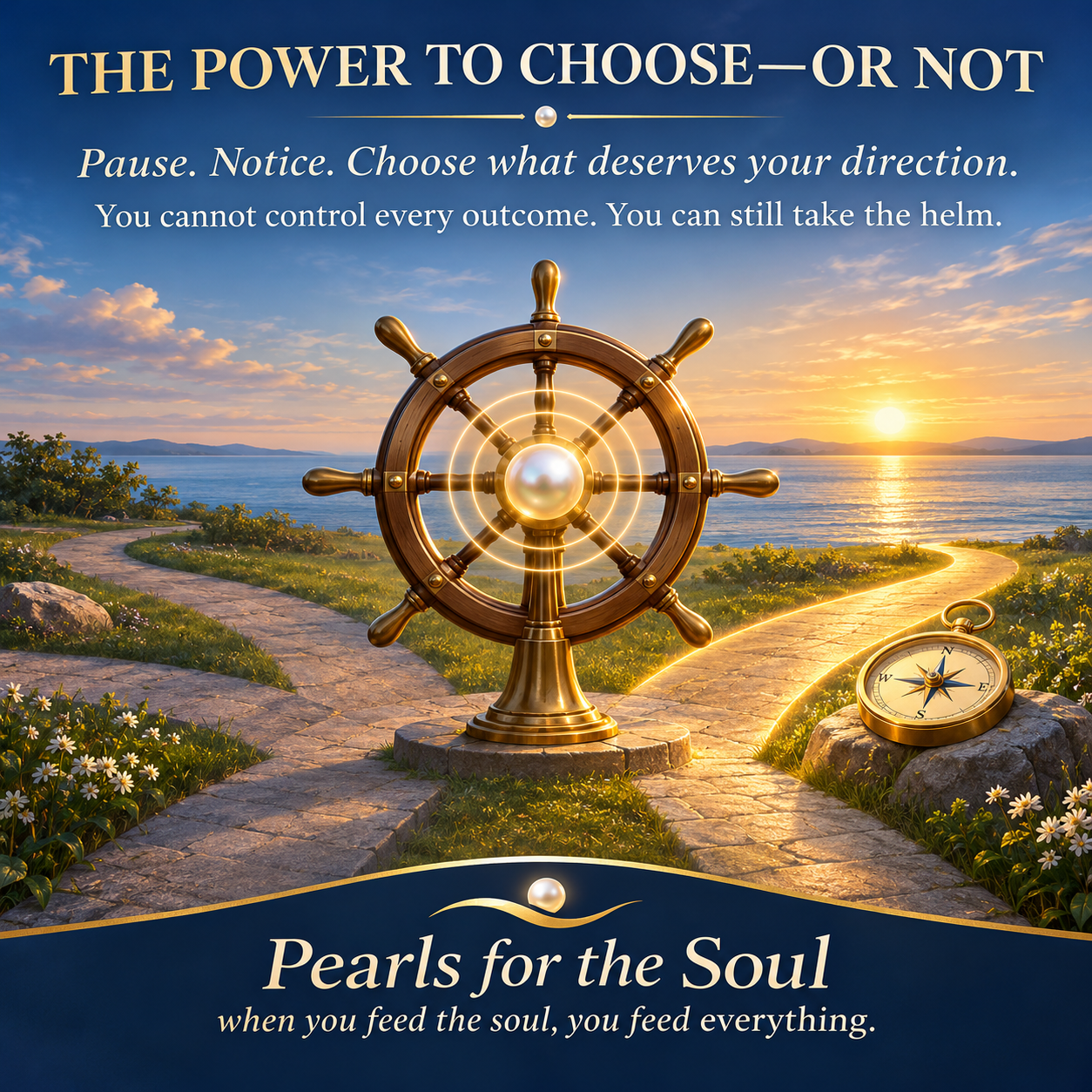
We are captains of our own ships.
We do not control the ocean, weather, wind, other vessels, or every hidden condition beneath the surface.
But the helm still answers to the person holding it.
We steer where we can.
We adjust when conditions change.
We decide whether to continue, turn, slow down, request assistance, or find a safer harbor.
Believing we control everything is unrealistic.
Believing we control nothing gives away the helm.
Beliefs should be examined, tested, modified, and used wisely.
It is often done to us according to what we believe because beliefs affect what we are prepared to see and do.
Spend time on this quality subject.
SIMPLE IS AS SIMPLE DOES
People who practice simplicity often discover that fewer unnecessary choices can improve life.
Too many options can exhaust attention and make minor matters seem important.
Life already knows how to perform many of its functions with little conscious interference. Sometimes we help ourselves by establishing sound routines, removing needless choices, and allowing good habits to carry part of the load.
Everything we seek is not automatically found within us.
But much of what we need to recognize—our values, conscience, capacity to love, ability to learn, and willingness to begin—must eventually be activated from within.
Simple is as simple does.
BECOME CAREFREE
True freedom can include freedom from unnecessary choices.
That lesson may take a lifetime to understand.
We often imagine freedom as having endless options. Yet endless options can become another burden.
The childlike spirit offers a different model.
A child can become involved in what is happening without analyzing every possible alternative. That lighthearted, carefree quality allows life to be experienced instead of constantly evaluated.
Childlike does not mean childish or irresponsible.
It means retaining receptivity, curiosity, and innocent attention.
Willfulness and pride can block that input because they insist that every moment must obey the self.
MAY I HAVE A MOMENT?
One of the best gifts we can give ourselves or others is attention.
Become more aware.
Increase your receptivity to what is happening around you.
The present moment is the starting place for every choice. It is also where the effects of past choices become visible and where a new direction can begin.
The past can teach.
The future can call.
But the choice is always made now.
The present remains a mystery because the moment we recognize it, it is already moving.
Still, it is the only place where life can be met.
PROOF OF FOREVER
The present moment can feel like a taste of eternity.
Life continues through one now after another.
Something greater than us perpetuates and sustains this process.
We participate, but we did not invent it.
In this realm, we are observers and receivers as well as choosers and doers.
We receive breath, time, awareness, opportunity, and the capacity to respond.
For those who believe, this allows room for a Father in Heaven to care for His own.
We take the helm without pretending we created the sea.
SOLVE THIS RIDDLE
“If you do nothing right, you will do nothing wrong.”
There is the riddle.
Doing nothing may prevent certain mistakes. It also prevents many discoveries, corrections, contributions, and accomplishments.
Refusing to choose is itself a choice.
Yet constant interference is not the answer either.
There is a right way that begins verifying itself through wisdom, peace, responsibility, and results.
The mother concept of choosing may be found between two extremes:
Do not force every moment.
Do not abandon the helm.
Pause.
Observe.
Receive what is present.
Then choose what deserves your direction.
FINAL THOUGHT
You cannot control every outcome, but neither are you powerless.
Examine your beliefs.
Listen to intuition without making it your only evidence.
Use common sense.
Stop playing the blame game.
Become aware of the present moment and take responsibility for the direction available to you.
Life supplies the water.
Circumstances supply the weather.
You still have a hand on the helm.
PEARLS INSIGHT (SEO)
Better decision-making begins with self-awareness, personal responsibility, common sense, and the ability to pause before choosing. Examining limiting beliefs and avoiding overthinking can help us make wiser life choices while accepting that not every outcome is under our control.
PEARLS FROM THE BOOKS
Refusing to choose does not remove choice. It quietly hands your direction to circumstances, habits, or someone else.
PEARLS CONNECTION
What repeated choice—or repeated avoidance—is quietly determining your direction?
Pause long enough to notice it.
Then decide whether it still deserves control of the helm.
RICHIE SPEAKS
Do not sink so deeply into thinking that you lose the simple answer standing in front of you.
You do not control the ocean, but you are not merely cargo either.
You have a hand on the helm.
Use it wisely.
FINAL SAY
Pause. Notice. Choose what deserves your direction.
You cannot control every outcome.
You can still take the helm.
— Richie
Pearls for the Soul
when you feed the soul, you feed everything.
https://pearlsforthesoul.com

Been expecting you