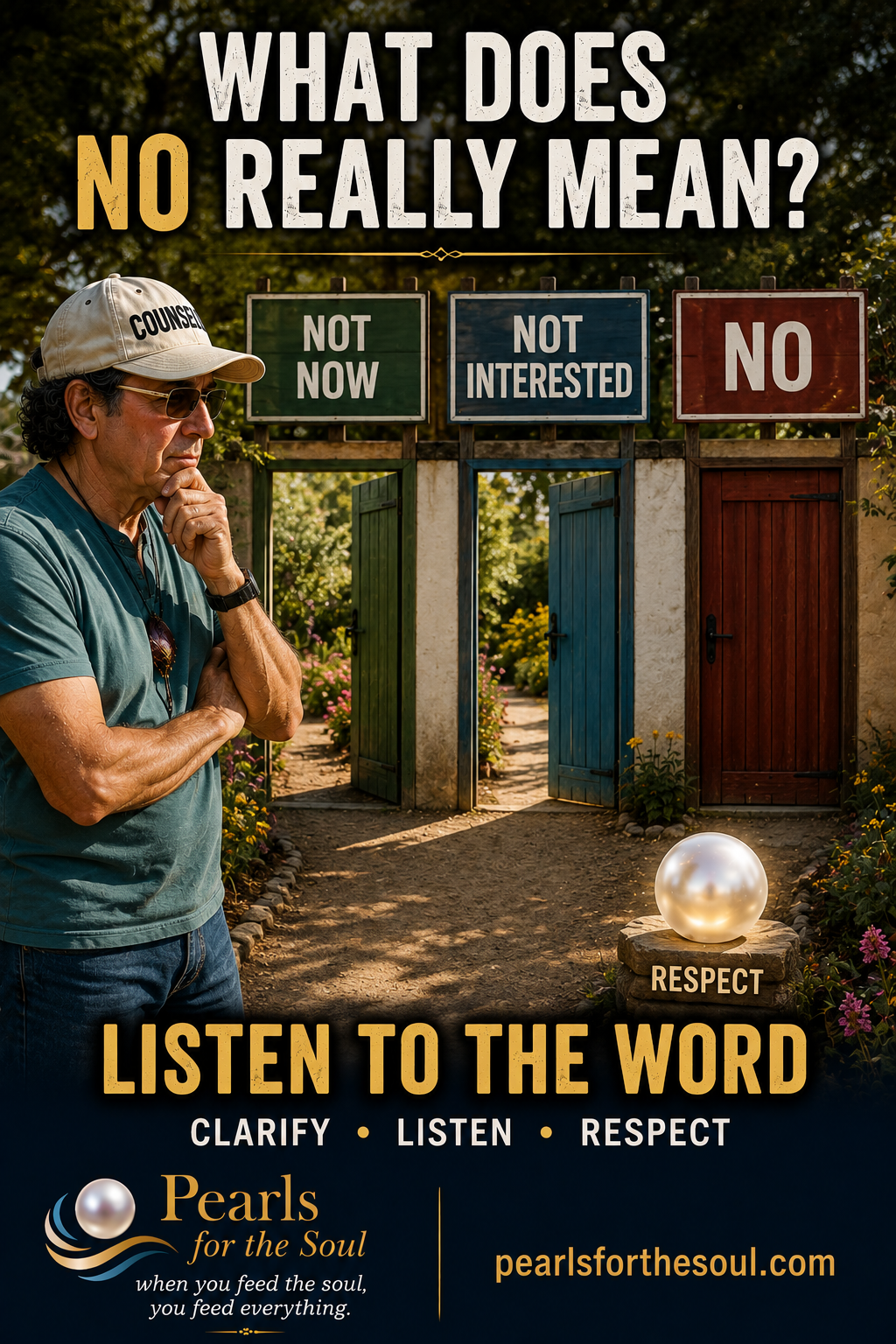

NO is a very small word.
But it can carry a very large message.
The trick is knowing when NO means:
not now,
not interested,
or simply…
NO.
A person’s word should mean something.
NO is definitely a word where someone has chosen a side.
So what do you say to someone who says NO?
That depends on the situation.
And this is where people get themselves into trouble.
Because NO can be:
a boundary,
a delay,
a hesitation,
a rejection,
a temporary answer,
or the final answer.
The challenge is knowing which one you are hearing.
SALES PEOPLE SEE IT AS AN OPPORTUNITY
In sales, NO has traditionally been interpreted in many different ways.
Not now.
I have to go.
I am not ready.
I did not bring my checkbook.
I am not feeling well.
I do not want to be bothered.
I need more information.
I do not see the value yet.
That is why experienced salespeople sometimes do not automatically interpret the first NO as the end of the conversation.
They may ask a question.
Clarify.
Change the approach.
Address an objection.
Fine.
But PAUSE FOR CAUSE.
There is a line.
A professional explores.
A nonprofessional ARGUES.
Once the other person has made their position clear…
respect it.
There is a tremendous difference between:
“May I ask what is holding you back?”
and
“Let me keep wearing you down until you surrender.”
One is inquiry.
The other is pressure.
NO DICE
Now take the same little word into another setting.
A date.
A relationship.
Physical contact.
Personal boundaries.
Here, NO carries much more weight.
If someone says NO to physical or sexual contact, it means stop.
Not:
convince me.
Not:
ask seventeen more times.
Not:
maybe if you keep pushing.
NO.
That boundary deserves immediate respect.
Different settings require different judgment.
That is why context matters.
The same two letters can carry different implications depending on what is being discussed.
KIDS KNOW HOW TO WORK A NO
Children are famous for testing the word.
“Can I go out?”
NO.
“Why?”
“Can I go later?”
NO.
“How about after dinner?”
NO.
“What if everybody else is going?”
Now the negotiations have begun.
LOL.
Children learn very quickly that sometimes NO means:
ask again.
Then ask another way.
Then ask the other parent.
Then wait ten minutes.
Then return with new evidence.
That is why parents have to decide what THEIR NO means.
If the answer is truly final…
make it final.
Otherwise the child learns that NO is merely the opening bid.
NON-SENSE…OR NO SENSE
When NO is repeatedly ignored, some people eventually stop answering.
Silence becomes the next boundary.
But even silence can be misunderstood.
The other person may:
repeat themselves,
talk louder,
try another angle,
or assume they did not hear you.
Sometimes a polite response works better.
“No, thank you.”
That little THANK YOU can carry surprising strength.
It says:
I heard you.
I understood you.
I have decided.
And I am not inviting another round.
TEENS KNOW NO
People have invented all kinds of versions of NO.
NO.
NO!
No thank you.
No no no.
NOoooooo.
Teenagers have practically turned it into a complete language.
LOL.
Tone matters.
Facial expression matters.
Context matters.
But the word itself still deserves respect.
If you mean NO…
say NO.
If you mean NOT NOW…
say not now.
If you mean MAYBE…
say maybe.
Communication improves tremendously when people stop making others guess what the word actually means.
IT’S A NO-NO
NO smoking.
NO pets.
NO parking.
NO refunds.
NO loitering.
NO talking.
NO eating.
Pretty clear language.
And yet…
what happens?
Somebody tests it.
That tells us something interesting about human beings.
We do not merely hear boundaries.
We often TEST them.
Can I get away with it?
Will they enforce it?
Does that rule apply to me?
How serious are they?
That is why boundaries without follow-through become weak very quickly.
WHAT DOES NO REALLY MEAN?
Maybe the larger issue is not the word.
Maybe it is CREDIBILITY.
If people repeatedly say NO when they really mean MAYBE…
the word weakens.
If rules say NO but are never enforced…
the rule weakens.
If a salesperson treats every NO as meaningless…
trust weakens.
If someone states a personal boundary and it is ignored…
the relationship weakens.
Words gain power when behavior supports them.
NO should mean what the person intends it to mean.
And when you are not sure…
ASK.
That is much better than assuming.
RICHIE SPEAKS
Here is one Richie rule:
Do not make people guess whether your NO is real.
Another:
A question after NO can be appropriate.
Pressure after a clear NO usually is not.
And one more:
Respecting somebody else’s boundary does not make you weak.
It proves you heard them.
PEARLS FROM THE BOOKS
From the spirit of Pearls for the Soul:
“Words gain strength when conduct repeatedly proves they mean what they say.”
From the spirit of God I AM:
“Respect begins when another person’s boundary is allowed to remain theirs.”
From the spirit of It Is Finished:
“When the answer is clear, stop trying to reopen what has already been closed.”
PEARLS INSIGHT
The word NO works best when people use it clearly and respect it appropriately.
In low-stakes situations such as sales or scheduling, a first NO may sometimes mean hesitation, timing, or lack of information.
In personal safety, physical contact, and sexual boundaries, a clear NO should be treated as final.
The safest approach when meaning is uncertain is simple:
clarify once,
listen carefully,
then respect the answer.
PEARLS CONNECTION
This connects directly with MORE VALUABLE THAN GOLD…A PERSON’S WORD.
If words are to have value, they have to mean something.
It also connects with I NEVER SAID THAT…YES YOU DID.
Communication breaks down when people hear what they WANT rather than what was actually said.
And PERSPECTIVE: COMMUNICATING YOURS AND UNDERSTANDING THEIRS reminds us that communication is not complete until both sides understand what the other one means.
FINAL SAY
What does NO really mean?
Sometimes:
not now.
Sometimes:
not interested.
Sometimes:
I need more information.
And sometimes…
it means exactly what it sounds like.
NO.
So listen to the word.
Listen to the context.
Ask for clarity if needed.
Then respect the answer.
Because when people stop meaning what they say…
or stop respecting what others say…
communication becomes NON-SENSE.
Or perhaps…
NO SENSE.
Know what I mean?
NO?
LOL.
— Richie
Pearls for the Soul
when you feed the soul, you feed everything.
https://pearlsforthesoul.com

Been expecting you