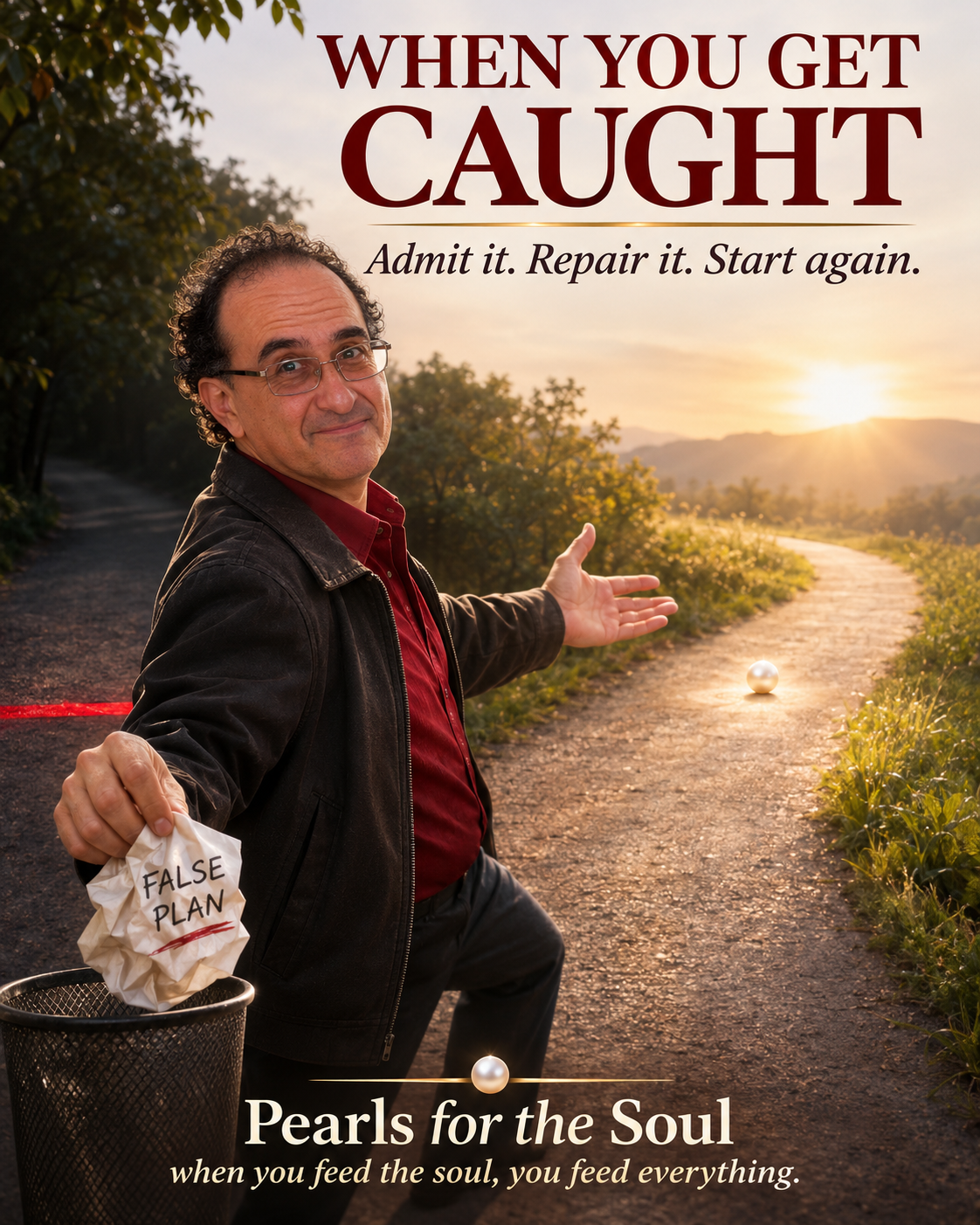
Getting caught exposes more than the act.
It reveals the warning we ignored, the story we told ourselves, and the next choice waiting to be made.
WHEN YOU GET CAUGHT—ADMIT IT, REPAIR IT, AND START AGAIN
Caught doing what?
There is no need to specify.
The dynamic itself suggests that something is not right—and we have become a star player in it.
Plotting a steady course, doing what is right, maintaining honesty, and protecting integrity are easier to discuss than to practice.
Why?
The true testing ground is not the mind, the lips, or what we profess.
It is the moment when temptation, pressure, opportunity, fear, appetite, or secrecy asks what we will actually do.
EMBARRASSMENT
Books, faith, instruction, and observation can teach us a great deal.
Embarrassment teaches differently.
In a fraction of a moment, we recognize that something did not go according to plan.
Inner heat appears.
The face may flush.
The stomach drops.
We see the part we played—or failed to play.
Embarrassment can become useful if it directs attention toward correction rather than permanent self-condemnation.
The lesson arrives at an uncomfortable price.
Pay attention to what it is trying to teach.
HUMILIATION
Humiliation is different.
It harms through shame, disgrace, degradation, and attacks upon dignity.
A person may never forget the experience.
That does not make humiliation a healthy teaching tool.
Correction addresses behavior.
Humiliation attempts to reduce the human being.
If someone has done wrong, accountability may be necessary.
Public consequences may occur.
Still, cruelty does not become wisdom merely because the person made a mistake.
We can learn from being exposed without treating degradation as something deserved or beneficial.

CROSSING THE LINE
Where are the boundaries, fences, red lines, and warning signals telling us beforehand what we should or should not do?
Some are visible.
Laws.
Rules.
Promises.
Contracts.
Safety instructions.
Relationship boundaries.
Others appear internally through conscience, common sense, experience, discomfort, or reasonable doubt.
The warning may already be present.
The problem is often not the absence of a heads-up.
It is our refusal to obey it.
CONSCIENCE
Conscience can operate like a rudder.
It helps direct where we do and do not want to go.
We may not need to summon it deliberately.
It can activate on its own.
“Do not do this.”
“Tell the truth.”
“Return it.”
“Stop.”
“Apologize.”
Conscience is shaped by beliefs, upbringing, culture, knowledge, and experience. It should be informed rather than assumed perfect.
Its warning still deserves examination.
A rudder cannot help if the person steering continually ignores it.
GREED
We are allowed to pursue, participate, accomplish, gain, and have.
Then a silent caveat appears.
At what cost?
Greed is not merely wanting more.
It is an overreach—a dominant portion aggressively pursued or taken without reasonable concern for fairness, consequences, or other people.
Greed says:
“More for me, regardless of what it does to you.”
It turns opportunity into appetite without a stopping point.
NOT THE RIGHT WAY
When greed crosses the line, we may know immediately that we overdid it.
Others may see it too.
Then greed’s companion arrives:
Denial.
Denial explains why the behavior was acceptable.
Excuses defend the moment.
The story becomes more complicated because reality remains simple:
The line was crossed.
If we obey denial, the defense begins working against us instead of for us.
We become trapped maintaining what should have been admitted.
RELATIONSHIPS
Abuse, aggression, dishonesty, and selfish behavior take a toll upon more than the person practicing them.
Those closest may be harmed first.
Trust is damaged.
Safety disappears.
Words remain remembered.
Deep emotional injuries may require time, distance, professional help, accountability, or complete separation.
An apology does not automatically repair every relationship.
Forgiveness cannot be demanded.
The person who caused harm is responsible for changing behavior, respecting boundaries, and accepting that the injured person controls their own participation.
CRIMINAL COURTS
Court brings conduct into a structured public process.
Events are slowed down.
Evidence is presented.
Connections are examined.
Arguments are heard.
Judgments may follow.
Penalties can range widely depending upon the facts, law, jurisdiction, and decision-maker.
Private remorse and public accountability are not the same.
Feeling sorry does not erase legal consequences.
Legal consequences do not prevent genuine remorse or future change.
When legal matters are involved, qualified legal counsel—not assumptions—should guide decisions.
REGRET
Regret includes disappointment or sadness about something done, not done, or poorly done.
It points toward a missed opportunity or an ill-spent one.
Regret can become a stepping stone toward healing if its message is respected.
Ask:
What exactly do I regret?
Who was affected?
What can be repaired?
What must never be repeated?
Regret that produces only endless self-punishment becomes another prison.
Regret that produces truth and correction becomes instruction.
SECOND CHANCES
Thank goodness for opportunities to return, repair, learn, and start again.
Without second chances, one error could define an entire life.
A second chance does not mean pretending nothing happened.
It carries the first lesson into the next decision.
Within Richie’s spiritual language, this change of mind and direction is repentance.
We see what occurred.
We reject the desire to repeat it.
Then we build evidence of change through different behavior.
WHY GETTING CAUGHT?
Who wants to live continually wondering whether exposure is coming?
That is no peaceful life.
Secrecy requires surveillance.
Every question feels threatening.
Every unexpected call produces fear.
Some people experience relief when the truth finally appears because maintaining the hidden conduct had become its own punishment.
Getting caught ends the hiding.
It does not end the consequences.
It begins the possibility of honesty.
CALCULATE THE RISK
No one lives with perfect performance.
We make mistakes, misunderstand situations, overlook consequences, and sometimes choose badly.
We still possess valuable resources:
Warning systems.
Advice.
Experience.
Conscience.
Laws and standards.
The ability to pause.
The opportunity to admit.
The possibility of repair.
A route back toward integrity.
When standing at a crossroads, give the decision a good pause.
Ask what happens if the act becomes completely known.
HOW NOT TO GET CAUGHT
Do not plan or commit something that requires hiding from discovery.
That is Richie’s simple answer.
Not everything we want is lawful, ethical, wise, healthy, or ours to take.
Before acting, ask:
Will this profit anyone beyond the immediate appetite?
Who could be harmed?
What promise would be broken?
What story will I need to tell afterward?
Would I proceed if everyone affected were watching?
Temptation may create discomfort when refused.
That discomfort usually passes.
The consequences of giving in may remain much longer.
WHEN YOU ARE ALREADY CAUGHT
Stop adding new deception.
Do not destroy evidence, pressure witnesses, threaten anyone, or invent another story.
If the matter could have legal consequences, obtain qualified legal advice before making statements or decisions.
For personal wrongs:
Admit what is true.
Listen to the harm caused.
Apologize without demanding forgiveness.
Offer appropriate repair.
Accept reasonable consequences.
Demonstrate change over time.
The purpose is not to escape discomfort.
It is to leave the dishonest conduct behind.
STARTING FRESH
Starting fresh does not mean starting innocent.
It means starting informed.
You now know what the ignored warning sounded like.
You know what denial said.
You know the cost of the conduct.
You know what exposure felt like.
Use that knowledge.
A second beginning becomes valuable when the first lesson travels with it.
FINAL THOUGHT
Getting caught can become a crossroads.
One direction adds denial, excuses, and further deception.
The other admits the truth, accepts consequences, repairs what can be repaired, and begins again.
Exposure does not decide which path you take next.
You do.
PEARLS INSIGHT (SEO)
Getting caught in wrongdoing can trigger embarrassment, shame, regret, legal consequences, damaged trust, and relationship loss. Recovery begins with stopping further deception, accepting accountability, seeking qualified help when necessary, making appropriate restitution, respecting boundaries, and demonstrating changed behavior over time.
PEARLS FROM THE BOOKS
A pearl cannot be improved by covering a damaged surface with dirt.
The surface must first be seen clearly.
Personal repair begins the same way.
Exposure is uncomfortable, but truth gives correction something solid to work with.
PEARLS CONNECTION
Think of one warning you ignored before making a poor decision.
Ask:
What did the warning feel or sound like?
What excuse overruled it?
What consequence followed?
What will you do when that warning returns?
Turn the memory into a working safeguard.
RICHIE SPEAKS
The easiest way not to get caught is to stop planning things that require hiding.
If you are already caught, stop digging.
Put down the excuse.
Tell the truth responsibly.
Repair what you can.
Then make the second chance prove that the first lesson was received.
FINAL SAY
Admit it.
Repair it.
Start again—and do not cross the same line pretending you have never seen it.
— Richie
Pearls for the Soul
when you feed the soul, you feed everything.
https://pearlsforthesoul.com

Been expecting you