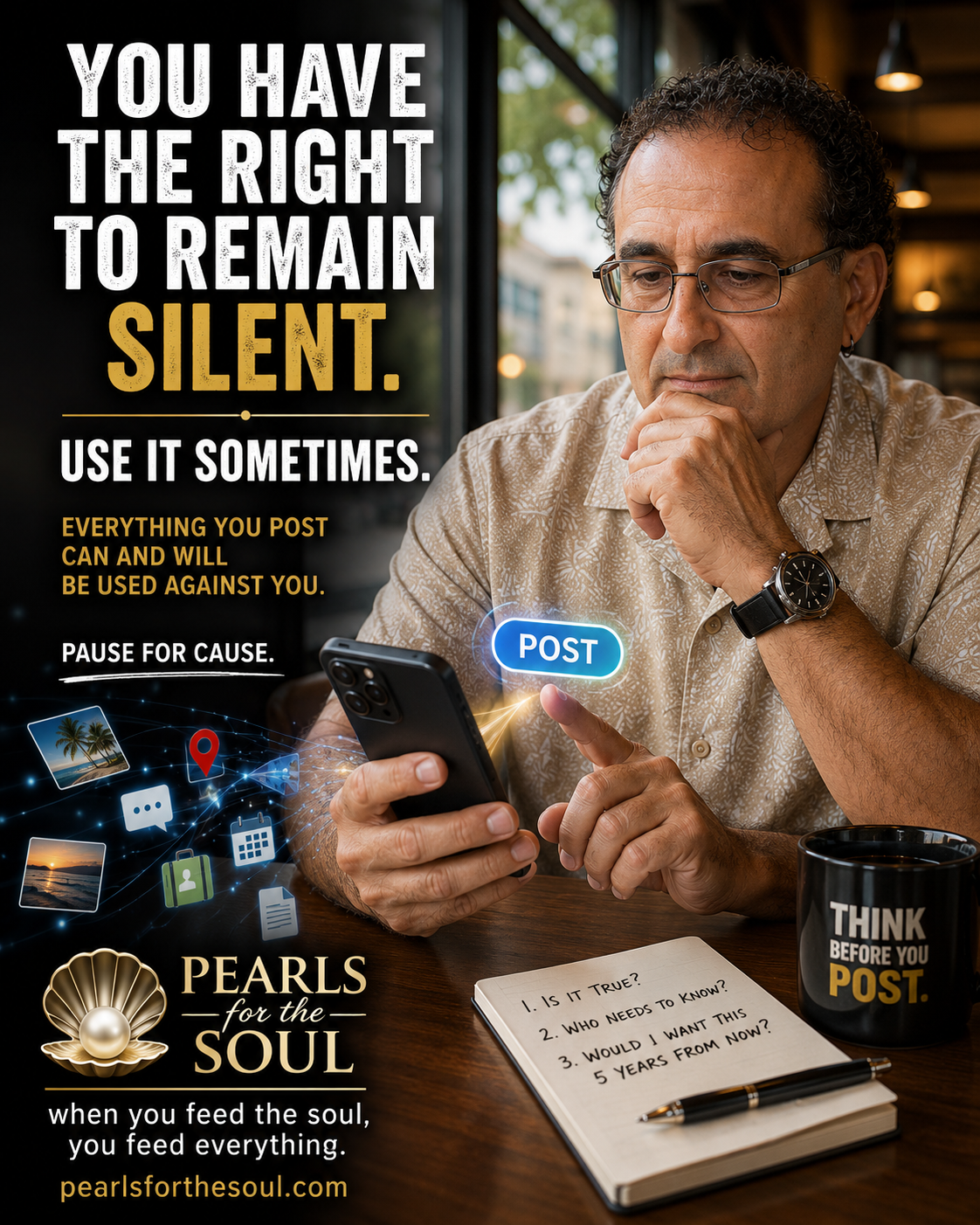
“You have the right to remain silent.”
Good advice in a police station.
Maybe it isn’t bad advice on the Internet either.
Before you POST it…
Ask yourself:
DOES THE WHOLE WORLD REALLY NEED TO KNOW THIS?
“You have the right to remain silent.
Anything you say can and will be used against you…”
WHOA.

Think about that.
The Miranda warning exists because people have an amazing ability to hurt themselves with their own words.
Sometimes we talk when silence would serve us better.
Now move that thought from the interrogation room to the Internet.
Every day people voluntarily announce:
Where they are.
Where they are going.
What they bought.
Who they are angry with.
Who they broke up with.
What they drank.
What they did last night.
What they think about their employer.
What they think about their customers.
What they think about their former spouse.
What they earn.
What they own.
When they are leaving town.
When they will return.
What their children are doing.
Where their children go to school.
And then we press:
POST.
No subpoena.
No interrogation.
No oath.
No attorney asking questions.
WE JUST HANDED IT OVER.
HEY… LOOK AT ME
There is nothing inherently wrong with social media.
It can be fun.
Useful.
Educational.
Professional.
Social.
It can connect families, build businesses, create friendships, share ideas and introduce your work to people you might otherwise never meet.
But somewhere along the way, sharing became oversharing.
And attention became confused with value.
HEY LOOK AT ME.
Look where I am.
Look what I bought.
Look what I’m eating.
Look what I’m drinking.
Look who I’m with.
Look what happened.
Look what somebody did to me.
Look what I did to them.
Fine.
But understand something:
Once you make information public, you no longer completely control how other people interpret, copy, save, forward or use it.
That deserves a little thought.
YOU MAY HAVE UNDONE YOUR OWN MIRANDA WARNING
There is information people once had to work hard to obtain.
Now people publish it voluntarily.
Imagine yourself in court.
“Call the next witness.”
Who is it?
MYSELF.
You wrote it.
You photographed it.
You recorded it.
You timestamped it.
You posted it.
You may not have deliberately turned against yourself.
You simply never imagined that yesterday’s harmless post might someday appear in tomorrow’s very different circumstances.
That is the problem with information.
THE CONTEXT CAN CHANGE.
Your post doesn’t.
WHO MIGHT BE LOOKING?
People sometimes imagine their audience as friends and family.
It may be considerably larger than that.
Depending upon what you make public, information can be viewed or collected by employers, prospective employers, attorneys, creditors, investigators, scammers, identity thieves, competitors, journalists, customers, former partners and complete strangers.
And sometimes the information you provide answers questions you were never asked.
Consider:
You announce that your family is enjoying another two weeks in Mexico.
Wonderful vacation.
But you have also announced:
THE HOUSE MAY BE EMPTY.
You repeatedly post pictures of expensive possessions.
Someone else may be making an inventory.
You attack a former employer publicly.
Your future employer may wonder:
WILL I BE NEXT?
You publicly attack an ex-spouse or former business partner.
You may believe you have damaged them.
Sometimes you have simply provided everybody else with information about YOU.
You document drinking, fighting, reckless behavior or questionable judgment.
Years later you are trying to convince someone that this no longer represents you.
Maybe it doesn’t.
But now you have to explain it.
YOU CREATED YOUR OWN EXHIBIT A
That is the fascinating thing about the Internet.
We document ourselves.
Photographs.
Videos.
Comments.
Locations.
Arguments.
Opinions.
Messages.
Confessions.
Celebrations.
Mistakes.
The Internet can become a living diary written by your own hand.
And diaries used to have locks.
Now we sometimes give everybody the key.
THINK BEFORE YOU CONFESS TO THE WORLD
People occasionally use social media as therapy.
They are angry.
Hurt.
Embarrassed.
Drinking.
Fighting.
Heartbroken.
They grab the phone and unload everything they are feeling.
For ten minutes it feels wonderful.
RELIEF.
Then tomorrow arrives.
The emotion has passed.
THE POST HASN’T.
This is why I have always believed in something very simple:
PAUSE FOR CAUSE.
Before you publish something emotional, controversial, deeply personal or potentially damaging…
WAIT.
Read it again.
Ask yourself:
Why am I posting this?
Who needs to know it?
Would I say this standing in front of my family?
My customers?
My employer?
A judge?
A future spouse?
My grandchildren?
Would I still want this attached to my name five years from now?
If the answer makes you uncomfortable…
Maybe your finger shouldn’t hit SEND.
GET PROFESSIONAL AND ADULT-LIKE HERE
Professional organizations understand this.
Corporations do not normally release information by accident.
Public-relations firms don’t simply announce everything they know.
News conferences are prepared.
Statements are reviewed.
Marketing campaigns are planned.
Public companies carefully consider what information they release.
Why?
Because INFORMATION HAS CONSEQUENCES.
Yet an individual will sometimes publish intimate details about their finances, relationships, employment, travels and problems while sitting in pajamas at two o’clock in the morning.
Maybe we ought to borrow a little professionalism.
Review your online presence.
Look at old posts.
Look at photographs.
Check privacy settings.
Search your own name occasionally.
Ask:
DOES THIS REPRESENT WHO I AM TODAY?
You cannot control everything that exists online.
But you can stop adding unnecessary material to the pile.
PRIVATE MEANS PRIVATE
There is another part of this conversation that has become even more important.
Intimate photographs and videos.
Never assume that because something exists on one person’s phone it will always remain there.
Accounts get compromised.
Relationships end.
Phones get lost.
Images get copied.
And sometimes people deliberately distribute private sexual images without consent.
That is not entertainment.
It is not a joke.
It can be an enormous violation of another human being.
And if someone is intoxicated, unconscious or otherwise unable to consent, that does not give anyone permission to photograph, assault, exploit or humiliate them.
THE RESPONSIBILITY BELONGS TO THE PERSON WHO COMMITS THE ACT.
Period.
We should certainly teach people to protect themselves and their privacy.
But we should also teach something even more basic:
DO NOT EXPLOIT PEOPLE.
DO NOT RECORD PEOPLE WITHOUT CONSENT.
DO NOT DISTRIBUTE INTIMATE IMAGES WITHOUT CONSENT.
And do not confuse somebody else’s vulnerability with your permission.
CYBERSPACE HAS A LONG MEMORY
Years ago we used to say:
“You can’t take it back once it goes on the Internet.”
The technology changes.
Platforms change.
Posts can sometimes be deleted.
Accounts disappear.
Privacy tools improve.
But the underlying warning remains valid.
Someone may already have:
Saved it.
Copied it.
Downloaded it.
Forwarded it.
Screenshot it.
Archived it.
Once another copy exists, your control decreases.
That is why prevention remains easier than explanation.
THIS IS NOT ABOUT HIDING
I am not suggesting everybody become secretive.
Quite the opposite.
Share.
Communicate.
Participate.
Promote your work.
Celebrate your family.
Show your vacation.
Have some fun.
But understand the difference between:
SHARING
and
SURRENDERING YOUR PRIVACY.
There is no medal for telling everybody everything.
Some things belong to you.
Some things belong to your family.
Some things belong inside a relationship.
Some things belong inside a business.
Some things belong in yesterday.
And some thoughts belong nowhere except inside your head until tomorrow morning.
FINAL THOUGHT
The Internet gave everybody a microphone.
It did not automatically give everybody judgment.
Before publishing something, remember:
YOU HAVE THE RIGHT TO REMAIN SILENT.
And occasionally…
YOU SHOULD USE IT.
PEARLS INSIGHT
Responsible social-media use requires understanding that online information can persist, travel beyond its intended audience and affect privacy, reputation, employment, relationships and personal security. Digital literacy is therefore not merely knowing how to post—it is knowing what should remain private, when emotions should cool before publishing, and how consent applies to photographs, videos and personal information.
PEARLS FROM THE BOOKS
One of the recurring lessons throughout Pearls for the Soul is that wisdom frequently appears in the space between impulse and action.
That space has a name around here:
PAUSE FOR CAUSE.
You don’t have to publish every thought simply because technology gives you the ability.
Self-control is still one of the greatest forms of personal freedom.
PEARLS CONNECTION
This Pearl connects directly with:
HOW TO INCREASE YOUR PERSONAL AWARENESS
and
CREDIBILITY… THE CROWN JEWEL OF BELIEVABILITY
Awareness asks:
WHAT AM I DOING?
Credibility asks:
WHAT DOES THIS SAY ABOUT ME?
The Internet preserves enough evidence to make both questions worth asking before you press POST.
RICHIE SPEAKS
You have the right to remain silent.
And apparently…
THE INTERNET HAS CONVINCED US OTHERWISE.
Before you announce your location…
Your argument…
Your breakup…
Your boss…
Your drinking…
Your money…
Your private business…
Ask yourself:
WHO NEEDS TO KNOW THIS?
If you cannot come up with a good answer…
DON’T HIT SEND.
PAUSE FOR CAUSE.
— Richie
Pearls for the Soul
when you feed the soul, you feed everything.
pearlsforthesoul.com

Been expecting you