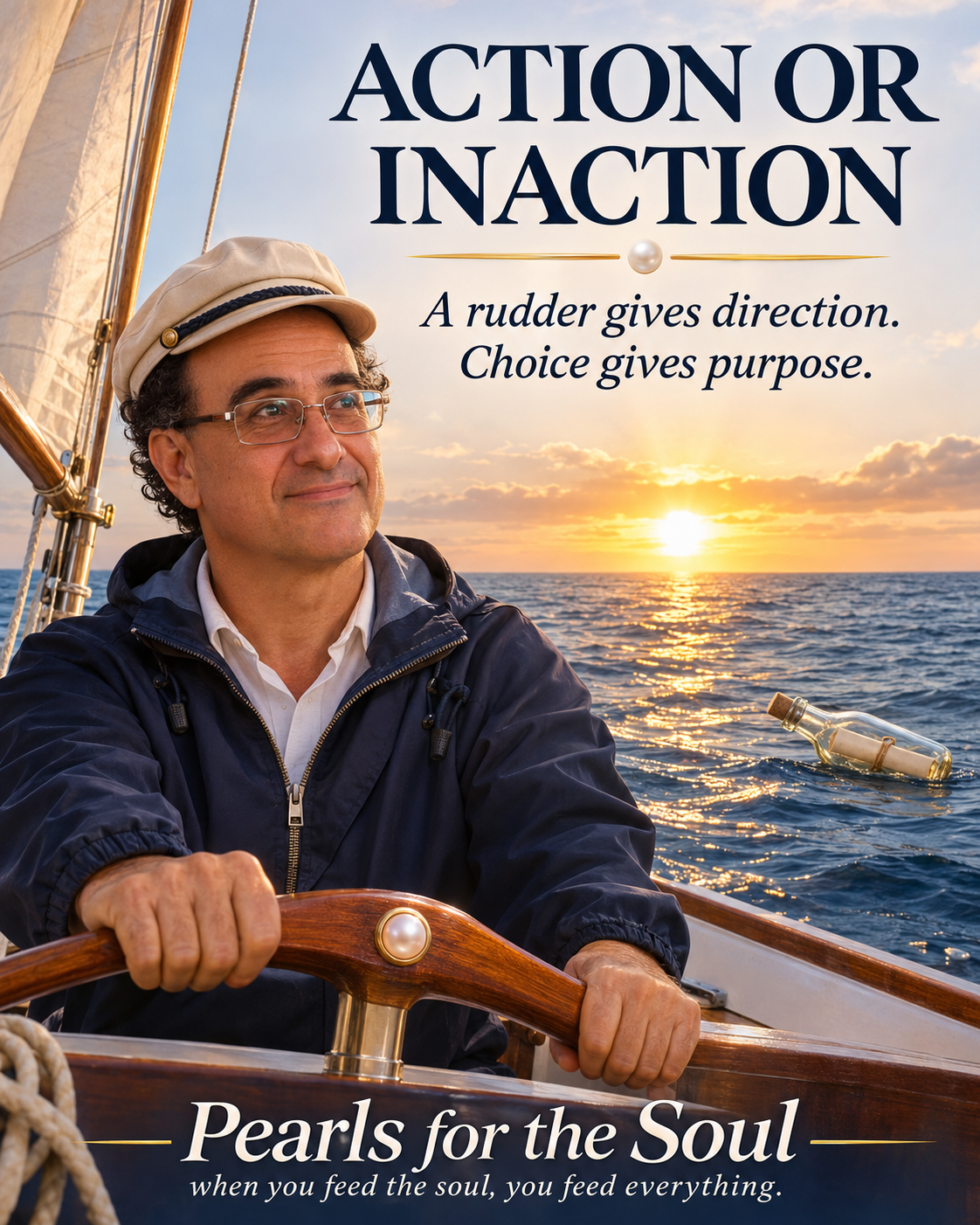
Imagine two bottles at sea.
One drifts wherever the current takes it. The other has a rudder.
Both are moving—but only one has direction.
ACTION OR INACTION—CHOICE GIVES LIFE DIRECTION
Think of a bottle with a cork floating at sea.
It is at the mercy of the currents, wind, sun, and weather. Outside forces carry it here and there.
Now compare it with a similar vessel equipped with a rudder.
The rudder does not control the ocean.
It does not eliminate the wind.
It does not guarantee a smooth journey.
It gives the vessel some ability to guide itself.
Its movement can now include direction, destination, and purpose.
The rudder is an action tool.
Without it, the bottle drifts according to whatever forces are operating around it.
Human beings also face outside forces—but we possess choices that can function like a rudder.
WHY DO WE HAVE REASONING?
Reasoning is the process of thinking about something calmly, logically, and objectively.
It shines a light of reality upon the subject before us.
Without reason, we would be more vulnerable to whatever forces are presently at work.
Impulse would decide.
Pressure would decide.
Fear would decide.
Appetite would decide.
Other people would decide.
Reasoning gives us an opportunity to participate in the direction.
It does not make us superior to every other form of life or guarantee that we will choose correctly.
It gives us a tool.
The question is whether we use it.

WHAT DO WE DO WITH IT?
Common sense complements reasoning nicely.
Of course, your common sense and mine are usually just called sense when we are using them.
We depend upon it continually.
It helps us navigate rooms without walking into walls, recognize ordinary risks, learn routines, and make countless daily decisions.
Common sense is useful, but it is not infallible.
Our experience may be incomplete.
What appears obvious to one person may not be obvious to another.
Reason, evidence, experience, conscience, and reliable advice can work together.
Imagine what might happen if we used these resources consistently—and for good.
NOW AND LATER
We often forget a basic principle:
What we do now can affect what happens later.
This applies to short-term and long-term results.
To make the point more potent, I return to the grain of sand.
Look at a beach as it presently exists.
Move one grain of sand and it is technically a different shore.
The change may be almost impossible to see, but something is no longer exactly as it was.
Our choices can work in similar ways.
One decision may seem insignificant.
Repeated decisions can build a shoreline.
SUBTLE POWER
The individual power known as choice should be respected.
Until disciplined, it may even deserve some healthy caution.
Choice gives action or inaction permission to enter.
Doing something is a choice.
Doing nothing may also be a choice.
There are times when inaction is avoidance.
There are also times when inaction is patience, restraint, observation, or wisdom.
The important question is not merely:
“Did I act?”
It is:
“Why did I act—or refuse to act—and what did that choice produce?”
We cannot entirely refuse participation in life.
Our presence, absence, action, and inaction can all affect what follows.
WHAT SHOULD WE DO?
This question challenges everyone:
What should I do?
That is why we have beginnings, learning curves, experiments, practice, and trial and error.
We attempt something.
We observe the result.
We learn what works, what does not, and what requires adjustment.
Then we act accordingly.
It helps when people share trustworthy knowledge and guide one another through these eye-opening experiences.
We do not have to learn every lesson alone.
EXISTENCE VERSUS LIVING
Take a moment to consider that everything around us participates in some form of function, relationship, or consequence.
Life appears interconnected in ways we do not fully comprehend.
We are invited to play a part during the time available to us.
We may accept the invitation enthusiastically.
We may hesitate.
We may refuse one part and choose another.
Now consider action and inaction in this light.
Which is more useful in this particular moment?
Which is more responsible?
Which serves life rather than merely filling time?
The answer may change with the circumstances.
MEANING OR MEANINGLESS MOVEMENT
A person can run rapidly in circles or set a course toward a destination.
Return to the opening example.
Which bottle has more possibilities—the one drifting without direction or the one equipped to steer?
The drifting bottle may accidentally reach a beautiful shore.
The guided vessel may still encounter difficulty.
Direction is not a guarantee.
It is participation.
Look at your life—one of the great mysteries—and examine what you are doing or continually postponing.
Does it carry meaning?
Does it serve a useful purpose?
Is it merely motion?
Or are you drifting because choosing a direction feels risky?
TIME SPENT
Time is an important coin in the realm of life.
It cannot be stored indefinitely for later use.
It is spent while we deliberate about spending it.
Time used with purpose can lead toward satisfaction, contentment, learning, contribution, and further purpose—not only for the person using it but also for others.
Imagine individuals collectively doing meaningful things.
Time well spent is no myth.
Time continually spent without awareness can become a thief.
FOOD, SHELTER, AND CLOTHING
Within the realm of responsibility, people must pursue necessities such as food, shelter, clothing, safety, and care.
These basics are not equally accessible or easy for everyone to obtain. Circumstances, health, geography, economics, discrimination, disaster, and opportunity can affect what is available.
People often need assistance, cooperation, and fair systems.
Once reasonable security has been established, another question may appear:
What will I do beyond survival?
This question famously presents itself during retirement.
The job ends.
The schedule changes.
The title may disappear.
Then the person asks:
Who am I when the function I performed is no longer organizing my days?
WHY WAIT?
That is why it is important to taste life and discover what is worthwhile, healthy, and meaningful as awareness develops.
Do not wait until retirement to become acquainted with yourself.
Living purposefully is a mystery of its own.
Going from point A to point B is function.
Why we go, what we learn, whom we help, and what the movement means can introduce purpose.
Purpose does not always require a grand mission.
It may appear through ordinary responsibilities performed with extraordinary awareness.
DISCOVERING THE DISCOVERER
Before making great discoveries elsewhere, direct some attention toward discovering yourself.
What are your capabilities?
What are your limitations?
How do you respond under pressure?
What brings satisfaction?
What weakens you?
What do you repeatedly avoid?
What can you contribute?
Testing ourselves responsibly allows us to observe how we act, recover, choose, and participate in producing results.
Discovering the self may prepare us for greater discoveries.
The discoverer is part of every discovery made.
WHAT CAME FIRST?
What came first—the adventure or the adventurer?
Was the adventure waiting for someone willing to enter it?
Or was the adventurer waiting for something worth beginning?
Consider that we are portable, self-sustaining motion machines equipped with thought, attention, senses, memory, and varying abilities.
We can navigate toward outcomes, even though we do not control everything encountered along the way.
Again, action and inaction both appear as part of the mixture.
The adventure may be present.
The adventurer must still decide whether to enter.
THE BREVITY OF LIFE
Eventually, the brevity of life introduces itself.
Life is brief.
No one knows exactly how much personal time remains.
That realization can feel unreasonable when creation appears so magnificent and our appetite for experience remains strong.
Yet temporary does not mean meaningless.
The limited nature of time gives weight to attention and choice.
Because we cannot do everything, we must decide what deserves participation.
Because no tomorrow is guaranteed, the present should not be treated merely as a waiting room.
PAUSE
Which does life invite from you now—action or inaction?
What kind?
For what reason?
Do not move merely to prove that you are moving.
Do not remain still merely because direction requires courage.
Examine the conditions.
Use reason.
Apply common sense.
Listen to conscience.
Then place your hand upon the rudder available to you.
FINAL THOUGHT
You cannot control the entire ocean.
You can still participate in your direction.
Action without thought may become reckless motion.
Inaction without purpose may become drift.
Awareness helps determine which response belongs to the moment.
PEARLS INSIGHT (SEO)
Purposeful action begins with reasoning, common sense, self-awareness, and recognition that present choices can influence future outcomes. Inaction may represent avoidance, but it can also be wise restraint. The goal is not constant movement; it is choosing the response that provides appropriate direction, meaning, and responsible participation.
PEARLS FROM THE BOOKS
A pearl does not travel through the ocean searching for importance.
It develops according to the process taking place within it.
Our outward direction matters, but so does the inner formation of the person holding the rudder.
PEARLS CONNECTION
Choose one area of your life that feels adrift.
Ask:
What outside forces are moving me?
What part can I influence?
Would action improve this situation?
Would a deliberate pause be wiser?
What is one responsible movement—or purposeful restraint—I can choose now?
Use the rudder you actually possess.
RICHIE SPEAKS
The current is real.
The wind is real.
Circumstances are real.
So is your available choice.
Do not demand control of the entire ocean before participating in your direction.
Find your rudder and use it with awareness.
FINAL SAY
NOW is your time.
Awe and mystery favor the bold—but wisdom tells boldness where to steer.
— Richie
Pearls for the Soul
when you feed the soul, you feed everything.
https://pearlsforthesoul.com

Been expecting you