What I don’t know, I don’t know.
Knowing that much is not ignorance—it is the beginning of awareness.
There are certain subjects that escape me entirely.
Some I do not know because I have had little or no exposure to them. Others, quite frankly, I have little interest in knowing.
Either way, I am at peace with it.
What I don’t know, I don’t know—and that in itself is a type of knowing.
How?
You know that you don’t know what you don’t know until something lets you know you don’t know it.
You know?

YOUTH IGNORANCE
In my younger years, when I was eager to please for any number of reasons, I was not eager to admit ignorance.
Youth know everything—LOL.
Admitting that you did not know something did not appear to move you ahead or raise your personal stock. You did not boast about not knowing—but you did not admit it either.
So, it remained hidden and suppressed.
That did not make the ignorance disappear. It merely kept anyone from helping you replace it with knowledge.
OH, THAT?
Today, it is much harder to hide or manipulate what we do not know.
With the internet, we can quickly find information about almost anything. But finding information does not give us an intimate, working knowledge of the subject.
Cursory awareness is everywhere—and it is cheap.
You heard about it.
You read something about it.
You watched a three-minute video about it.
But do you know it?
Information can introduce you to a subject. Experience is what introduces the subject to you.
WORTHY NOTE: Opinions are not “know food.” Most of the time, they are filler.
COME HITHER
When a subject activates something within you, an interesting thing happens.
As you move toward the subject, the subject appears to move toward you.
Desire, yearning or curiosity supplies the power. If allowed to complete its circle, the journey brings more than an answer. It produces an experience—and often a result.
What began as a question can become part of your purpose for the moment and perhaps beyond it.
We are natural receivers and observers.
Take note.
I CAN DO IT ALL?
Newly educated, degreed and licensed people are understandably eager to use what they have studied.
But without exception, no one begins with complete knowledge of what they are doing. They have studied—but they have not yet worked in all the trenches.
Their journey begins with qualifications, good intentions and many unknowns.
Education may open the door.
Experience teaches you how to move around inside the room.
STAGES OF LIFE EVOLVEMENT
Every subject, ability and meaningful experience tends to develop in stages:
- Desire
- Prompting
- Awareness
- Inquiry
- Experiment
- Comfort level
- Repetition
- Ownership
- Mastery
- Ruler of all you survey—second nature
You can opt out at any time.
But when you remain with the process and finish what you started, you eventually reach number ten.
What once required your full concentration becomes part of you.
Then ask yourself:
Where did this entire system come from?
Who placed within us the desire to know, the ability to learn and the capacity to master?
WORTHY NOTE: When you need someone’s services, it is worth asking which stage they have reached.
DOING YOUR BEST?
Have you ever said, “I am doing my best,” or, “I am giving it my best”?
It may be completely true.
But there are circumstances in which your best is still not good enough.
That is a sobering realization.
Perhaps you are not the right fit for the job, responsibility or relationship. Perhaps additional knowledge and experience are required. Perhaps someone else is better prepared for what must be done.
It has to be honestly examined.
Why?
Because who benefits from pretense?
I DIDN’T KNOW
When a person admits first to themselves—and then, when necessary, to others—that they do not know something, it is an honest and intimate gesture.
It creates vulnerability and growth at the same time.
In a safe environment, the admission may be welcomed.
In a high-risk situation, it may burn or backfire.
But pretending to know can burn far worse when the truth eventually arrives—and truth has a way of arriving.
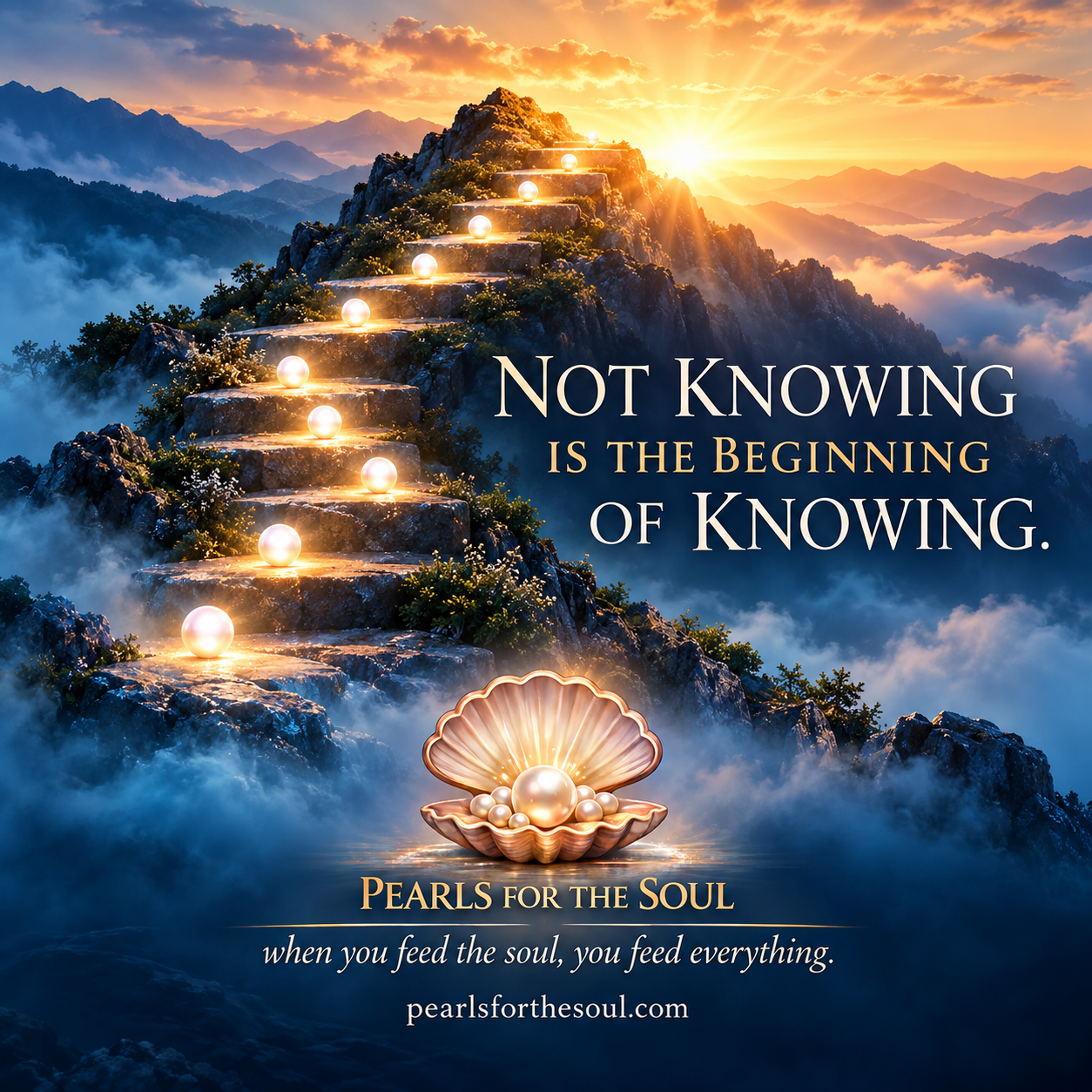
WORTHY NOTE: Admitting that you do not know is the beginning of knowing.
NONE OF US KNEW
Every one of us entered this world not knowing.
From our first breath, learning began. Some lessons arrived directly. Others were absorbed through observation, experience, pleasure, pain and repetition.
The body was programmed to develop without waiting for our instructions.
But the personal self must participate.
You must learn, adjust and evolve to survive—and then continue learning if you intend to thrive.
Homework, quizzes, examinations and finals can force information into the mind.
The heart is another matter.
The mind can be instructed.
The heart must be stirred.
RICHIE SPEAKS
Not knowing is not the problem.
Refusing to admit it, investigate it or grow beyond it is the problem.
There is no shame in standing on step one when you understand that a staircase is waiting.
The shame—if there is any—is pretending to be on step ten while refusing to take the next honest step.
FINAL SAY
We all begin without knowing.
Then desire prompts awareness. Awareness encourages inquiry. Inquiry creates experience. Experience—repeated honestly—can become mastery.
So, make peace with what you do not know.
It may be the very place where your next portion is waiting to introduce itself.
Part 2 continues with what happens when “I don’t know” becomes a source of credibility, personal value and heart-driven wisdom.
— Richie
Pearls for the Soul
when you feed the soul, you feed everything.
https://pearlsforthesoul.com

Been expecting you