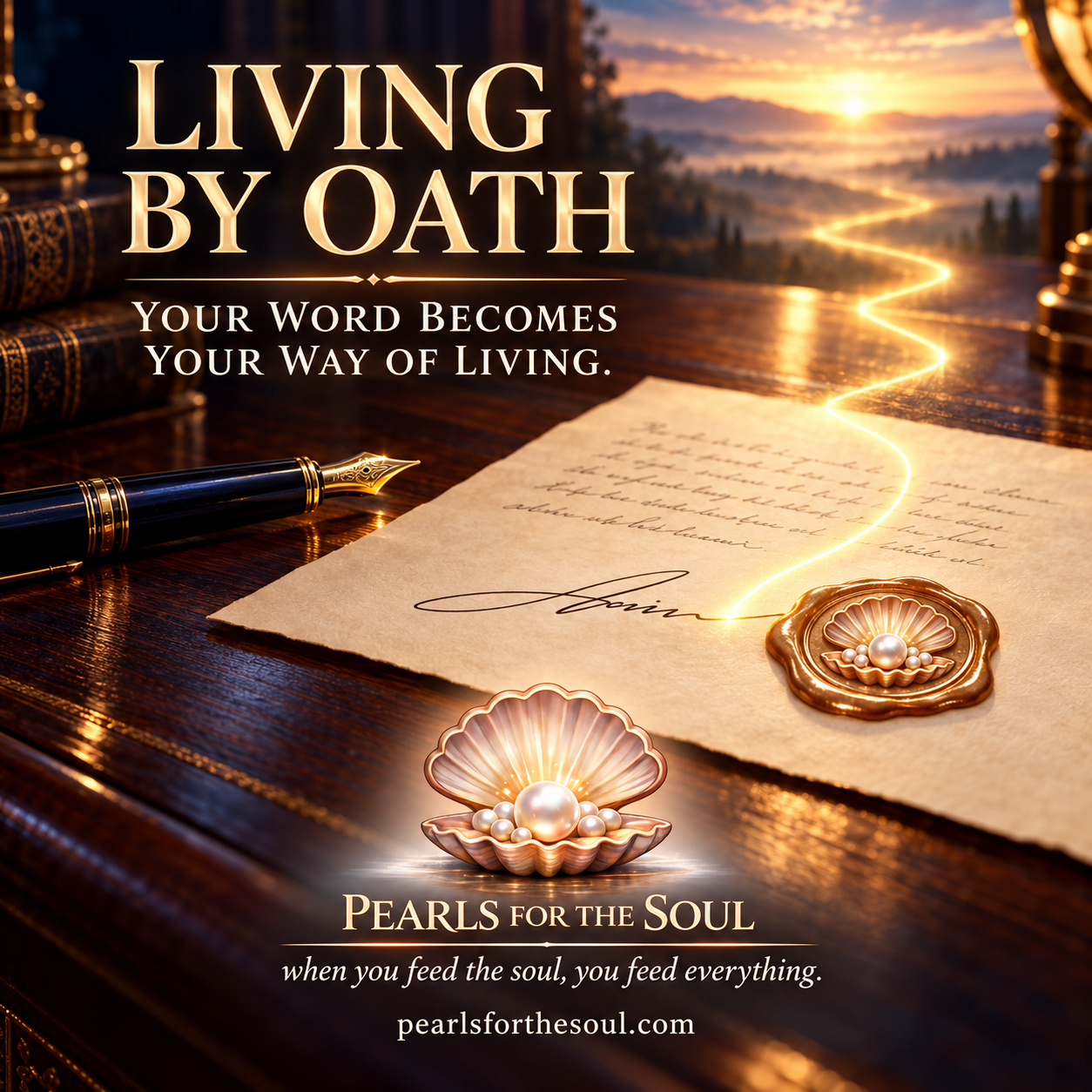
An oath is more than something spoken during a wedding, courtroom proceeding or public ceremony.
Every promise establishes a standard.
Every repeated action reveals whether we are living by it.
LIVING BY OATH
PAUSE FOR CAUSE

Two people decide to marry.
For ages, marriage ceremonies have marked a significant change in the lives of those involved. At some point, people placed a promise—an oath—at the center of that ceremony.
Why?
Because an oath represents commitment at its highest level.
A person does not merely describe a hope.
They pledge themselves toward it.
THE MARRIAGE OATH
The traditional marriage oath declares allegiance under changing circumstances:
In sickness and in health.
For richer or poorer.
For better or worse.
To love and cherish.
Then comes the kicker:
Till death do us part.
There was a time when that commitment was closely connected to survival itself. Today, wedding vows are often updated and personalized, but their purpose remains the same:
Two people publicly promise how they intend to live with one another.
SOLEMN OATH
Then we added the word “solemn.”
Solemn describes a serious, sober and dignified approach to the promise being made.
Place the words together—solemn oath—and the commitment seems to invite something higher to witness it.
Many call that a blessing.
The oath says:
I understand the seriousness of these words.
I accept responsibility for carrying them.
I intend to live accordingly.
OATH OF OFFICE
Many public positions require an oath of office.
The President, members of Congress, judges, peace officers, military personnel and other officials make formal promises concerning loyalty, duty and the responsible use of authority.
They do not swear loyalty merely to personal preference.
They pledge themselves to the duties, laws and institutions connected with the position.
The office comes with power.
The oath establishes how that power should be exercised.
OATH OF ALLEGIANCE
The Pledge of Allegiance is another familiar public commitment.
Naturalized citizens take a more detailed Oath of Allegiance when becoming United States citizens.
These words express loyalty to the country and acceptance of responsibilities connected with citizenship.
A pledge can unite people around a shared ideal—but its meaning depends upon how faithfully those ideals are lived.
Words introduce the promise.
Conduct completes it.
THE PURPOSE OF AN OATH
An oath binds us to duties, to other people and to a shared interest.
It establishes the place where the buck stops.
The duration may be short, long or lifelong. Some commitments—including marriage, military duty and public service—may involve risks extending even to death.
An oath is a personal stand.
It announces:
This is what I accept.
This is what I will protect.
This is how I intend to live.
YOU CAN CREATE YOUR OWN OATH
Remember Scarlett O’Hara in “Gone with the Wind”?
She raises her fist toward the heavens and declares that, as God is her witness, she will never be hungry again.
Those words become a personal oath—a declaration directing what she does next.
We can make commitments to ourselves, our families, our friends and God.
A person who deliberately chooses to live virtuously is establishing a personal oath:
I will attempt to do what is right—even when convenience suggests otherwise.
WILL YOU TAKE THE STAND?
In a courtroom, a witness may place a hand on a Bible or affirm on their honor that they will tell:
The truth.
The whole truth.
And nothing but the truth.
Why is the promise formalized?
Because the stakes can be extremely high. Testimony can influence property, freedom, reputation and even the course of a person’s life.
The law also establishes consequences for knowingly lying under oath.
When truth matters greatly, society asks the speaker to make their responsibility unmistakable.
ANGRY OATHS
Not every oath is wise.
“I will never forgive you for this!”
Whoa.
Promises can be made in anger, fueled by emotional pain and irrational thinking.
The words may sound final, but the message underneath is often different:
“What happened is unacceptable to me.”
“I am deeply hurt.”
“I need you to understand what this has done.”
An angry oath may imprison the person making it long after the original moment has passed.
Be careful what you promise while wounded.
GO TO HELL
Many people have thrown out the phrase “Go to hell” in anger.
It is colorful, forceful and intended to have an effect.
But pause and consider its meaning.
Why would we sentence another person—even verbally—to the worst fate we can imagine?
People also say:
“There is a special place in hell for…”
Then they fill in the blank.
But who among us possesses enough knowledge, perfect justice and complete understanding to decide such things?
JUDGE NOT
To judge an entire human life fairly, we would need to examine every experience from birth to death:
Every influence.
Every wound.
Every opportunity.
Every limitation.
Every decision.
Every circumstance.
We entered life as loving, innocent babies. Then helpful and harmful forces began working upon us—some intentional, some accidental, some chosen and others completely random.
A person and their life are complicated subjects.
Pause.
This does not excuse harmful conduct or eliminate accountability. It reminds us to judge actions carefully without pretending we completely understand another soul.
THE MEASURE WE RELEASE
The measure we use against others can become the measure we accept for ourselves.
If we declare a standard proper for another person, the old saying awakens:
What is good for the goose is good for the gander.
Certain people—juries, judges, military tribunals and other authorized decision-makers—must evaluate conduct under established laws and procedures.
But personal vengeance is not the same as justice.
Before releasing condemnation, ask whether you would accept the same measure being applied to you.
IMPLIED CONDUCT
Formal ceremonies are not required for every oath.
When we accept employment, enter a profession or participate in public life, we encounter implied codes of conduct.
We wait our turn.
We perform the work we agreed to do.
We avoid cutting ahead of others in line.
We keep confidential information private.
We return what we borrow.
These may not always be spoken as oaths, but they function as everyday commitments that allow people to trust one another.
THE DRIVER’S LICENSE
A driver’s license is another good example.
When I was young and qualified for a driving permit, I did whatever was required to receive that privilege.
Once licensed, some of us could not resist testing what a car could do—or how fast it could do it. LOL.
But permission to drive is conditional.
By accepting the license, we agree to follow the laws and operate the vehicle responsibly. Serious or repeated violations can cause that privilege to be restricted or removed.
The license is a practical promise:
You grant me permission, and I accept the responsibility.
WORDS DRIVEN BY OATH
Words can help, hurt or hinder.
Behind those sounds—and beneath our public conduct—is the silent oath each of us lives before our conscience and, ultimately, before the Life-Giver.
Our routines reveal our commitments.
Our reactions reveal our values.
Our choices reveal which promises have become real.
Even choosing to be lighthearted, peaceful and encouraging can become a silent oath:
This is the spirit I intend to bring into the world.
THE OATH BENEATH THE WORDS
An oath is not proved when it is spoken.
It is proved afterward.
Marriage vows are proved through daily care.
Public oaths are proved through responsible service.
A courtroom oath is proved through truthful testimony.
A personal promise is proved when keeping it becomes inconvenient.
The words establish the standard.
Life supplies the test.
FINAL THOUGHT
Before making a promise, understand its weight.
After making it, allow your actions to carry it.
Your word should not merely describe the person you hope to become. It should help direct the person you are becoming.
PEARLS INSIGHT
Personal integrity grows when our words, values and repeated actions agree. A promise becomes trustworthy when consistent conduct turns intention into character.
PEARLS FROM THE BOOKS
“Epilogue of Ebenezer Scrooge: A Second Chance” shows that Scrooge’s transformation could not end with an emotional promise. His changed life had to become the continuing evidence that his word was real.
PEARLS CONNECTION
Choose one promise already operating in your life:
A marriage vow.
A professional responsibility.
A commitment to family.
A promise to yourself.
A spiritual conviction.
Ask:
What does this promise require from me today?
Then give it one visible action.
RICHIE SPEAKS
An oath is easy to speak while everyone is listening. Character begins when no one is listening and you continue living it anyway.
FINAL SAY
Your word becomes your way of living—or it was only words.
— Richie
Pearls for the Soul
when you feed the soul, you feed everything.
https://pearlsforthesoul.com
Been expecting you