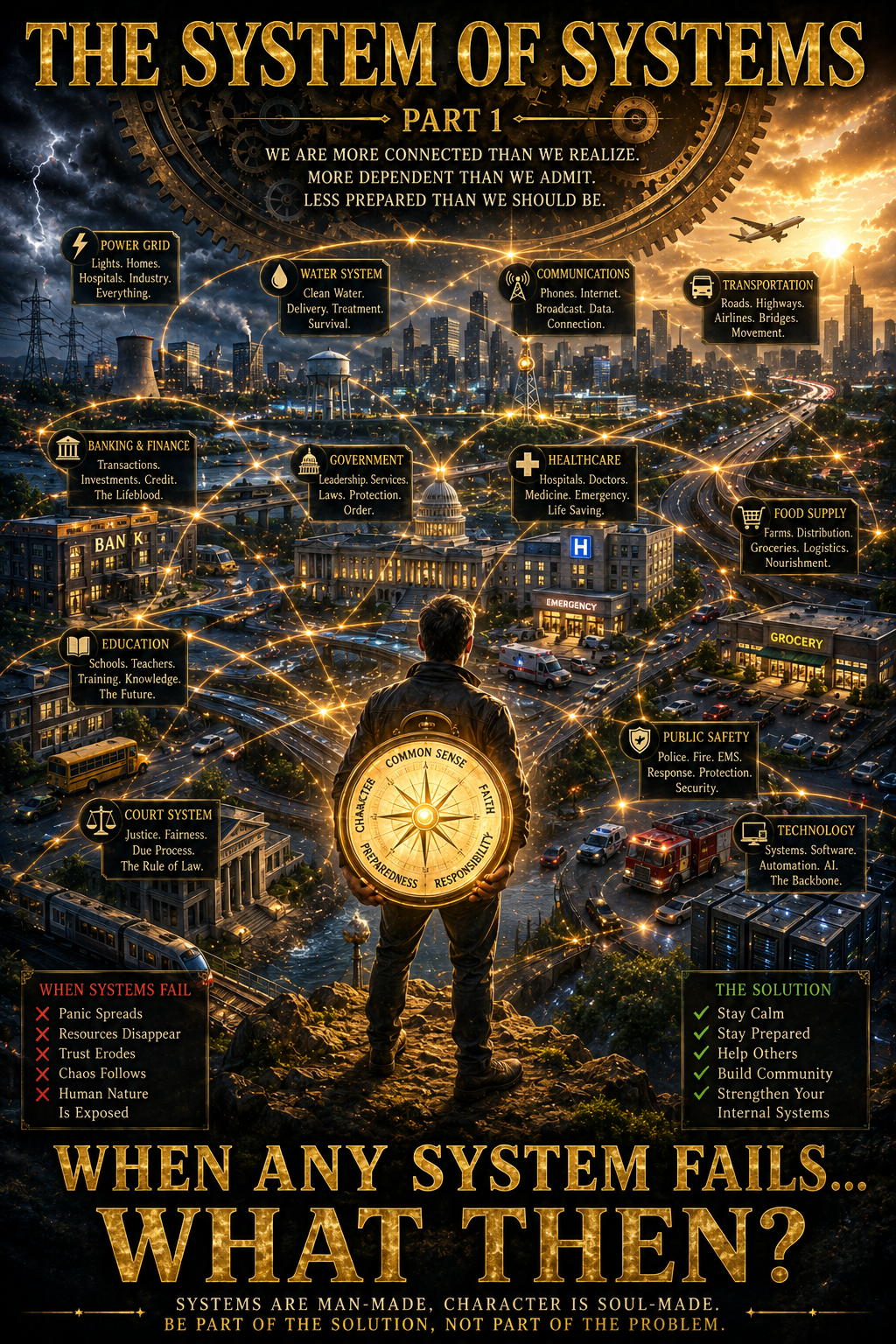
WHEN THE SYSTEM FAILS… WHAT THEN?
Turn the key.
Flip the switch.
Open the faucet.
Swipe the card.
Drive the freeway.
Call 911.
Buy groceries.
Most of us never stop to think about the thousands of systems working for us every day…
Until one of them doesn’t.

THE SYSTEM OF SYSTEMS
PART 1
WHEN THE SYSTEM FAILS… WHAT THEN?
We live in a nation of systems.
In fact, we live in a world of systems.
Every day we wake up and interact with dozens of them before breakfast.
Electricity.
Water.
Transportation.
Communication.
Banking.
Healthcare.
Food distribution.
Law enforcement.
Government.
Technology.
The list is endless.
The systems have become so efficient and so dependable that most people never notice them.
Until they fail.
THEN WE NOTICE.
TURN THE KEY
You get into your car.
Turn the key.
Nothing.
Suddenly a system that has worked flawlessly for years has your complete attention.
The same thing happens when the power goes out.
When the internet stops working.
When the cell towers fail.
When your bank card gets declined.
When your doctor is unavailable.
The system that was invisible yesterday becomes the most important thing in your life today.
WE ARE SYSTEM RELIANT
Think about it.
How much of your daily life depends upon systems you neither own nor control?
Your electricity.
Your water.
Your banking.
Your transportation.
Your communications.
Your food supply.
Your healthcare.
Your insurance.
Your taxes.
Your retirement accounts.
Your internet.
Your mobile phone.
Your paycheck.
Your fuel.
The average person is far more dependent upon systems than they realize.
The realization can be uncomfortable.
THE GREAT OUTSOURCING
What we have gradually done is outsource many of the things that once made us self-reliant.
We no longer grow our own food.
Repair our own equipment.
Make our own clothing.
Generate our own power.
Teach our own skills.
Store our own reserves.
We rely upon systems.
There is nothing inherently wrong with that.
Systems allow civilization to flourish.
The problem arises when dependence becomes excessive.
EXCESSIVE DEPENDENCE WEAKENS
If you want to weaken a person, do everything for them.
Never let them struggle.
Never let them solve problems.
Never let them learn consequences.
Never let them develop skills.
Eventually they become dependent.
The same principle applies everywhere.
Parents see it.
Teachers see it.
Employers see it.
Entire nations see it.
A person who cannot function without assistance becomes vulnerable.
A society that cannot function without systems becomes vulnerable too.
SYSTEMS WORK UNTIL THEY DON’T
One of the most interesting things about systems is that they appear permanent.
They are not.
The housing system shocked millions.
The banking system shocked millions.
The stock market has shocked millions more than once.
Airlines shut down.
Computer systems crash.
Governments make mistakes.
Supply chains break.
History repeatedly reminds us that systems are man-made.
And anything man-made can fail.
HUMAN NATURE IS EXPOSED
When systems fail, something fascinating happens.
Human nature becomes visible.
Some people panic.
Some people loot.
Some people blame.
Some people freeze.
Others step forward.
Others lead.
Others help.
Others solve problems.
The system failure reveals what was already present inside people.
Character comes to the surface.
So does the lack of it.
THE BACKUP PLAN
Preparing for system failure is not fear.
It is wisdom.
Having savings is not fear.
Having food reserves is not fear.
Having alternative plans is not fear.
Learning useful skills is not fear.
Knowing your neighbors is not fear.
Being prepared is common sense.
As I have often written:
“Hope for the best, but plan for the worst.”
That is not pessimism.
That is maturity.
THE REAL SYSTEM
As I reflected upon all these systems, a larger question emerged.
What about our personal systems?
What about the intimate systems?
The systems of thought.
The systems of belief.
The systems of values.
The systems of character.
The systems of morality.
The systems of decision-making.
What happens when those systems fail?
What happens when common sense breaks down?
What happens when integrity stops working?
What happens when truth is abandoned?
What happens when people lose their internal compass?
Perhaps those failures are more dangerous than all the others combined.
PEARLS TO PONDER
“The purpose of life is to discover the purpose of life.”
“We were not put here to be defeated.”
“Common sense is often the first thing to enter the room and the last thing people listen to.”
“No one got to where they are without the help of another.”
“When you feed the soul, you feed everything.”
These are not merely sayings.
They are operating systems.
Internal systems.
Guidance systems.
Navigation systems.
And they continue functioning even when external systems fail.
WHAT THEN?
By all means appreciate the systems around you.
Support them.
Use them wisely.
Improve them when possible.
But never become completely dependent upon them.
Because one day a system may fail.
And when it does…
You will discover whether your internal systems are still working.
That discussion begins in Part 2.
— Richie
Pearls for the Soul
when you feed the soul, you feed everything.
https://pearlsforthesoul.com

Been expecting you